
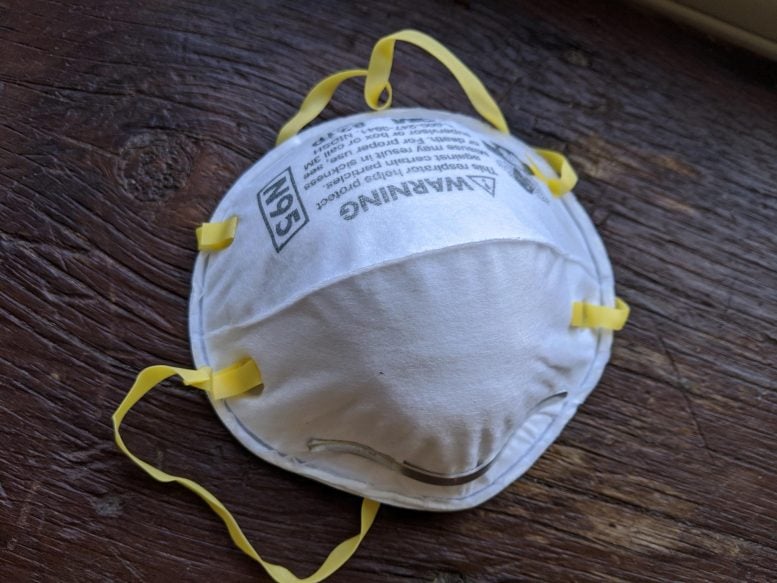
Researchers confirmed that VHP decontamination effectively maintains N95 respirators’ functionality for 25 reuse cycles, offering a viable solution for PPE shortages.
N95 respirators are commonly used in hospitals worldwide to protect healthcare personnel from infectious pathogens. During the COVID-19 pandemic, healthcare facilities have experienced shortages of the respirators, forcing personnel to re-use them or resort to less protective masking alternatives.
In keeping with guidance from the Centers for Disease Control and Prevention and the Occupational Safety and Health Administration, staff at Beth Israel Deaconess Medical Center (BIDMC) re-used N95 respirators to ease supply constraints, employing vaporized hydrogen peroxide (VHP) – a common, effective environmental disinfection agent – as a decontamination method. In a new study looking at the approach evaluated between June and August of 2020, physician-scientists at BIDMC reported that a common type of N95 respirator reprocessed with VHP maintained its function and effectiveness through 25 cycles of re-use. The results appear in the American Journal of Infection Control.
“The findings from our study expand upon previous findings and show that VHP is a relatively safe method for reprocessing N95 respirators and could help address shortages in future epidemics,” said lead author Christina F. Yen, MD, who was a fellow in medicine at BIDMC during the research and is now at the University of Texas, Southwestern. “It is important that we now find ways to scale and translate this disinfection capability to smaller hospitals and resource-limited healthcare settings that could benefit just as much – perhaps more – from this type of personal protective equipment reprocessing in future disaster scenarios.”
Yen and colleagues conducted a series of qualitative and quantitative tests to evaluate both the function and effectiveness of seven N95 respirators that were used by three male and four female volunteers from June to August of 2020. These tests comprised a user seal check (performed by subjects donning and doffing the respirators), qualitative and quantitative respirator fit testing, and filtration efficiency testing, which assesses the ability of the respirator to filter out particles.
Even after 25 decontamination cycles, the researchers found no changes in respiratory integrity or filtration efficiency among the seven N95 respirators. All seven N95 respirators met the primary endpoints of function and effectiveness, passing 25 user seal checks and eight quantitative and four qualitative fit tests, in addition to maintaining filtration efficiencies of 95 percent or above throughout the study.
Yen and colleagues noted that successful, large-scale implementation of N95 respirator reprocessing requires planning and coordination, multidisciplinary teams to ensure disinfection efficacy and end-user safety, and significant logistical support.
“In order for reprocessing to be a realistic option for healthcare facilities, certain steps need to be taken,” said senior author Preeti Mehrotra, MD, MPH, senior medical director of Infection Control at BIDMC. “Reprocessing can be made possible by creating relationships among infection prevention, occupational health, environmental services, and other relevant departments within hospitals to facilitate implementation of appropriate technologies and advocating for the inclusion of personal protective equipment reprocessing in epidemic and pandemic planning.”
Reference: “Assessing changes to N95 respirator filtration efficiency, qualitative and quantitative fit, and seal check with repeated vaporized hydrogen peroxide (VHP) decontamination” by Christina F. Yen, MD; Robert Seeley, MS, CSP; Patrick Gordon, DNP, RN, CIC; Lalitha Parameswaran, PhD; Sharon B Wright, MD, MPH; Dana E Pepe, MD, MPH and Preeti Mehrotra, MD, MPH, 5 January 2022, American Journal of Infection Control.
DOI: 10.1016/j.ajic.2021.11.005
Co-authors included Robert Seeley, MS, CSP, Patrick Gordon, DNP, RN, CIC, Sharon B. Wright, MD, MPH, Dana Pepe, MD, MPH of BIDMC; and Lalitha Parameswaran, PhD of Massachusetts Institute of Technology, Lincoln Laboratory.
Never miss a breakthrough: Join the SciTechDaily newsletter.
Follow us on Google and Google News.
1 Comment
The thing that makes N-95 masks as effective as they are is that the fibers have an electrostatic charge in them to attract and intercept foreign particles.
Once this charge is destroyed (by, I dunno, getting it wet?) the masks efficiency goes out the window.