
Close Menu
    Facebook X (Twitter) Instagram
    SciTechDaily
    • Biology
    • Chemistry
    • Earth
    • Health
    • Physics
    • Science
    • Space
    • Technology
    Facebook X (Twitter) Pinterest YouTube RSS
    SciTechDaily
    Home»Physics»Nano-Rogues: From Mythic Ocean Waves to Micro-Manufacturing Marvels
    Physics

    Nano-Rogues: From Mythic Ocean Waves to Micro-Manufacturing Marvels

    By University of WarwickOctober 24, 20231 Comment3 Mins Read
    Facebook Twitter Pinterest Telegram LinkedIn WhatsApp Email Reddit
    Share
    Facebook Twitter LinkedIn Pinterest Telegram Email Reddit
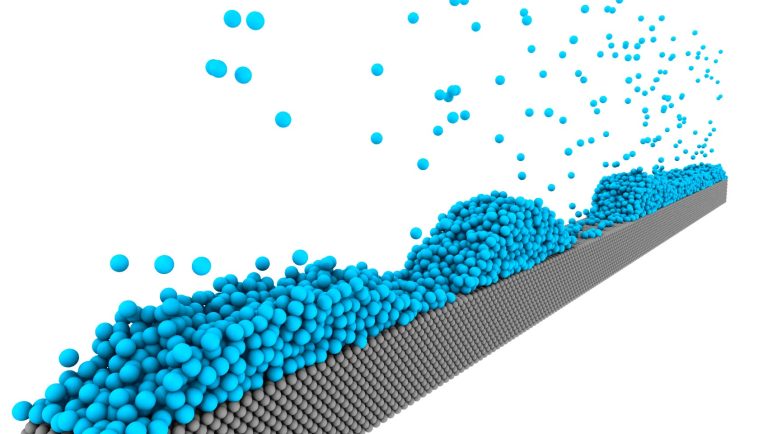
    Rogue Wave Nanoparticles Computer Simulation
    MD simulation: The silver balls are solid particles and the blue balls are the fluid (liquid and vapour) particles. There is a liquid film sitting on a solid substrate, and there are waves at the surface. Credit: Jingbang Liu, University of Warwick

    Scientists have adapted the principles of large, unexpected oceanic rogue waves to a nanoscale, revealing potential applications in nano-manufacturing and medical insights, supported by mathematical models inspired by quantum physics.

    Researchers have shown how the principles of rogue waves – huge 30-meter waves that arise unexpectedly in the ocean – can be applied on a nanoscale, with dozens of applications from medicine to manufacturing.

    Long considered to be a myth, rogue waves strike from comparably calm surroundings, smashing oil rigs and ships in their path. Unlike tsunamis, rogue waves form by the chance combination of smaller waves in the ocean, creating an event that is very rare.

    Nanoscale Application of Rogue Wave Principles

    There has been a lot of research into rogue waves in recent years but now, for the first time, scientists are showing how this can be applied on a much smaller scale – nanometrically. A nanometer is a million times smaller than the thickness of the page of a book. This is a completely new approach to the behavior of liquids on a nanometric scale, published as a Letter in Physical Review Fluids.

    The holes and bumps caused by rogue waves can be manipulated to spontaneously produce patterns and structures for use in nano-manufacturing (manufacturing on a scale one-billionth of a meter). For example, patterns formed that rupture liquid films can be used to build microelectronic circuits, which could be used in the production of low-cost components of solar cells. Furthermore, the behavior of thin liquid layers could help to explain why millions of people worldwide suffer from dry eye. This occurs when the tear film covering the eye ruptures.

    Uncovering the Behavior of Nanoscopic Liquid Layers

    Through direct simulations of molecules and new mathematical models, the study led by the University of Warwick’s Mathematics Institute discovered how nanoscopic layers of liquid behave in counterintuitive ways. While a layer of spilled coffee on a table may sit apparently motionless, at the nanoscale the chaotic motion of molecules creates random waves on a liquid’s surface. A rare event occurs when these waves conspire to create a large ‘rogue nanowave’ that bursts through the layer and creates a hole. The new theory explains both how and when this hole is formed, giving new insight into a previously unpredictable effect, by taking their large oceanic cousins as a mathematical blueprint.

    The team of researchers is excited about the potential of this research in different industries; the applications are far-reaching.

    Professor James Sprittles, Mathematics Institute, University of Warwick, said: “We were excited to discover that mathematical models originally developed for quantum physics and recently applied to predict rogue ocean waves are crucial for predicting the stability of nanoscopic layers of liquid.

    “In the future, we hope that the theory can be exploited to enable an array of nano-technologies, where manipulating when and how layers rupture is crucial. There might also be applications in related areas, such as the behavior of emulsions, e.g. in foods or paints, where the stability of thin liquid films dictates their shelf-life.”

    Reference: “Rogue nanowaves: A route to film rupture” by James E. Sprittles, Jingbang Liu, Duncan A. Lockerby and Tobias Grafke, 11 September 2023, Physical Review Fluids.
    DOI: 10.1103/PhysRevFluids.8.L092001

    Never miss a breakthrough: Join the SciTechDaily newsletter.
    Follow us on Google and Google News.

    Nanotechnology Quantum Mechanics University of Warwick
    Share. Facebook Twitter Pinterest LinkedIn Email Reddit

    Related Articles

    Low Temperature Physics Gives Insight Into Quantum Turbulence

    Scientists Can Finally Explain Why Some Water Droplets Bounce Off Surfaces, Without Ever Actually Touching Them

    Quantum Destabilization of a Water Sandwich – Laws of Classical Physics Break Down

    Efficient Quantum-Mechanical Interface Leads to a Strong Interaction Between Light and Matter

    Flexo-Photovoltaic Effect Squeezes More Power Out of Solar Cells

    Researchers Confirm Theory of “Superballistic” Electron Flow

    Newly Discovered Phenomenon Shows Electrons Can Move Much Faster Than Expected

    New Quantum Dots Design for Solotronics

    Scientists Switch On and Off Magnetism Using Quantum Mechanics

    1 Comment

    1. Jose Lourenco Claudio Junior on July 31, 2024 3:05 am

      Congratulations on these fascinating discoveries!

      Reply
    Leave A Reply Cancel Reply

    • Facebook
    • Twitter
    • Pinterest
    • YouTube

    Don't Miss a Discovery

    Subscribe for the Latest in Science & Tech!

    Trending News

    Popular Sugar-Free Sweetener Linked to Liver Disease, Study Warns

    What Is Hantavirus? The Deadly Disease Raising Alarm Worldwide

    Scientists Just Discovered How the Universe Builds Monster Black Holes

    Scientists Unveil New Treatment Strategy That Could Outsmart Cancer

    A Simple Vitamin May Hold the Key to Treating Rare Genetic Diseases

    Scientists Think the Real Fountain of Youth May Be Hiding in Your Gut

    Ravens Don’t Follow Wolves, They Predict Them

    This Common Knee Surgery May Be Doing More Harm Than Good

    Follow SciTechDaily
    • Facebook
    • Twitter
    • YouTube
    • Pinterest
    • Newsletter
    • RSS
    SciTech News
    • Biology News
    • Chemistry News
    • Earth News
    • Health News
    • Physics News
    • Science News
    • Space News
    • Technology News
    Recent Posts
    • Why Are So Many New Fathers Dying? Scientists Say the U.S. Has a Dangerous Blind Spot
    • Scientists Identify Simple Supplement That Greatly Reduces Alzheimer’s Damage
    • You May Have a Dangerous Type of Cholesterol Even if Your Tests Look Normal
    • Study Reveals Dangerous Flaw in AI Symptom Checkers
    • New MRI Breakthrough Captures Stunningly Clear Images of the Eye and Brain
    Copyright © 1998 - 2026 SciTechDaily. All Rights Reserved.
    • Science News
    • About
    • Contact
    • Editorial Board
    • Privacy Policy
    • Terms of Use

    Type above and press Enter to search. Press Esc to cancel.