
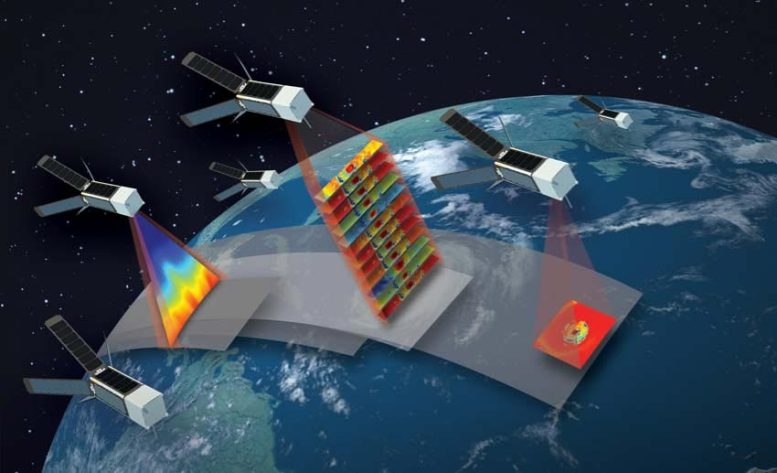
Observations made by NASA’s newest storm-watching satellites captured the evolution of Hurricane Adrian’s structure as the storm strengthened.
In the final week of June 2023, the season’s first Eastern Pacific hurricane spun off the coast of Mexico. The storm—Hurricane Adrian—steered northwest away from the coast and posed no threat to land. But Adrian garnered attention for another reason, especially among scientists. It was the first hurricane observed by NASA’s newest storm-watching satellites.
This animation shows the evolution of the Hurricane Adrian’s clouds from the morning of June 28 to the afternoon of June 29. Nearby, Beatriz was developing into a tropical storm, visible in these images as the less-organized clouds closer to the coast. Credit: NASA
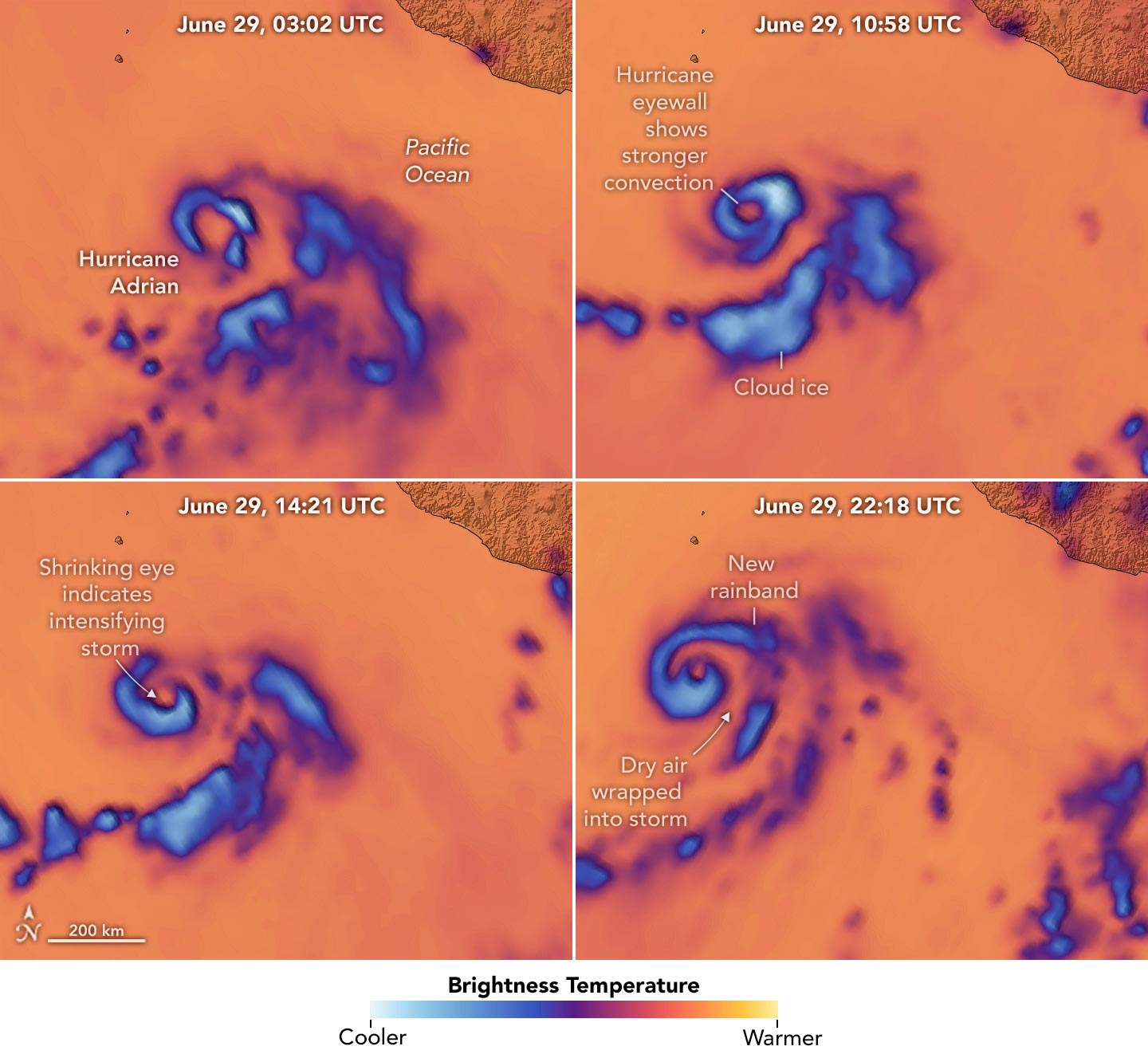
Data for the images in the animation (above) and series (below) were acquired by the TROPICS mission—short for Time-Resolved Observations of Precipitation structure and storm Intensity with a Constellation of Smallsats. The images shown were curated from nearly two dozen images acquired by the satellites around this time.
“As communities throughout the world are experiencing the growing impacts of increased extreme weather, it’s never been more important to get timely data to those who need it most to save livelihoods and lives,” said NASA Administrator Bill Nelson. “TROPICS will deliver vital information for forecasters, helping us all better prepare for hurricanes and tropical storms.”
How TROPICS Observes Hurricanes from Space
TROPICS is a constellation of four identical CubeSats designed to observe tropical cyclones. The cost-effective, milk carton-sized satellites were launched in May 2023 by Rocket Lab. Each TROPICS CubeSat contains a microwave radiometer that collects data across 12 channels to detect temperatures, moisture, and precipitation around and within a storm.
The images in this animation were built from data collected by a single channel (205 gigahertz) that is sensitive to ice in the clouds. Each scene shows brightness temperature; that is, the intensity of radiation detectable at that channel frequency moving upward from the cloud layers and toward the satellites.
Cold brightness temperatures (blue and white) represent radiation that has been scattered by ice particles in the storm clouds. The colder the temperature, the more ice there is likely to be in a column of the atmosphere. Ice in the clouds is an indication of intense movement of heat and moisture (convection) in a storm, noted Will McCarty, program scientist for TROPICS and program manager for weather and atmospheric dynamics at NASA Headquarters.
Detecting Storm Intensity and Evolution
Scott Braun, a research meteorologist at NASA’s Goddard Space Flight Center and project scientist for TROPICS, explained that patterns observed in the brightness temperature data can indicate the location of rain bands, the intensity of convection, whether the storm has formed an eye, and how those structures are changing over time. All are important to understanding how storms will evolve.
“Structural changes in brightness temperature can help tell us whether a storm is intensifying or weakening,” said Patrick Duran, the mission’s deputy program applications lead at NASA’s Marshall Space Flight Center. These structural changes are less apparent in natural-color images, which primarily show the tops of clouds. And some features, such as the eye, often show up in microwave images before they are detected by infrared sensors on other satellites.
Some of these structural changes are apparent in the animation and image series. The first frame of the animation shows the storm’s developing eye on June 28, visible as the warmer area surrounded by cooler areas associated with clouds and precipitating ice. Around the time of this image, NOAA’s National Hurricane Center had recently upgraded Adrian from a tropical storm to a category 1 hurricane. It continued to strengthen and remained a category 1 storm throughout this image series.
In the image acquired at 10:58 Universal Time (4:58 a.m. local time) on June 29, the eyewall shows stronger convection, and the eye appears smaller, which often occurs as a storm intensifies. By 22:18 Universal Time (4:18 p.m. local time) on that day, strong convection is apparent south of the eye, a new rainband has developed on the north side, and the eye reaches its smallest size seen in the image series.
Game-Changer for Storm Monitoring
Similar microwave measurements can be made with other satellites, such as the Global Precipitation Measurement (GPM) mission. TROPICS, however, has a time advantage. Whereas the orbits of most science satellites only permit observations of a storm every 6 to 12 hours, the low-Earth orbit and multiple satellites of TROPICS can allow storm imaging about once an hour. That’s a big advantage when trying to understand a rapidly evolving storm.
“The high-revisit observations from TROPICS show detailed structure in the inner eye and rain bands of tropical cyclones,” said William Blackwell, the mission’s principal investigator at MIT’s Lincoln Laboratory. “Rapidly updated data provided by TROPICS uniquely show the dynamic evolution of the storm structure and environmental conditions.”
As TROPICS continues to collect data over tropical cyclones, weather researchers will learn more about the environmental factors contributing to storm structure and intensity. Such information could prove useful for NOAA, the U.S. Joint Typhoon Warning Center, and international agencies responsible for developing hurricane, typhoon, and cyclone forecasts.
NASA Earth Observatory images by Lauren Dauphin, using data provided by the TROPICS team.
Never miss a breakthrough: Join the SciTechDaily newsletter.
Follow us on Google and Google News.