
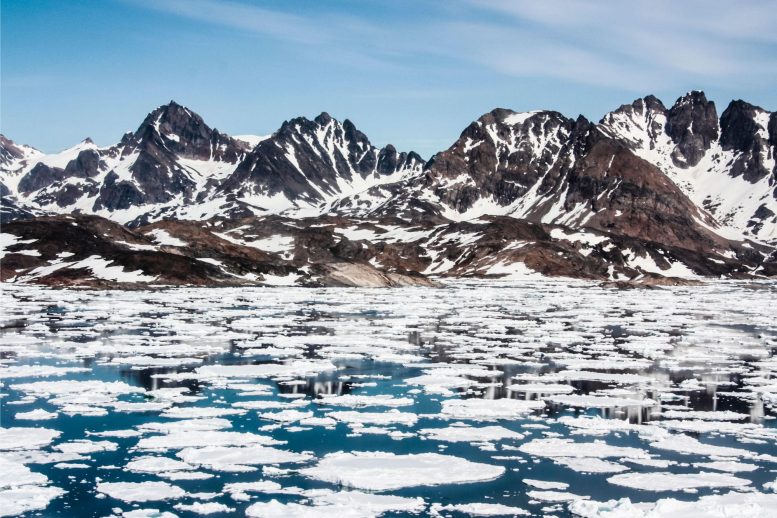
Salinity’s Crucial Role in Polar Sea Ice Formation
Polar sea ice formation is influenced by more than just the cold temperatures in the winter months. According to recent research from the University of Gothenburg and other institutions, salinity is even more important. Their research shows that the lower salinity of surface water in the polar regions prevents warmer water from rising to the surface, contributing to the formation of sea ice.
Polar sea ice typically forms in the winter months due to the cold temperatures. However, the sinking of colder, denser water should bring warmer water back to the surface and prevent the formation of sea ice. The researchers have recently published a study in the journal Science Advances explaining why this does not occur. According to their research, the lower salinity of surface water in the polar regions prevents the warmer water from rising to the surface, leading to the formation of sea ice.
“The salinity of the surface water is lower, thanks to the supply of freshwater from melting ice at the poles and precipitation to the ocean. The difference in salinity between the surface water and the deeper water is an important factor in the formation of sea ice at low temperatures at the poles. Without the difference in salinity, the water would not have become stratified, leading to continuous mixing of sea water, thus preventing the formation of ice,” says Fabien Roquet, professor of physical oceanography at the University of Gothenburg.
The Difference in Salinity Creates a “Lid”
The surface of the water, with its lower salinity, creates a “lid” that prevents warm water from rising to the surface. Without that lid, the cold polar temperatures would not be sufficient to freeze continuously moving warmer water.
The strength of this salinity lid is due to the unique properties of the seawater. In freshwater, water that is colder than 4 degrees Celsius (39 degrees Fahrenheit) has a lower density and therefore remains at the surface and freezes into ice, without mixing with water from greater depths. In the ocean, saltwater has a density that is lowest exactly at the freezing point, around -2C (28F). However, the density of the water varies much less with the temperature in cold water than when it is warmer, which is very unusual for a fluid.
Sea Ice Inhibits the Greenhouse Effect
“The closer you get to the poles, the more important salinity is for limiting the mixing and evening out of water temperature throughout the water,” says Fabien Roquet.
This discovery shows how important the special properties of the water molecule are for Earth’s climate. The exchange of heat between the ocean and atmosphere is affected not only by temperature differences but also by the salinity of the ocean. Without this fact, it would be impossible for sea ice to form to any greater extent. Sea ice is itself an important factor in impeding the greenhouse effect because it reflects sunlight away.
“With global warming, we see a decline in sea ice, which impairs the capacity of the polar seas to maintain the ‘lid’ of lower salinity that prevents carbon from rising into the atmosphere. But at the same time, warmer weather can lead to increased freshwater in the polar seas as glaciers melt and precipitation potentially increases. The difference in salinity can then increase, which may contribute to sustaining sea ice formation. But it’s difficult to predict which effect will be dominant; we just have to wait and see,” says Fabien Roquet.
Reference: “Unique thermal expansion properties of water key to the formation of sea ice on Earth” by Fabien Roquet, David Ferreira, Romain Caneill, Daniel Schlesinger and Gurvan Madec, 16 November 2022, Science Advances.
DOI: 10.1126/sciadv.abq0793
Never miss a breakthrough: Join the SciTechDaily newsletter.
Follow us on Google and Google News.
1 Comment
“… the lower salinity of surface water in the polar regions prevents the warmer water from rising to the surface, …”
Water that sinks has to be replaced. However, it doesn’t have to come from depth. There can be horizontal movement. In fact, that is exactly what is predicted when the ocean currents are viewed as a mechanism for distributing heat. In general, it appears that warm surface waters from the tropics move towards the poles, and cold, high salinity water moves at depth towards the Equator.
While the density and salinity relationships tend to be complex in the range of -2 to 4 deg C, things become a little simpler at much colder temperatures, say -40 deg. Also, when sea water does freeze, it exudes a dense, high salinity brine that tends to concentrate in downward tendrils, instead of sub-horizontal sheets that sink en masse.