
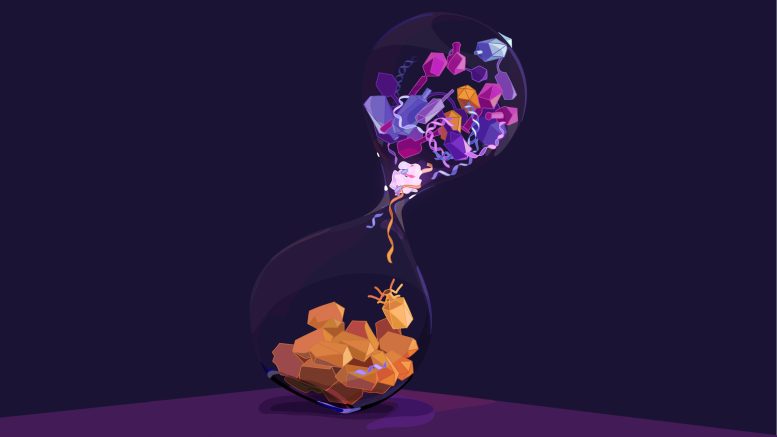
Researchers are utilizing the gene-editing technology CRISPR to modify the viruses that have evolved to engineer bacteria.
CRISPR, the revolutionary gene-editing tool, is making waves in the scientific community once more with its potential to edit the genomes of viruses that infect bacteria.
Led by CRISPR pioneers Jennifer Doudna and Jill Banfield, a team has used a rare form of CRISPR to engineer custom bacteriophages, a development that could aid in the treatment of drug-resistant infections and allow researchers to control microbiomes without the use of antibiotics. The research, published in Nature Microbiology, represents a significant achievement as the engineering of bacteriophages has long been a challenge for the scientific community.
“Bacteriophages are some of the most abundant and diverse biological entities on Earth. Unlike prior approaches, this editing strategy works against the tremendous genetic diversity of bacteriophages,” said first author Benjamin Adler, a postdoctoral fellow in Doudna’s lab. “There are so many exciting directions here – discovery is literally at our fingertips!”
Bacteriophages, also simply called phages, insert their genetic material into bacterial cells using a syringe-like apparatus, then hijack the protein-building machinery of their hosts in order to reproduce themselves – usually killing the bacteria in the process. (They’re harmless to other organisms, including us humans, even though electron microscopy images have revealed that they look like sinister alien spaceships.)
CRISPR-Cas is a type of immune defense mechanism that many bacteria and archaea use against phages. A CRISPR-Cas system consists of short snippets of RNA that are complementary to sequences in phage genes, allowing the microbe to recognize when invasive genetic material has been inserted, and scissor-like enzymes that neutralize the phage genes by cutting them into harmless pieces, after being guided into place by the RNA.
Challenges in Editing Phages
Over millennia, the perpetual evolutionary battle between phage offense and bacterial defense forced phages to specialize. There are a lot of microbes, so there are also a lot of phages, each with unique adaptations. This astounding diversity has made phage editing difficult, including making them resistant to many forms of CRISPR, which is why the most commonly used system – CRISPR-Cas9 – doesn’t work for this application.
“Phages have many ways to evade defenses, ranging from anti-CRISPRs to just being good at repairing their own DNA,” said Adler. “So, in a sense, the adaptations encoded in phage genomes that make them so good at manipulating microbes are the exact same reason why it has been so difficult to develop a general-purpose tool for editing their genomes.”
Project leaders Doudna and Banfield have developed numerous CRISPR-based tools together since they first collaborated on an early investigation of CRISPR in 2008. That work – performed at Lawrence Berkeley National Laboratory (Berkeley Lab) – was cited by the Nobel Prize committee when Doudna and her other collaborator, Emmanuelle Charpentier, received the prize in 2020. Doudna and Banfield’s team of Berkeley Lab and UC Berkeley researchers were studying the properties of a rare form of CRISPR called CRISPR-Cas13 (derived from a bacterium commonly found in the human mouth) when they discovered that this version of the defense system works against a huge range of phages.
The phage-fighting potency of CRISPR-Cas13 was unexpected given how few microbes use it, explained Adler. The scientists were doubly surprised because the phages it defeated in testing all infect using double-stranded DNA, but the CRISPR-Cas13 system only targets and chops single-stranded viral RNA. Like other types of viruses, some phages have DNA-based genomes and some have RNA-based genomes. However, all known viruses use RNA to express their genes. The CRISPR-Cas13 system effectively neutralized nine different DNA phages that all infect strains of E. coli, yet have almost no similarity across their genomes.
According to co-author and phage expert Vivek Mutalik, a staff scientist in Berkeley Lab’s Biosciences Area, these findings indicate that the CRISPR system can defend against diverse DNA-based phages by targeting their RNA after it has been converted from DNA by the bacteria’s own enzymes prior to protein translation.
Phage Genome Editing: A Two-Step Process
Next, the team demonstrated that the system can be used to edit phage genomes rather than just chop them up defensively.
First, they made segments of DNA composed of the phage sequence they wanted to create flanked by native phage sequences and put them into the phage’s target bacteria. When the phages infected the DNA-laden microbes, a small percentage of the phages reproducing inside the microbes took up the altered DNA and incorporated it into their genomes in place of the original sequence. This step is a longstanding DNA editing technique called homologous recombination. The decades-old problem in phage research is that although this step, the actual phage genome editing, works just fine, isolating and replicating the phages with the edited sequence from the larger pool of normal phages is very tricky.
This is where the CRISPR-Cas13 comes in. In step two, the scientists engineered another strain of host-microbe to contain a CRISPR-Cas13 system that senses and defends against the normal phage genome sequence. When the phages made in step one were exposed to the second-round hosts, the phages with the original sequence were defeated by the CRISPR defense system, but the small number of edited phages were able to evade it. They survived and replicated themselves.
Impressive Results in Phage Engineering
Experiments with three unrelated E. coli phages showed a staggering success rate: more than 99% of the phages produced in the two-step processes contained the edits, which ranged from enormous multi-gene deletions all the way down to precise replacements of a single amino acid.
“In my opinion, this work on phage engineering is one of the top milestones in phage biology,” said Mutalik. “As phages impact microbial ecology, evolution, population dynamics, and virulence, seamless engineering of bacteria and their phages has profound implications for foundational science but also has the potential to make a real difference in all aspects of the bioeconomy. In addition to human health, this phage engineering capability will impact everything from biomanufacturing and agriculture to food production.”
Buoyed by their initial results, the scientists are currently working to expand the CRISPR system to use it on more types of phages, starting with ones that impact microbial soil communities. They are also using it as a tool to explore the genetic mysteries within phage genomes. Who knows what other amazing tools and technologies can be inspired by the spoils of microscopic war between bacteria and viruses?
Reference: “Broad-spectrum CRISPR-Cas13a enables efficient phage genome editing” by Benjamin A. Adler, Tomas Hessler, Brady F. Cress, Arushi Lahiri, Vivek K. Mutalik, Rodolphe Barrangou, Jillian Banfield and Jennifer A. Doudna, 31 October 2022, Nature Microbiology.
DOI: 10.1038/s41564-022-01258-x
The study was was funded by the Department of Energy Microbial Community Analysis & Functional Evaluation in Soils (m-CAFES) Scientific Focus Area.
Never miss a breakthrough: Join the SciTechDaily newsletter.
Follow us on Google and Google News.
2 Comments
A significant Achievement as Proper Gene Editing of bacteriophages has long been a challenge for the scientific community. Gene Editing of VIRUSES (Bacteriophages) that KILL Bacteria is now being done – HARMLESS Viruses are Produced To HELP, if Antibiotics/Medicines are USELESS. No More FOOD (Bacteria) for Edited/Modified Virus inside the Patient, It ALSO Disappears.
I guess ethics is no longer a hurdle in science anymore. To hell with “Should we?”
Man playing God will never end well. The Ancient Egyptians, Romans, and all other civilizations tried it. Where are they now? In museums? Wonder what will be left of us for the museums that may exist 2000 years from now…