
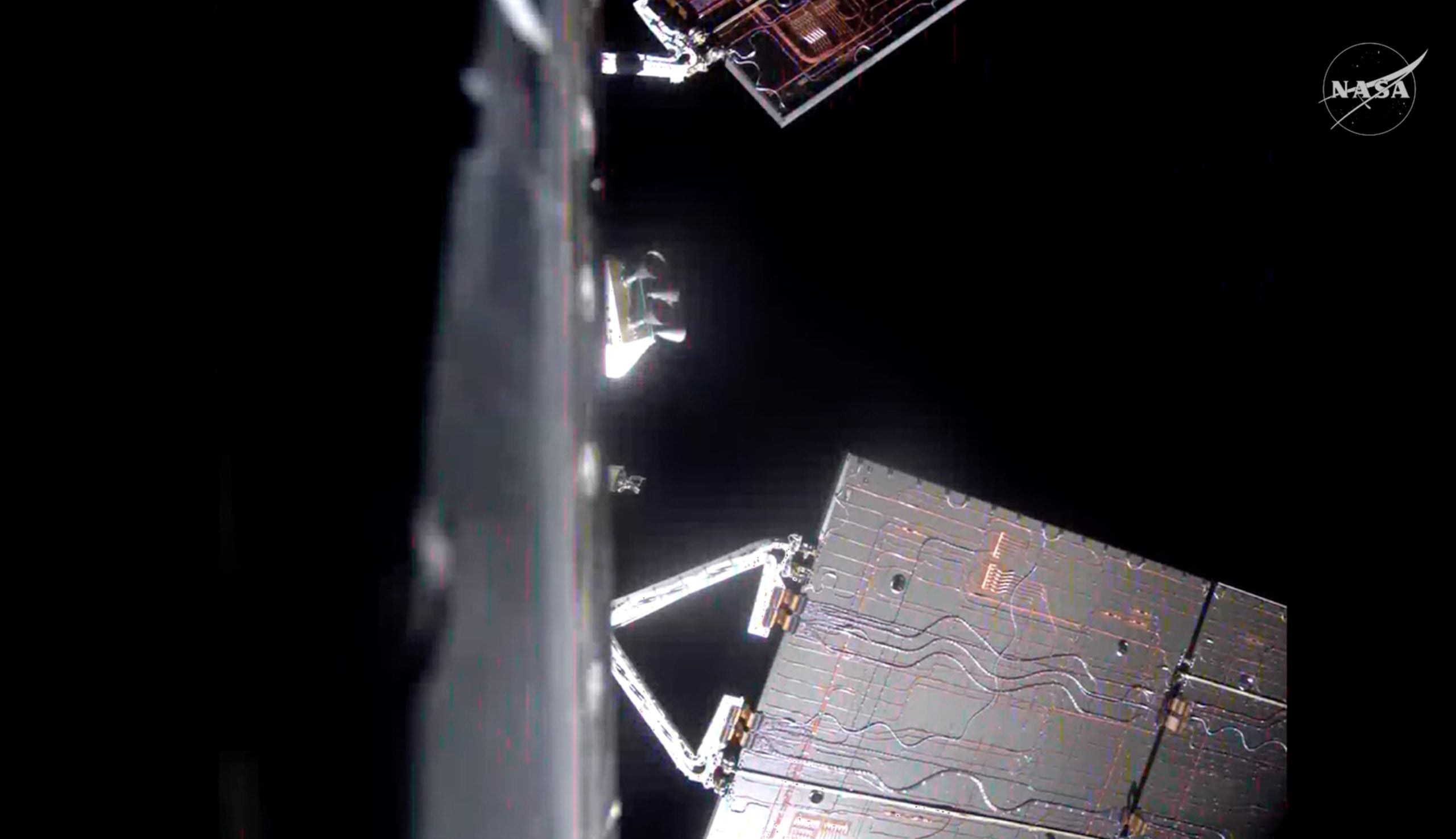
Artemis II astronauts are closing in on the Moon, testing life-saving suits and preparing for a far side flyby packed with record-breaking milestones and stunning cosmic views.
Mission controllers in Houston, working together with the Artemis II crew, carried out an outbound correction burn to fine-tune Orion’s path toward the Moon. The maneuver started at 11:03 p.m. EDT and ran for 17.5 seconds, helping ensure the spacecraft remains on its planned course.
Artemis II Crew Continues Precise Lunar Approach
NASA astronauts Reid Wiseman, Victor Glover, and Christina Koch, joined by CSA (Canadian Space Agency) astronaut Jeremy Hansen, are maintaining a carefully guided trajectory as they prepare for a Moon flyby on Monday, April 6.
Orion Crew Survival System Suit Testing
Earlier in the day, the astronauts completed one of the mission’s key test objectives by evaluating the Orion Crew Survival System (OCSS) suit.
Each crew member performed a full set of procedures, including donning and pressurizing the suit, conducting leak checks, practicing seat ingress, and testing mobility as well as their ability to eat and drink. The suit is designed to protect astronauts during critical phases of flight, while also providing life support in case of cabin depressurization and during survival scenarios after splashdown.
Entering the Moon’s Sphere of Influence
As the day concludes, Orion is set to cross into the Moon’s sphere of influence at 12:41 a.m. Monday, April 6. At that point, lunar gravity will become the primary force guiding the spacecraft’s trajectory.
Preparing for Far Side Lunar Flyby
Reaching this stage marks a major step toward flight day 6, when the crew will travel around the far side of the Moon, one of the mission’s most anticipated moments.
How To Watch the Artemis II Lunar Flyby
Watch live coverage of the Artemis II lunar flyby on NASA+, Amazon Prime, Apple TV, Hulu, Netflix, HBO Max , and Roku beginning at 1 p.m., alongside NASA’s 24/7 coverage on its YouTube channel.
Key lunar flyby times, milestones (all times Eastern subject to change based on real-time operations):
- 1 p.m.: NASA+ coverage of lunar flyby begins.
- 1:56 p.m.: The crew will surpass the record for humans’ farthest distance from Earth, previously set by Apollo 13 in 1970.
- 2:10 p.m.: Crew remarks on breaking Apollo 13 distance record (audio only)
- 2:15 p.m.: Crew configures Orion’s cabin for flyby operations
- 2:45 p.m.: Lunar observation begins
- 6:44 p.m.: Predicted loss of communications as crew heads behind the Moon (approximately 40 minutes)
- 7:02 p.m. Orion closest approach to the Moon (4,070 miles)
- 7:07 p.m.: Orion reaches maximum distance from Earth (252,757 miles)
- 7:25 p.m.: “Earthrise” marks Earth coming back into view on the opposite edge of the moon; Predicted acquisition of communications as crew reemerges from behind the Moon
- 8:35-9:32 p.m.: During a solar eclipse, the Sun will pass behind the Moon from the crew’s perspective
- 9:20 p.m.: Lunar observation concludes
The crew is scheduled to begin their sleep period for the day at 2:20 a.m., and will receive their wake-up call to begin flight day 6 at 10:50 a.m. on Monday, April 6.
Never miss a breakthrough: Join the SciTechDaily newsletter.
Follow us on Google and Google News.