
Close Menu
    Facebook X (Twitter) Instagram
    SciTechDaily
    • Biology
    • Chemistry
    • Earth
    • Health
    • Physics
    • Science
    • Space
    • Technology
    Facebook X (Twitter) Pinterest YouTube RSS
    SciTechDaily
    Home»Space»NASA Confirms Roman Space Telescope Mission’s Flight Design in Milestone Review
    Space

    NASA Confirms Roman Space Telescope Mission’s Flight Design in Milestone Review

    By NASA’s Goddard Space Flight CenterOctober 3, 2021No Comments4 Mins Read
    Facebook Twitter Pinterest Telegram LinkedIn WhatsApp Email Reddit
    Share
    Facebook Twitter LinkedIn Pinterest Telegram Email Reddit
    Roman Space Telescope
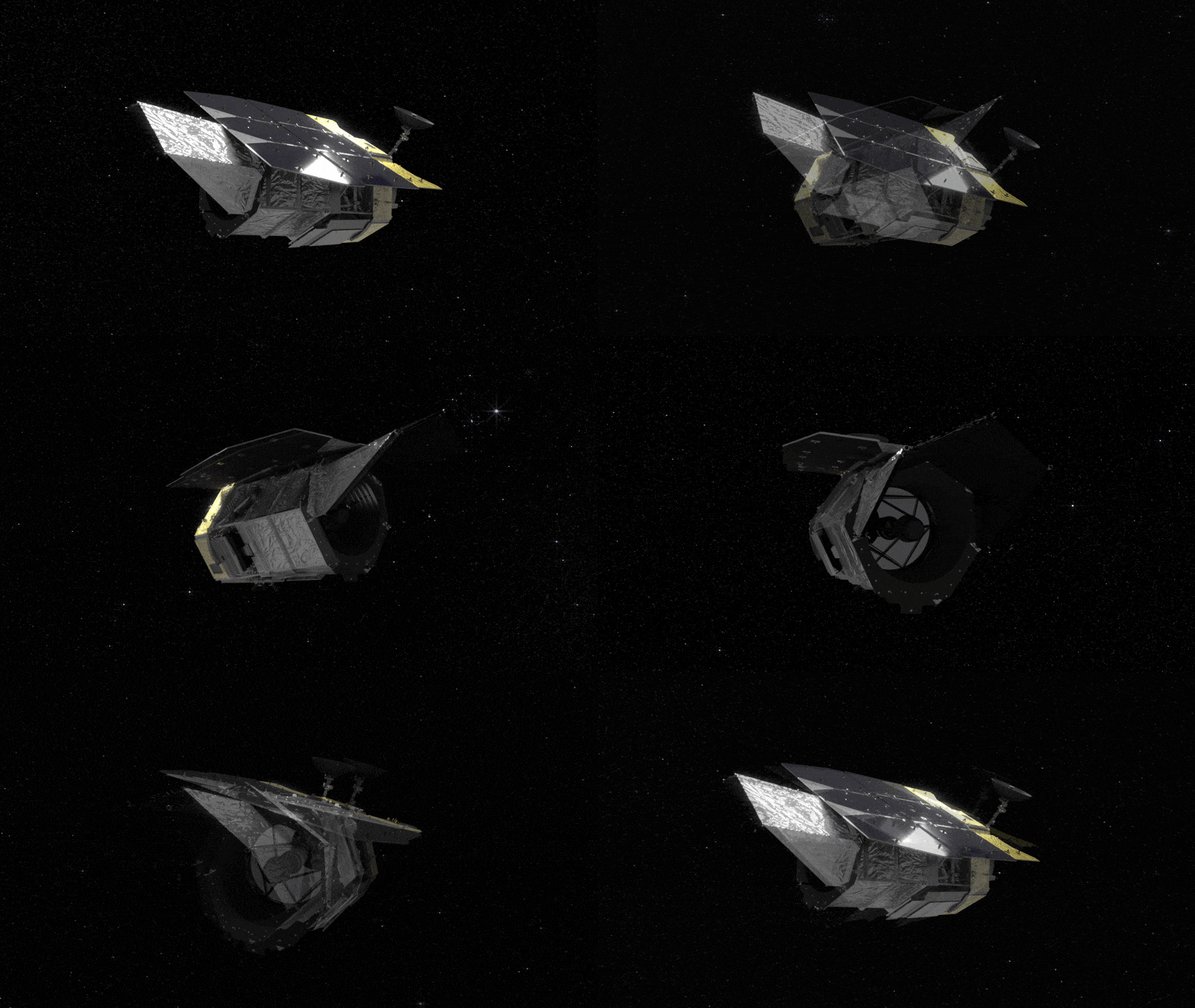
    NASA’s Nancy Grace Roman Space Telescope. Credit: NASA

    The Nancy Grace Roman Space Telescope has cleared its final design hurdle and is on track for launch by 2027. Designed to probe deep cosmic questions and survey the infrared universe, Roman will detect planets, galaxies, and dark matter at unprecedented scales.

    NASA’s Nancy Grace Roman Space Telescope has successfully passed its critical design review, signaling that all design and developmental engineering work is now complete.

    “After seeing our extensive hardware testing and sophisticated modeling, an independent review panel has confirmed that the observatory we have designed will work,” said Julie McEnery, the Roman Space Telescope senior project scientist at NASA’s Goddard Space Flight Center in Greenbelt, Maryland. “We know what it will look like and what it will be capable of. Now that the groundwork is laid, the team is thrilled to continue building and testing the observatory they’ve envisaged.”

    The Roman Space Telescope is a next-generation observatory that will peer across vast stretches of space and time to survey the infrared universe. Thanks to the mission’s enormous field of view and fast survey speeds, astronomers will be able to observe planets by the thousands, galaxies by the millions, and stars by the billions. Astronomers expect Roman to reveal significant numbers of rocky worlds in and beyond the region where liquid water may exist. The mission’s observations will also help illuminate two of the biggest cosmic puzzles: dark energy and dark matter.
    Roman Solar Array Sun Shield Space Environment Testing
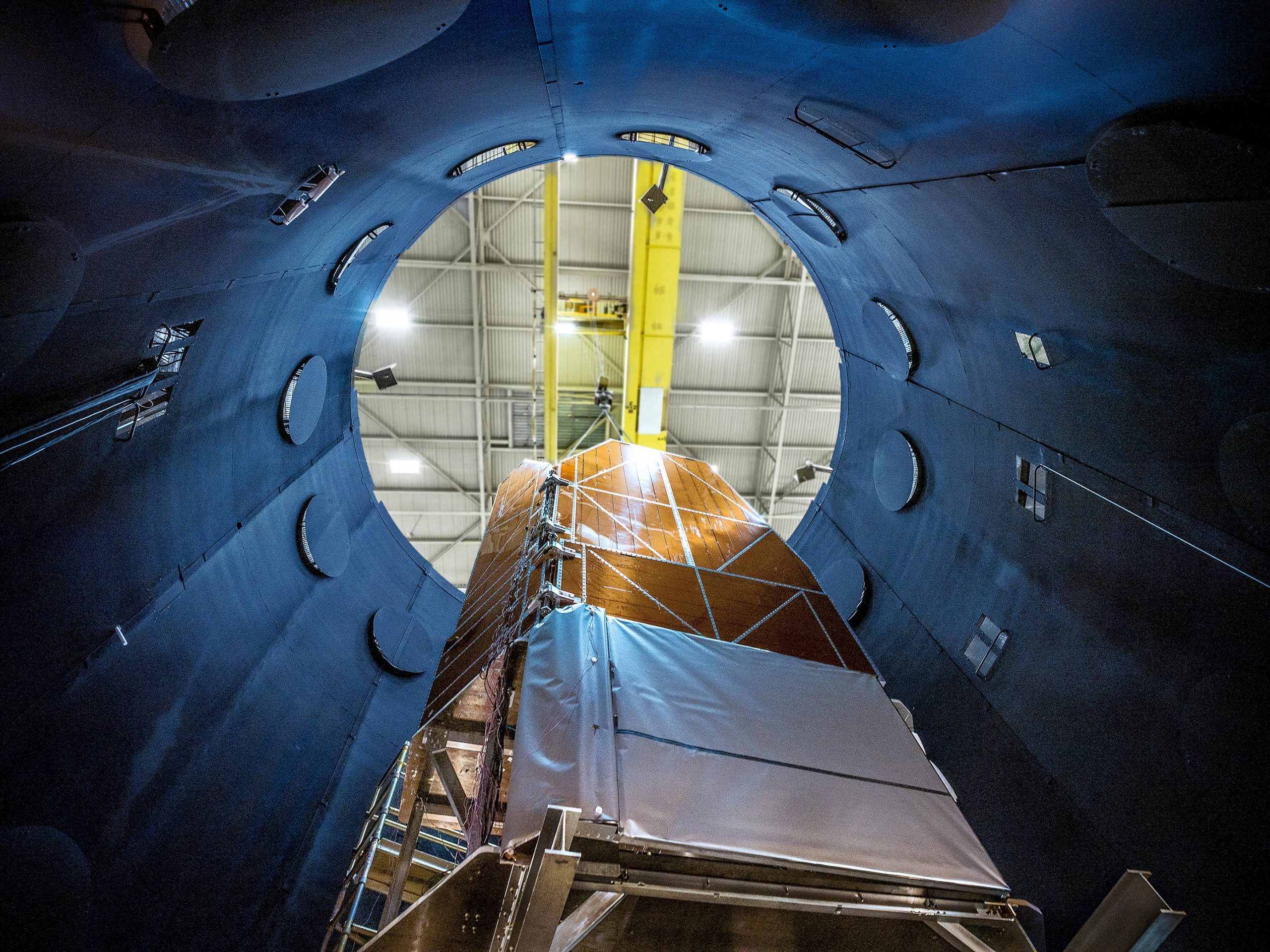
    This photo shows the setup for space environment testing of the engineering development unit for Roman’s Solar Array Sun Shield, which will serve two purposes. First, it will supply electrical power to the observatory. Second, it will shield the Optical Telescope Assembly, the Wide Field Instrument, and the Coronagraph Instrument from sunlight. Credit: NASA/Chris Gunn

    “With this review complete, we enter the exciting phase where we will assemble and test the Roman hardware that we plan to fly,” said Jackie Townsend, deputy project manager for the Roman Space Telescope at Goddard. “When all our flight hardware is ready in 2024, we’ll hold the System Integration Review and integrate the Roman observatory. Finally, we’ll test the whole observatory in environments that simulate launch and our orbit to make sure Roman will work as designed.” The mission is slated to launch no later than May 2027.

    Providing the same crisp infrared resolution as Hubble over a field of view 200 times larger, Roman will conduct sweeping cosmic surveys that would take hundreds of years using Hubble. Roman will map stars, galaxies, and dark matter to explore the formation and evolution of large cosmic structures, like clusters and superclusters of galaxies, and investigate dark energy, which is thought to accelerate the expansion of the universe.

    The mission will discover a diverse array of planets, including those that orbit far from their host star. Such worlds have been largely elusive for other planet-hunting missions. Roman will also conduct a range of other astrophysics surveys to investigate topics such as the stars in nearby galaxies and probe for new asteroids, comets, and minor planets in the outer solar system. Scientists will use Roman’s surveys to help us better understand the universe and our place within it.

    The Nancy Grace Roman Space Telescope is managed at NASA’s Goddard Space Flight Center in Greenbelt, Maryland, with participation by NASA’s Jet Propulsion Laboratory and Caltech/IPAC in Southern California, the Space Telescope Science Institute in Baltimore, and a science team comprising scientists from various research institutions. The primary industrial partners are Ball Aerospace and Technologies Corporation in Boulder, Colorado; L3Harris Technologies in Melbourne, Florida; and Teledyne Scientific & Imaging in Thousand Oaks, California.

    Never miss a breakthrough: Join the SciTechDaily newsletter.
    Follow us on Google and Google News.

    Astronomy Astrophysics NASA NASA Goddard Space Flight Center Roman Space Telescope
    Share. Facebook Twitter Pinterest LinkedIn Email Reddit

    Related Articles

    NASA’s Roman Telescope Set to Map Billions of Galaxies and Hunt Rogue Planets

    Echoes of Creation: The Roman Telescope’s Quest for Primordial Black Holes

    The End of Cosmic Dark Ages: How NASA’s Roman Space Telescope Could Expand on Hubble’s Deepest View

    A New Era of Cosmological Discovery: NASA’s Roman Space Telescope To Unravel the Secrets of Dark Energy and Dark Matter

    NASA’s Roman Mission: Using Exploding Stars to Solve the Biggest Cosmic Mysteries

    NASA’s Roman Space Telescope Predicted to Find 100,000 Transiting Planets

    Discrepancies in the Hubble Constant Have Vexed Astronomers – NASA’s Roman Space Telescope Could Help Resolve the Puzzle

    NASA’s Roman Space Telescope Will Probe Galaxy’s Core for Hot Jupiters and Brown Dwarfs

    Major Milestone for NASA’s Roman Space Telescope Mission

    Leave A Reply Cancel Reply

    • Facebook
    • Twitter
    • Pinterest
    • YouTube

    Don't Miss a Discovery

    Subscribe for the Latest in Science & Tech!

    Trending News

    Popular Sugar-Free Sweetener Linked to Liver Disease, Study Warns

    What Is Hantavirus? The Deadly Disease Raising Alarm Worldwide

    Scientists Just Discovered How the Universe Builds Monster Black Holes

    Scientists Unveil New Treatment Strategy That Could Outsmart Cancer

    A Simple Vitamin May Hold the Key to Treating Rare Genetic Diseases

    Scientists Think the Real Fountain of Youth May Be Hiding in Your Gut

    Ravens Don’t Follow Wolves, They Predict Them

    This Common Knee Surgery May Be Doing More Harm Than Good

    Follow SciTechDaily
    • Facebook
    • Twitter
    • YouTube
    • Pinterest
    • Newsletter
    • RSS
    SciTech News
    • Biology News
    • Chemistry News
    • Earth News
    • Health News
    • Physics News
    • Science News
    • Space News
    • Technology News
    Recent Posts
    • Scientists Revive Ancient Chemistry Trick To Engineer Next-Generation Glass
    • Scientists Use AI To Supercharge Ultrafast Laser Simulations by More Than 250x
    • Scientists Just Found a Surprising Way To Destroy “Forever Chemicals”
    • Popular Supplement Ingredient Linked to Shorter Lifespan in Men
    • Scientists May Have Found a Way To Repair Nerve Damage in Multiple Sclerosis
    Copyright © 1998 - 2026 SciTechDaily. All Rights Reserved.
    • Science News
    • About
    • Contact
    • Editorial Board
    • Privacy Policy
    • Terms of Use

    Type above and press Enter to search. Press Esc to cancel.