

NASA Taps Telecommunications Technology to Develop More Capable, Miniaturized Spectrometer
A technology that has enabled ever-faster delivery of voice and data over the Internet and other telecommunications platforms could play a front-and-center role in NASA’s quest to develop a super-small instrument for gathering unprecedented details about extraterrestrial planets, moons, comets, and asteroids.
Although its critical component is the size of a computer chip, the instrument promises to exceed the performance of a similar-type, but significantly larger instrument installed at a ground-based observatory in Hawaii. Since its installation at the summit of Mt. Haleakala in 2014, the Japanese-developed Mid-Infrared Heterodyne Instrument, or MILAHI, has gathered extraordinarily detailed, continuous measurements of the atmospheric dynamics, thermal structure, and surface compositions of Mars and Venus.
As good as MILAHI is, it’s too big and heavy to fly on a traditional satellite, let alone a less-expensive CubeSat whose small size and lower cost would allow scientists to fly multiple, similarly equipped platforms for multipoint observations, said Principal Investigator Tony Yu, a technologist at NASA’s Goddard Space Flight Center in Greenbelt, Maryland, who recently won technology-development funds from NASA’s Planetary Concepts for the Advancement of Solar System Observations (PICASSO) program to mature a smaller MILAHI-type instrument.
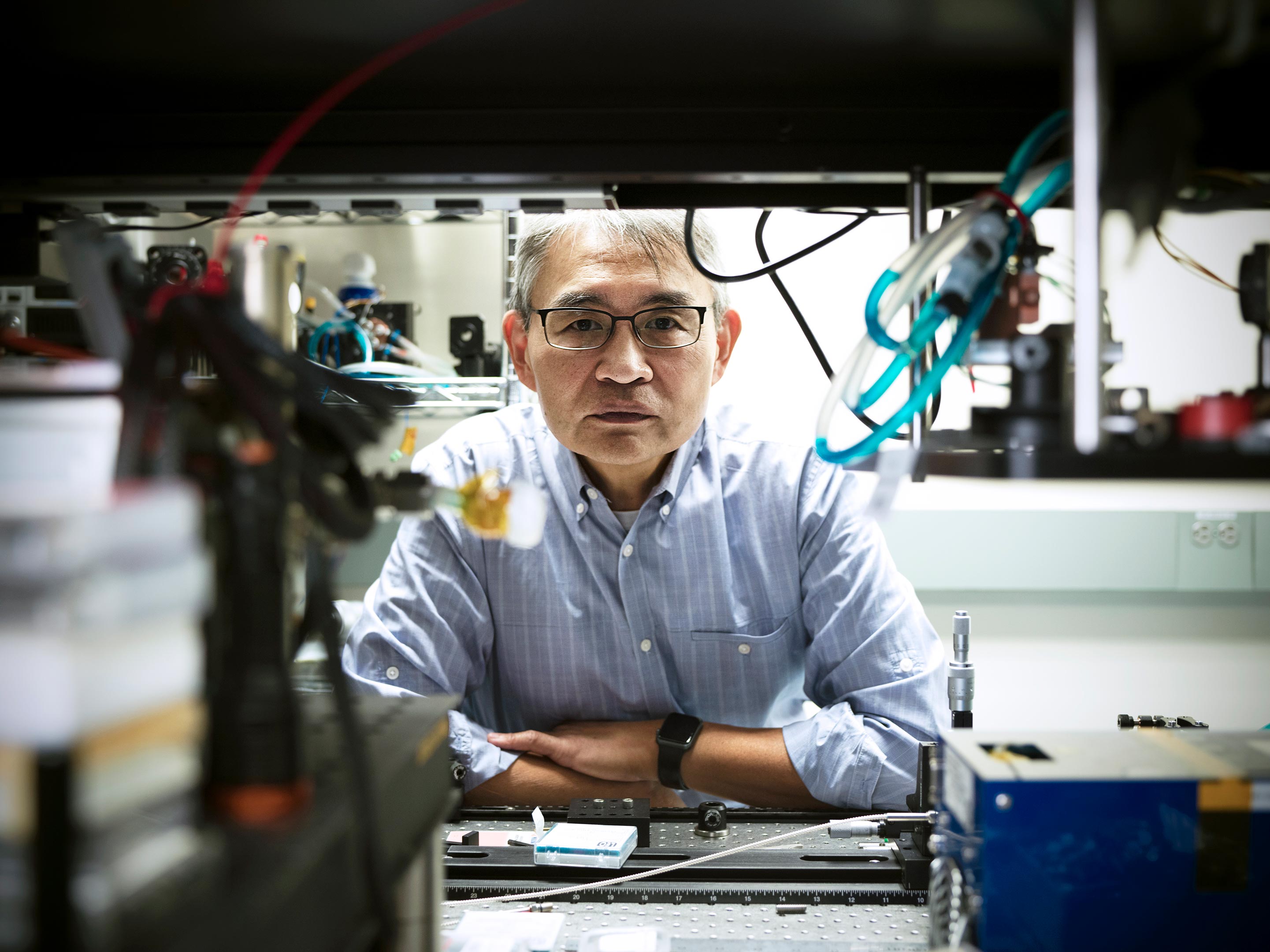
“We want to do similar science, but we need to reduce the instrument’s size,” Yu said, adding that his team’s goal is to create a small, lightweight device that consumes significantly less power and operates without moving parts, making it ideal for flying on CubeSat platforms.
PICTURE Perfect for Planetary Studies
Like MILAHI, the Photonic Integrated Circuit Tuned for Reconnaissance and Exploration, or PICTURE, would be tuned to the mid-infrared wavelengths — the spectral or frequency range ideal for remotely sensing water, carbon dioxide, methane, and many other compounds in extraterrestrial atmospheres and surfaces. And also like MILAHI, PICTURE would split mid-infrared light into its component colors — a science called spectroscopy — to reveal a wealth of information about an object’s composition and other physical properties.
But shrinking the instrument to fit inside a CubeSat, which is often no larger than a loaf of bread, will require that Yu and his team, including the Naval Research Laboratory and the University of California-Santa Barbara, adopt techniques originally created by the telecommunications industry. “Basically, what we’re doing is applying telecom technologies for use in space,” Yu said.
Under his PICASSO award, Yu and his team are focusing on one of PICTURE’s most critical subsystems: the PIC spectrometer, the chip-sized device inspired by the telecom industry’s arrayed waveguide gratings, or AWGs.
In telecommunications and computer networks, AWGs serve a couple of functions. In a process called multiplexing, they combine multiple analog or digital signals with varying wavelengths into a single optic fiber. At the receiver end of an optical communications network, a reverse process — known as demultiplexing — occurs. The waveguides then retrieve the individual channels.
With this two-step process, multiple channels can share a resource — in this case, typically a fiber-optic cable — and experience greatly reduced interference and crosstalk while dramatically increasing the efficiency and speed of telecommunications signals.
“Its Day Has Come”
The team plans to adopt the same general principle. The chip-sized PIC spectrometer, equipped with the telecommunications-inspired waveguides, would separate the light into its individual mid-infrared wavelengths — an important step in ultimately determining the molecular composition of planetary atmospheres and surfaces. These individual channels would then be mixed with laser light, also tuned to a specific wavelength, in a process called heterodyning — a commonly used technique to amplify signals.
Under this effort, the team will develop a PIC spectrometer that focuses on the spectral band ideal for detecting carbon monoxide. The goal under the PICASSO is to raise the device’s technology readiness level (TRL) — the scale that NASA uses to determine a technology’s readiness for use in space — from its current TRL of two to a TRL of four and then to advance the instrument’s other subsystems, as well as its ability to detect other molecular compounds beyond carbon monoxide.
“We’re really excited about this instrument,” said Mike Krainak, the former head of Goddard’s Laser and Electro-Optics Branch and a PICTURE team member, who now holds the post of Emeritus engineer. “It’s a technology with a tremendous future in all types of applications. Its day has come.”
Never miss a breakthrough: Join the SciTechDaily newsletter.
Follow us on Google and Google News.