
The habits of a needle-toothed tetrapod that lived more than 370 million years ago have filled in a piece of the evolutionary puzzle thanks to new research.
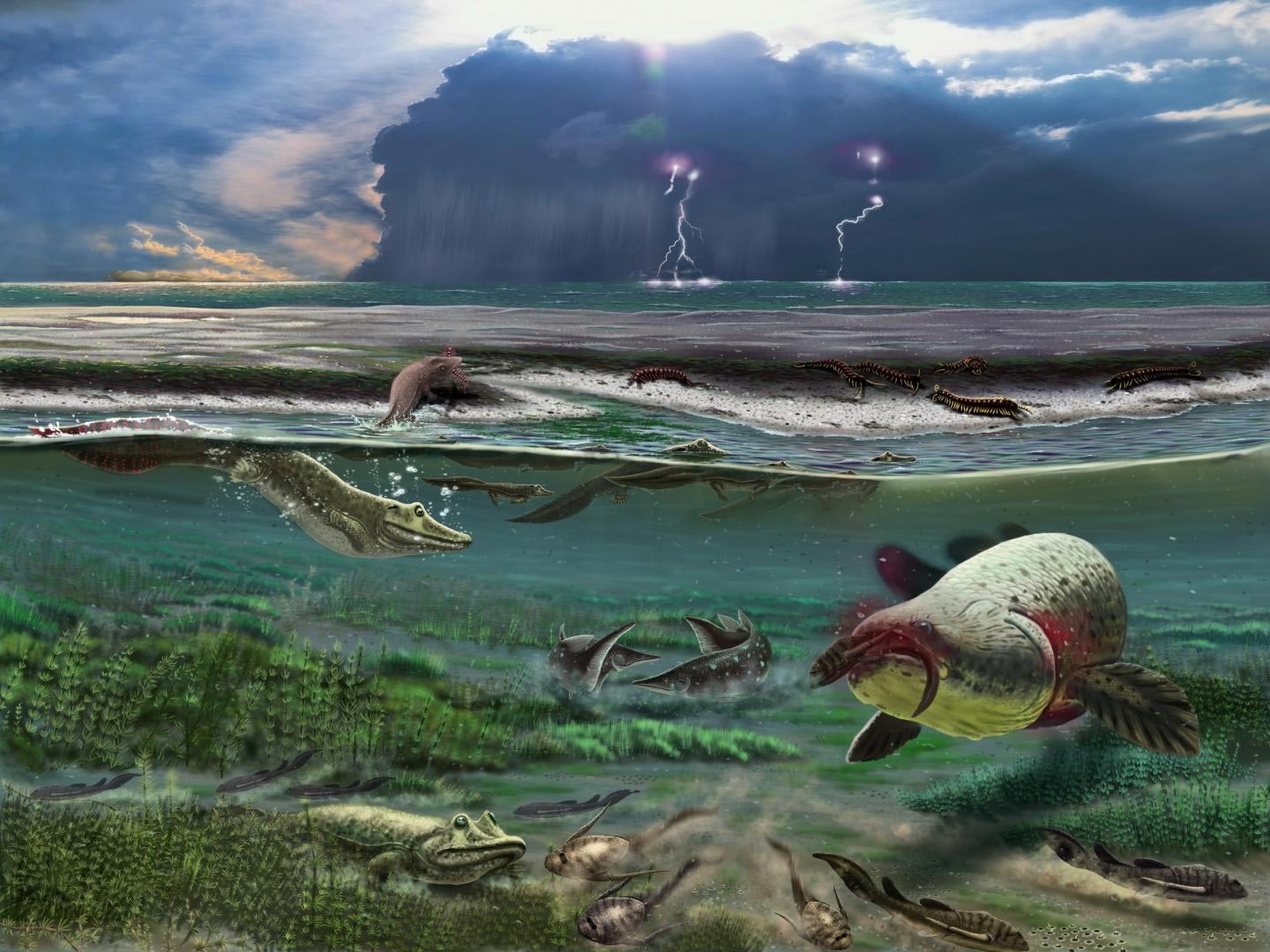
An international team of paleontologists pieced together the fossilized skeletons of a new species of tetrapod called Parmastega aelidae and found it had a skull which resembled a crocodile – a unique feature among the earliest tetrapods – with eyes situated well above the top of its head, suggesting it was capable of “keeping an eye” on unsuspecting prey while swimming close to the surface of a tropical lagoon.
The unusual combination of anatomical features has cast new light on how one of the most distant ancestors hunted and its lifestyle. Researchers believe it would have used its slender needle-like teeth and elastic jaw to snatch prey before crushing it to death with massive fangs protruding from its palate.
The team also found that part of its shoulder girdle consisted of cartilage, and its vertebral column and paired limbs could also be made of cartilage, indicating it probably spent most or all its time in the water. The concentration of the fossil remains also suggests that it may have lived in large groups.
Tetrapods are represented today by amphibians, reptiles, birds, and mammals, and Parmastega predates the former earliest records of complete or almost complete tetrapod skeletons by nearly 12 million years.
The new study was led by the Ural Branch of the Russian Academy of Science, in partnership with the Universities of Lincoln and Cambridge in the UK, the University of Latvia, and the University of Uppsala in Sweden. It was funded by the National Geographic Society, the Latvian Council of Science, and the Knut and Alice Wallenberg Foundation.
“The evolution of tetrapods is one of the most important events in the history of backboned animals, and ultimately led to the appearance of our own species. … These new findings demonstrate that the sequence of evolutionary changes that occurred during the transition from fish-like creatures to tetrapods were much less linear than previously thought.” — Dr. Marcello Ruta
Professor Per Ahlberg from the University of Uppsala in Sweden, explained that a clue to the lifestyle of Parmastega was provided by its sensory canals, used to detect vibrations in the water, which Parmastega inherited from its fish ancestors. “These canals are well developed on the lower jaw, the snout, and the sides of the face, but they die out on top of the head behind the eyes,” he said. “This probably means that it spent a lot of time hanging around at the surface of the water, with the top of the head just awash and the eyes protruding into the air.
“We believe there may have been large arthropods such as millipedes or sea scorpions to catch at the water’s edge. The slender, elastic lower jaw certainly looks well-suited to scooping prey off the ground, its needle-like teeth contrasting with the robust fangs of the upper jaw that would have been driven into the prey by the body weight of Parmastega.
“These fossils give us the earliest detailed glimpse of a tetrapod: an aquatic, surface-skimming predator, just over a meter in length, living in a lagoon on a tropical coastal plain.”
Dr. Marcello Ruta from Lincoln’s School of Life Sciences added: “The evolution of tetrapods is one of the most important events in the history of backboned animals, and ultimately led to the appearance of our own species. Early in their history, tetrapods evolved many changes in their feeding strategies, movement abilities, and sensory perception, but many of these are still shrouded in mystery.
“Like all fossil organisms, Parmastega occupies a special and unique place in the tree of life. Our study welcomes a new, very early member of that tree which shows considerable anatomical, functional and ecological experimentation.
“These new findings demonstrate that the sequence of evolutionary changes that occurred during the transition from fish-like creatures to tetrapods were much less linear than previously thought. This helps us to amend or challenge previous evolutionary scenarios and give new insights into the life and environments of our most distant forerunners. Findings like those of Parmastega can help us grasp the complex patterns and processes that have shaped life’s diversity for hundreds of millions of years.”
The findings were published in the scientific journal, Nature on October 23, 2019.
Reference: “Morphology of the earliest reconstructable tetrapod Parmastega aelidae” by Pavel A. Beznosov, Jennifer A. Clack, Ervīns Lukševičs, Marcello Ruta and Per Erik Ahlberg, 23 October 2019, Nature.
DOI: 10.1038/s41586-019-1636-y
Never miss a breakthrough: Join the SciTechDaily newsletter.
Follow us on Google and Google News.