
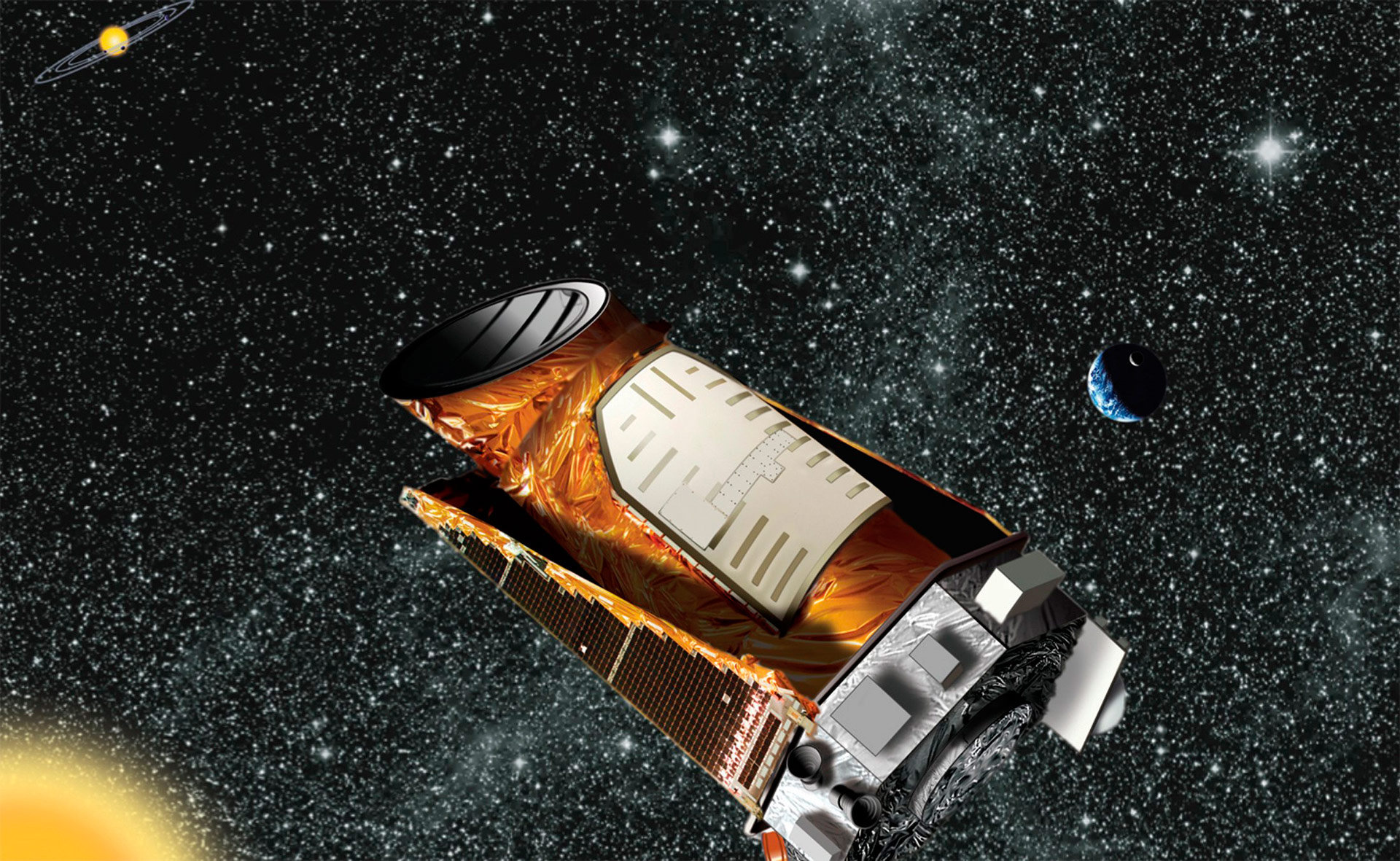
NASA has announced that all attempts to fully restore Kepler have failed and that they are now looking at potential new missions for the space telescope.
Following months of analysis and testing, the Kepler Space Telescope team is ending its attempts to restore the spacecraft to full working order, and now is considering what new science research it can carry out in its current condition.
Two of Kepler’s four gyroscope-like reaction wheels, which are used to precisely point the spacecraft, have failed. The first was lost in July 2012, and the second in May. Engineers’ efforts to restore at least one of the wheels have been unsuccessful.
Kepler completed its prime mission in November 2012 and began its four-year extended mission at that time. However, the spacecraft needs three functioning wheels to continue its search for Earth-sized exoplanets, which are planets outside our solar system, orbiting stars like our sun in what’s known as the habitable zone — the range of distances from a star where the surface temperature of a planet might be suitable for liquid water. As scientists analyze previously collected data, the Kepler team also is looking into whether the space telescope can conduct a different type of science program, potentially including an exoplanet search, using the remaining two good reaction wheels and thrusters.
“Kepler has made extraordinary discoveries in finding exoplanets including several super-Earths in the habitable zone,” said John Grunsfeld, associate administrator for NASA’s Science Mission Directorate in Washington. “Knowing that Kepler has successfully collected all the data from its prime mission, I am confident that more amazing discoveries are on the horizon.”
NASA’s Kepler mission has discovered two new planetary systems that include three super-Earth-size planets in the “habitable zone,” the range of distance from a star where the surface temperature of an orbiting planet might be suitable for liquid water.
On August 8, engineers conducted a system-level performance test to evaluate Kepler’s current capabilities. They determined wheel 2, which failed last year, can no longer provide the precision pointing necessary for science data collection. The spacecraft was returned to its point rest state, which is a stable configuration where Kepler uses thrusters to control its pointing with minimal fuel use.
“At the beginning of our mission, no one knew if Earth-size planets were abundant in the galaxy. If they were rare, we might be alone,” said William Borucki, Kepler science principal investigator at NASA’s Ames Research Center in Moffett Field, California. “Now at the completion of Kepler observations, the data holds the answer to the question that inspired the mission: Are Earths in the habitable zone of stars like our sun common or rare?”
An engineering study will be conducted on the modifications required to manage science operations with the spacecraft using a combination of its remaining two good reaction wheels and thrusters for spacecraft attitude control.
Informed by contributions from the broader science community in response to the call for scientific white papers announced August 2, the Kepler project team will perform a study to identify possible science opportunities for a two-wheel Kepler mission.
Depending on the outcome of these studies, which are expected to be completed later this year, NASA will assess the scientific priority of a two-wheel Kepler mission. Such an assessment may include prioritization relative to other NASA astrophysics missions competing for operational funding at the NASA Senior Review board early next year.
From the data collected in the first half of its mission, Kepler has confirmed 135 exoplanets and identified over 3,500 candidates. The team continues to analyze all four years of collected data, expecting hundreds, if not thousands, of new discoveries including the long-awaited Earth-size planets in the habitable zone of sun-like stars. Though the spacecraft will no longer operate with its unparalleled precision pointing, scientists expect Kepler’s most interesting discoveries are still to come.
Meanwhile, preparations are underway for hosting the second Kepler Science Conference November 4-8, at NASA’s Ames Research Center. This will be an opportunity to share not only the investigations of the Kepler project team, but also those of the wider science community using publicly accessible data from Kepler. Registration is now open.
Ames is responsible for the Kepler mission concept, ground system development, mission operations, and science data analysis. NASA’s Jet Propulsion Laboratory in Pasadena, California, managed Kepler mission development.
Ball Aerospace & Technologies Corp. in Boulder, Colorado, developed the Kepler flight system and supports mission operations with the Laboratory for Atmospheric and Space Physics at the University of Colorado in Boulder.
The Space Telescope Science Institute in Baltimore archives, hosts and distributes Kepler science data. Kepler is NASA’s 10th Discovery Mission and was funded by the agency’s Science Mission Directorate.
Listen to an audio recording of the NASA media telecon held August 15
- For more information about Kepler’s upcoming science conference, visit: http://go.nasa.gov/13kz012
- For more information about NASA’s Kepler spacecraft, visit: http://www.nasa.gov/kepler
Never miss a breakthrough: Join the SciTechDaily newsletter.
Follow us on Google and Google News.