
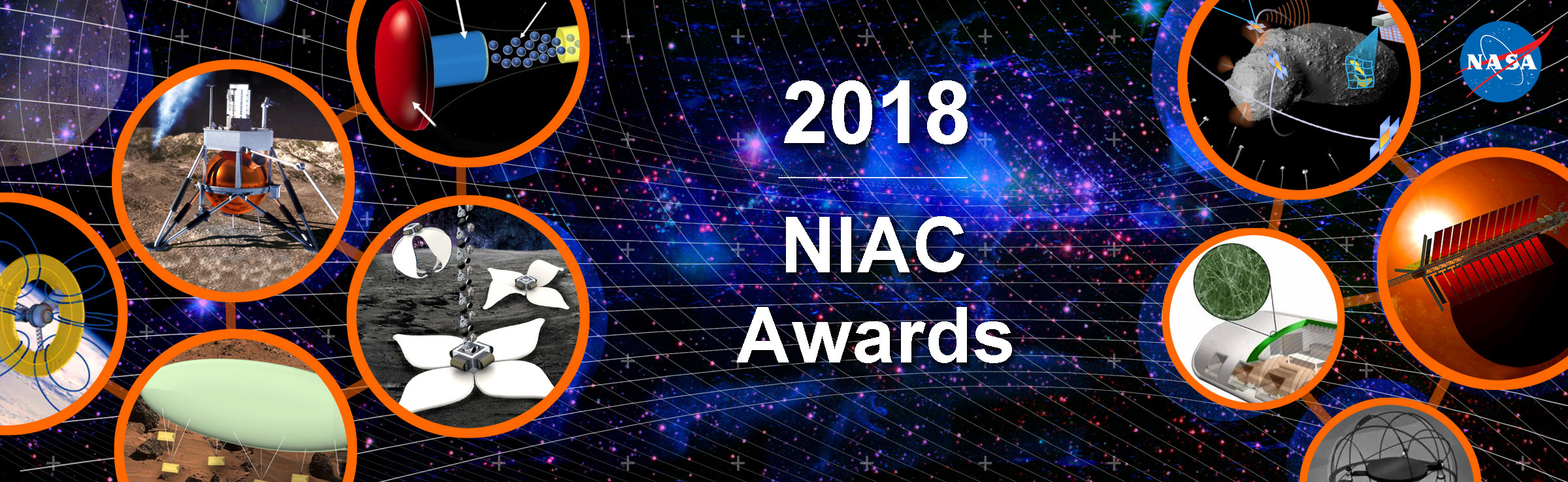
NASA is investing in technology concepts that include meteoroid impact detection, space telescope swarms, and small orbital debris mapping technologies that may one day be used for future space exploration missions.
The agency selected 25 early-stage technology proposals that have the potential to transform future human and robotic exploration missions, introduce new exploration capabilities, and significantly improve current approaches to building and operating aerospace systems.
The 2018 NASA Innovative Advanced Concepts (NIAC) Phase I concepts cover a wide range of innovations selected for their potential to revolutionize future space exploration. Phase I awards are valued at approximately $125,000, over nine months, to support the initial definition and analysis of their concepts. If these basic feasibility studies are successful, awardees can apply for Phase II awards.
“The NIAC program gives NASA the opportunity to explore visionary ideas that could transform future NASA missions by creating radically better or entirely new concepts while engaging America’s innovators and entrepreneurs as partners in the journey,” said Jim Reuter, acting associate administrator of NASA’s Space Technology Mission Directorate. “The concepts can then be evaluated for potential inclusion into our early stage technology portfolio.”
The selected 2018 Phase I proposals are:
Shapeshifters from Science Fiction to Science Fact: Globetrotting from Titan’s Rugged Cliffs to its Deep Seafloors
Aliakbar Aghamohammadi, NASA’s Jet Propulsion Laboratory (JPL), Pasadena, California
Biobot: Innovative Offloading of Astronauts for More Effective Exploration
David Akin, University of Maryland, College Park
Lofted Environmental and Atmospheric Venus Sensors (LEAVES)
Jeffrey Balcerski, Ohio Aerospace Institute, Cleveland
Meteoroid Impact Detection for Exploration of Asteroids (MIDEA)
Sigrid Close, Stanford University, California
On-Orbit, Collision-Free Mapping of Small Orbital Debris
Christine Hartzell, University of Maryland, College Park
Marsbee – Swarm of Flapping Wing Flyers for Enhanced Mars Exploration
Chang-kwon Kang, University of Alabama, Huntsville
Rotary Motion Extended Array Synthesis (R-MXAS)
John Kendra, Leidos, Inc., Reston, Virginia
PROCSIMA: Diffractionless Beamed Propulsion for Breakthrough Interstellar Missions
Chris Limbach, Texas A&M Engineering Experiment Station, College Station
SPARROW: Steam Propelled Autonomous Retrieval Robot for Ocean Worlds
Gareth Meirion-Griffith, JPL
BALLET: Balloon Locomotion for Extreme Terrain
Hari Nayar, JPL
Myco-Architecture off Planet: Growing Surface Structures at Destination
Lynn Rothscild, NASA’s Ames Research Center, Moffett Field, California
Modular Active Self-Assembling Space Telescope Swarms
Dmitry Savransky, Cornell University, Ithaca, New York
Astrophysics and Technical Study of a Solar Neutrino Spacecraft
Nickolas Solomey, Wichita State University, Kansas
Advanced Diffractive MetaFilm Sailcraft
Grover Swartzlander, Rochester Institute of Technology, New York
Spectrally-Resolved Synthetic Imaging Interferometer
Jordan Wachs, Ball Aerospace & Technologies Corporation, Boulder, Colorado
Radioisotope Positron Propulsion
Ryan Weed, Positron Dynamics, Livermore, California
“The 2018 Phase I competition was especially fierce, with over 230 proposals and only 25 winners,” said Jason Derleth, NIAC program executive. “I can’t wait to see what the new NIAC Fellows can do for NASA!”
Phase II studies allow awardees time to refine their designs and explore aspects of implementing the new technology. This year’s Phase II portfolio addresses a range of leading-edge concepts, including a breakthrough propulsion architecture for interstellar precursor missions, a large-scale space telescope, novel exploration tools for Triton, and Mach effect gravity assist drive propulsion.
Awards under Phase II of the NIAC program can be worth as much as $500,000 for two-year studies, and allow proposers to further develop Phase I concepts that successfully demonstrated initial feasibility and benefit.
The selected 2018 Phase II proposals are:
Pulsed Fission-Fusion (PuFF) Propulsion Concept
Robert Adams, NASA’s Marshall Space Flight Center, Huntsville, Alabama
A Breakthrough Propulsion Architecture for Interstellar Precursor Missions
John Brophy, JPL
Kilometer Space Telescope (KST)
Devon Crowe, Raytheon, El Segundo, California
Dismantling Rubble Pile Asteroids with AoES (Area-of-Effect Soft-bots)
Jay McMahon, University of Colorado, Boulder
Triton Hopper: Exploring Neptune’s Captured Kuiper Belt Object
Steven Oleson, NASA’s Glenn Research Center, Cleveland
Spacecraft Scale Magnetospheric Protection from Galactic Cosmic Radiation
John Slough, MSNW, LLC, Redmond, Washington
Direct Multipixel Imaging and Spectroscopy of an Exoplanet with a Solar Gravity Lens Mission
Slava Turyshev, JPL
NIMPH: Nano Icy Moons Propellant Harvester
Michael VanWoerkom, ExoTerra Resource, Littleton, Colorado
Mach Effect for in space propulsion: Interstellar mission
James Woodward, Space Studies Institute, Inc., Mojave, California
“Phase II studies are given to the most successful Phase I fellows, whose ideas have the best possibility of changing the possible,” said Derleth. “Their two-year timeframe and larger budget allow them to really get going on the business of creating the future.”
NASA selected these projects through a peer-review process that evaluated innovativeness and technical viability. All projects are still in the early stages of development, most requiring 10 or more years of concept maturation and technology development before use on a NASA mission.
NIAC partners with forward-thinking scientists, engineers, and citizen inventors from across the nation to help maintain America’s leadership in air and space. NIAC is funded by NASA’s Space Technology Mission Directorate, which is responsible for developing the cross-cutting, pioneering new technologies and capabilities needed by the agency to achieve its current and future missions.
Never miss a breakthrough: Join the SciTechDaily newsletter.
Follow us on Google and Google News.