
Close Menu
    Facebook X (Twitter) Instagram
    SciTechDaily
    • Biology
    • Chemistry
    • Earth
    • Health
    • Physics
    • Science
    • Space
    • Technology
    Facebook X (Twitter) Pinterest YouTube RSS
    SciTechDaily
    Home»Space»NASA Fermi Images: Moon Glows Brighter Than Sun
    Space

    NASA Fermi Images: Moon Glows Brighter Than Sun

    By Francis Reddy, NASA’s Goddard Space Flight CenterAugust 15, 2019No Comments4 Mins Read
    Facebook Twitter Pinterest Telegram LinkedIn WhatsApp Email Reddit
    Share
    Facebook Twitter LinkedIn Pinterest Telegram Email Reddit
    Fermi Moon
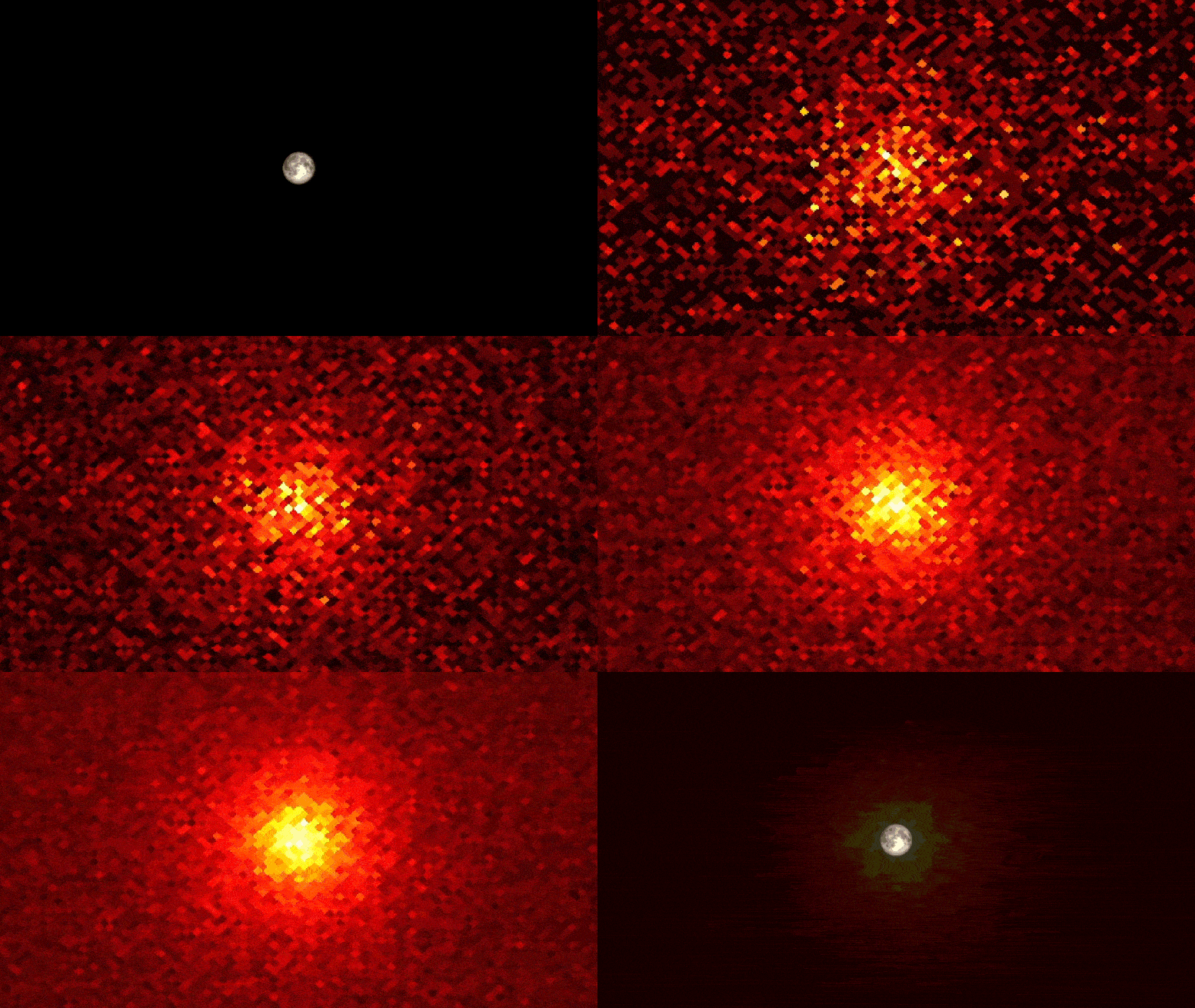
    The Moon shines brightly in gamma rays as seen in this time sequence from NASA’s Fermi Gamma-ray Space Telescope. Each 5-by-5-degree image is centered on the Moon and shows gamma rays with energies above 31 million electron volts, or tens of millions of times that of visible light. At these energies, the Moon is actually brighter than the Sun. Brighter colors indicate greater numbers of gamma rays. This animation shows how longer exposure, ranging from two to 128 months (10.7 years), improved the view. Credit: NASA/DOE/Fermi LAT Collaboration

    If our eyes could see high-energy radiation called gamma rays, the Moon would appear brighter than the Sun! That’s how NASA’s Fermi Gamma-ray Space Telescope has seen our neighbor in space for the past decade.

    Gamma-ray observations are not sensitive enough to clearly see the shape of the Moon’s disk or any surface features. Instead, Fermi’s Large Area Telescope (LAT) detects a prominent glow centered on the Moon’s position in the sky.

    Mario Nicola Mazziotta and Francesco Loparco, both at Italy’s National Institute of Nuclear Physics in Bari, have been analyzing the Moon’s gamma-ray glow as a way of better understanding another type of radiation from space: fast-moving particles called cosmic rays.

    “Cosmic rays are mostly protons accelerated by some of the most energetic phenomena in the universe, like the blast waves of exploding stars and jets produced when matter falls into black holes,” explained Mazziotta.

    Because the particles are electrically charged, they’re strongly affected by magnetic fields, which the Moon lacks. As a result, even low-energy cosmic rays can reach the surface, turning the Moon into a handy space-based particle detector. When cosmic rays strike, they interact with the powdery surface of the Moon, called the regolith, to produce gamma-ray emission. The Moon absorbs most of these gamma rays, but some of them escape.

    Mazziotta and Loparco analyzed Fermi LAT lunar observations to show how the view has improved during the mission. They rounded up data for gamma rays with energies above 31 million electron volts — more than 10 million times greater than the energy of visible light — and organized them over time, showing how longer exposures improve the view.

    “Seen at these energies, the Moon would never go through its monthly cycle of phases and would always look full,” said Loparco.
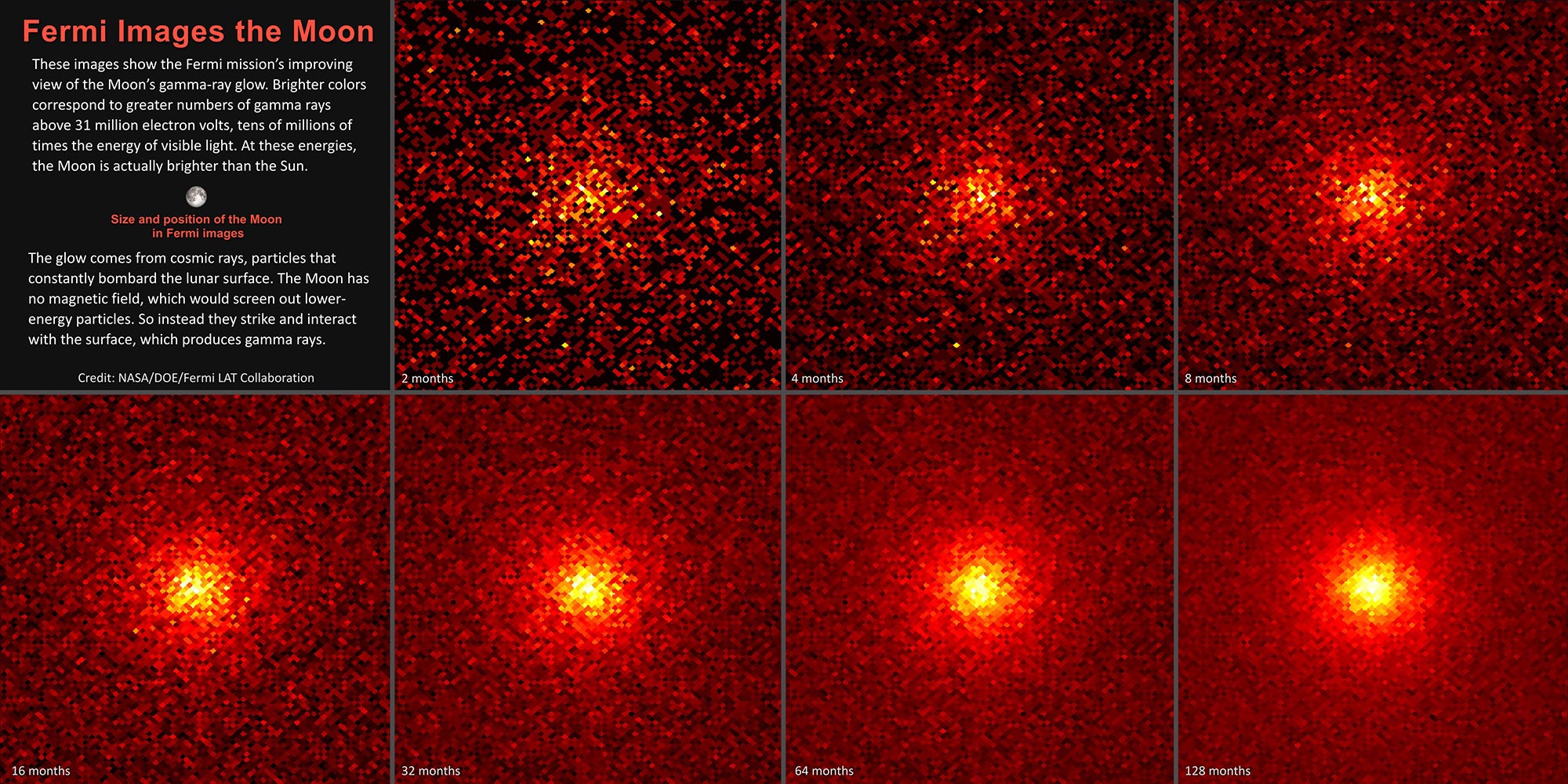
    Fermi Images of the Moon
    These images show the steadily improving view of the Moon’s gamma-ray glow from NASA’s Fermi Gamma-ray Space Telescope. Each 5-by-5-degree image is centered on the Moon and shows gamma rays with energies above 31 million electron volts, or tens of millions of times that of visible light. At these energies, the Moon is actually brighter than the Sun. Brighter colors indicate greater numbers of gamma rays. This image sequence shows how longer exposure, ranging from two to 128 months (10.7 years), improved the view. Credit: NASA/DOE/Fermi LAT Collaboration

    As NASA sets its sights on sending humans to the Moon by 2024 through the Artemis program, with the eventual goal of sending astronauts to Mars, understanding various aspects of the lunar environment take on new importance. These gamma-ray observations are a reminder that astronauts on the Moon will require protection from the same cosmic rays that produce this high-energy gamma radiation.

    While the Moon’s gamma-ray glow is surprising and impressive, the Sun does shine brighter in gamma rays with energies higher than 1 billion electron volts. Cosmic rays with lower energies do not reach the Sun because its powerful magnetic field screens them out. But much more energetic cosmic rays can penetrate this magnetic shield and strike the Sun’s denser atmosphere, producing gamma rays that can reach Fermi.

    Although the gamma-ray Moon doesn’t show a monthly cycle of phases, its brightness does change over time. Fermi LAT data show that the Moon’s brightness varies by about 20% over the Sun’s 11-year activity cycle. Variations in the intensity of the Sun’s magnetic field during the cycle change the rate of cosmic rays reaching the Moon, altering the production of gamma rays.

    Never miss a breakthrough: Join the SciTechDaily newsletter.
    Follow us on Google and Google News.

    Fermi Gamma-ray Space Telescope Moon NASA NASA Goddard Space Flight Center Telescope
    Share. Facebook Twitter Pinterest LinkedIn Email Reddit

    Related Articles

    NASA Spots Fresh Lunar Impact From Crashed Moon Mission

    NASA’s LEXI Will Unveil Earth’s Magnetic Shield With Lunar X-Ray Vision

    NASA’s Fermi Measures Extragalactic Background Light

    Evolution of the Moon Video

    Fermi Detects the Highest-Energy Light Ever Associated With an Eruption on the Sun

    New Technique Leads to the Discovery of 5 New Pulsars

    A Closer Look at Titan’s Chemical Production

    Fermi Finds Celestial Sources of Photons, Some Unexplainable

    NASA LRO Spacecraft Reveals Geological Activity on the Moon’s Surface

    Leave A Reply Cancel Reply

    • Facebook
    • Twitter
    • Pinterest
    • YouTube

    Don't Miss a Discovery

    Subscribe for the Latest in Science & Tech!

    Trending News

    The Universe Is Expanding Too Fast and Scientists Can’t Explain Why

    “Like Liquid Metal”: Scientists Create Strange Shape-Shifting Material

    Early Warning Signals of Esophageal Cancer May Be Hiding in Plain Sight

    Common Blood Pressure Drug Shows Surprising Power Against Deadly Antibiotic-Resistant Superbug

    Scientists Uncover Dangerous Connection Between Serotonin and Heart Valve Disease

    Scientists Discover a “Protector” Protein That Could Help Reverse Hair Loss

    Bone-Strengthening Discovery Could Reverse Osteoporosis

    Scientists Uncover Hidden Trigger Behind Stem Cell Aging

    Follow SciTechDaily
    • Facebook
    • Twitter
    • YouTube
    • Pinterest
    • Newsletter
    • RSS
    SciTech News
    • Biology News
    • Chemistry News
    • Earth News
    • Health News
    • Physics News
    • Science News
    • Space News
    • Technology News
    Recent Posts
    • Scientists Overcome Major Quantum Bottleneck, Potentially Transforming Teleportation and Computing
    • Quantum Physics’ Strangest Problem May Hold the Key to Time Itself
    • Scientists Create “Liquid Gears” That Spin Without Touching
    • The Simple Habit That Could Help Prevent Cancer
    • Forgotten Medicinal Plant Shows Promise in Fighting Dangerous Superbugs
    Copyright © 1998 - 2026 SciTechDaily. All Rights Reserved.
    • Science News
    • About
    • Contact
    • Editorial Board
    • Privacy Policy
    • Terms of Use

    Type above and press Enter to search. Press Esc to cancel.