

NASA’s LEXI, an innovative X-ray imager, is embarking on a groundbreaking mission to the Moon under the Artemis campaign.
Once on the lunar surface, LEXI will capture unprecedented global images of Earth’s magnetic field, offering insights into how it shields us from solar radiation and reacts to space weather.
LEXI’s Lunar Mission
NASA is sending an advanced X-ray imager to the Moon as part of the Artemis campaign. This groundbreaking instrument will capture the first-ever global images of Earth’s magnetic field, which protects the planet from harmful solar radiation.
The Lunar Environment Heliospheric X-ray Imager (LEXI) is one of 10 payloads included in NASA’s upcoming lunar delivery. This mission, part of the Commercial Lunar Payload Services (CLPS) initiative, is slated to launch no earlier than mid-January from Kennedy Space Center in Florida aboard Firefly Aerospace’s Blue Ghost Lander. LEXI will contribute to NASA’s efforts to better understand how Earth responds to space weather — dynamic conditions in space caused by the Sun.
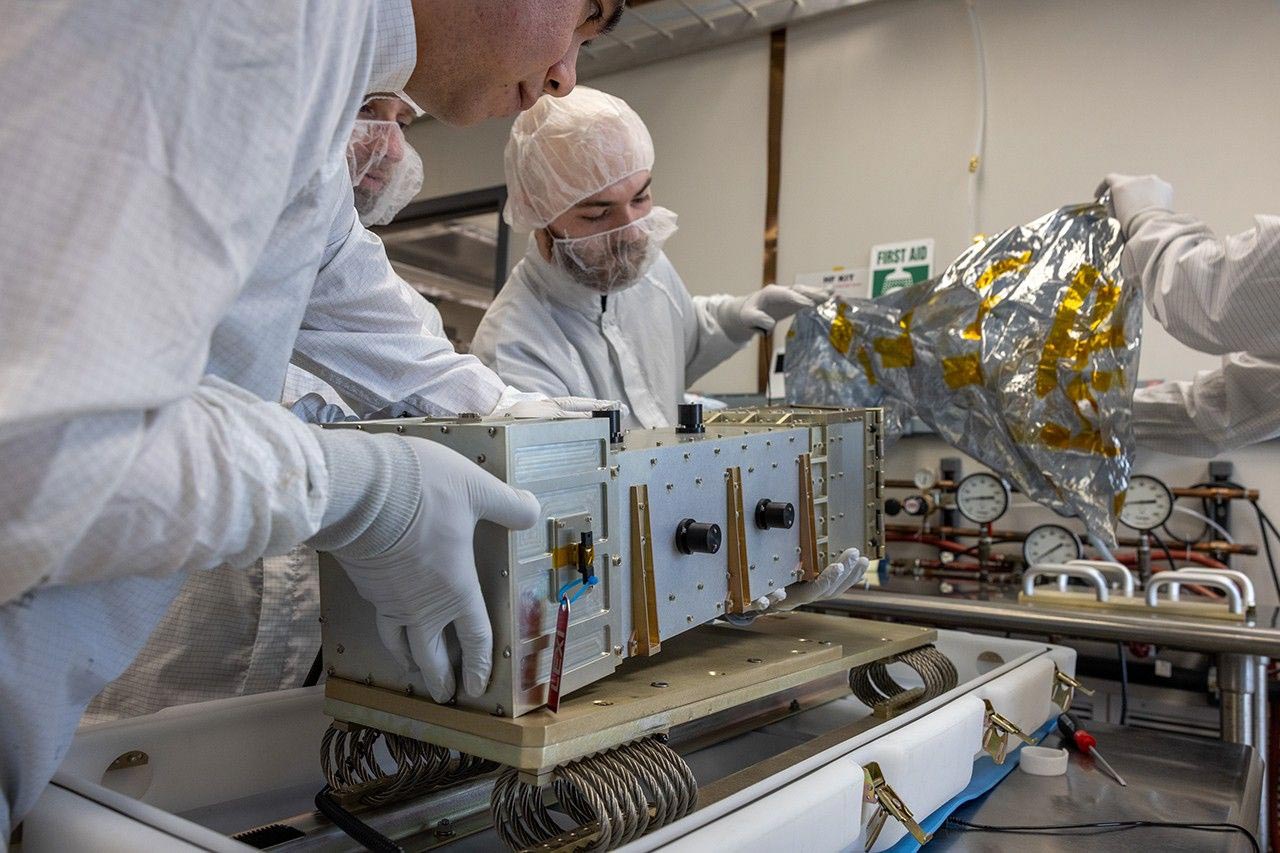
NASA’s next mission to the Moon will carry an instrument called LEXI (the Lunar Environment Heliospheric X-ray Imager), which will provide the first-ever global view of the magnetic environment that shields Earth from solar radiation. Credit: NASA’s Goddard Space Flight Center
Observing Earth’s Magnetic Field from the Moon
Once the dust clears from its lunar landing, LEXI will power on, warm up, and direct its focus back toward Earth. For six days, it will collect images of the X-rays emanating from the edges of our planet’s vast magnetosphere. This comprehensive view could illustrate how this protective boundary responds to space weather and other cosmic forces, as well as how it can open to allow streams of charged solar particles in, creating aurora and potentially damaging infrastructure.
“We’re trying to get this big picture of Earth’s space environment,” said Brian Walsh, a space physicist at Boston University and LEXI’s principal investigator. “A lot of physics can be esoteric or difficult to follow without years of specific training, but this will be science that you can see.”
Understanding the Magnetosphere’s Dynamics
What LEXI will see is the low-energy X-rays that form when a stream of particles from the Sun, called the solar wind, slams into Earth’s magnetic field. This happens at the edge of the magnetosphere, called the magnetopause. Researchers have recently been able to detect these X-rays in a patchwork of observations from other satellites and instruments. From the vantage point of the Moon, however, the whole magnetopause will be in LEXI’s field of view.
The team back on Earth will be working around the clock to track how the magnetosphere expands, contracts, and changes shape in response to the strength of the solar wind.
“We expect to see the magnetosphere breathing out and breathing in, for the first time,” said Hyunju Connor, an astrophysicist at NASA’s Goddard Space Flight Center in Greenbelt, Maryland, and the NASA lead for LEXI. “When the solar wind is very strong, the magnetosphere will shrink and push backward toward Earth, and then expand when the solar wind weakens.”
Capturing the Phenomenon of Magnetic Reconnection
The LEXI instrument will also be poised to capture magnetic reconnection, which is when the magnetosphere’s field lines merge with those in the solar wind and release energetic particles that rain down on Earth’s poles. This could help researchers answer lingering questions about these events, including whether they happen at multiple sites simultaneously, whether they occur steadily or in bursts, and more.
These solar particles streaming into Earth’s atmosphere can cause brilliant auroras, but they can also damage satellites orbiting the planet or interfere with power grids on the ground.
“We want to understand how nature behaves,” Connor said, “and by understanding this we can help protect our infrastructure in space.”
Historical Context and Future Impact
The CLPS delivery won’t be LEXI’s first trip to space. A team at Goddard, including Walsh, built the instrument (then called STORM) to test technology to detect low-energy X-rays over a wide field of view. In 2012, STORM launched into space on a sounding rocket, collected X-ray images, and then fell back to Earth.
It ended up in a display case at Goddard, where it sat for a decade. When NASA put out a call for CLPS projects that could be done quickly and with a limited budget, Walsh thought of the instrument and the potential for what it could see from the lunar surface.
“We’d break the glass — not literally — but remove it, restore it, and refurbish it, and that would allow us to look back and get this global picture that we’ve never had before,” he said. Some old optics and other components were replaced, but the instrument was overall in good shape and is now ready to fly again. “There’s a lot of really rich science we can get from this.”
Under the CLPS model, NASA is investing in commercial delivery services to the Moon to enable industry growth and support long-term lunar exploration. As a primary customer for CLPS deliveries, NASA aims to be one of many customers on future flights. NASA Goddard is a lead science collaborator on LEXI. NASA’s Marshall Space Flight Center in Huntsville, Alabama, manages the development of seven of the 10 CLPS payloads carried on Firefly’s Blue Ghost lunar lander, including LEXI.
Never miss a breakthrough: Join the SciTechDaily newsletter.
Follow us on Google and Google News.