
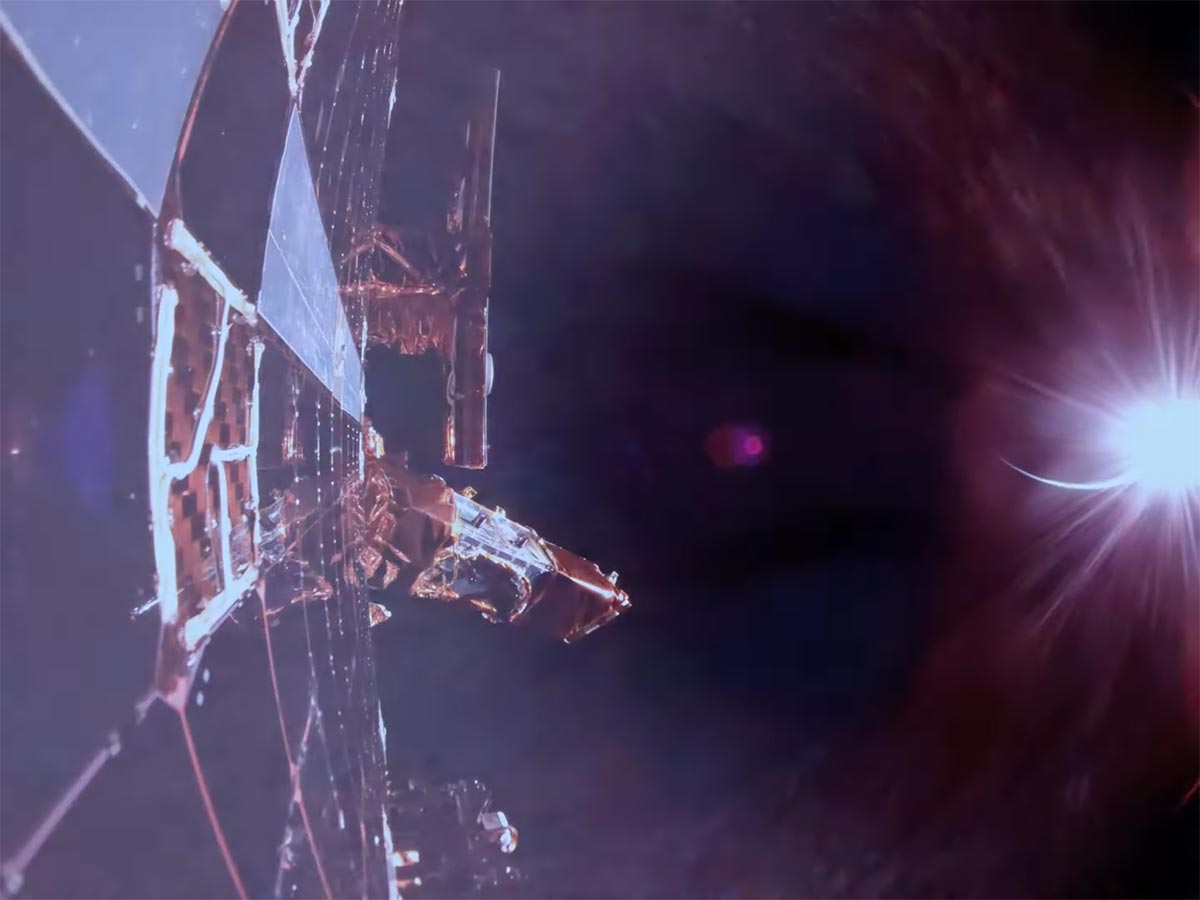
Blue Ghost, a lunar lander carrying 10 NASA instruments, successfully executed its first main engine burn as part of its 45-day journey to the Moon.
Firefly’s Blue Ghost lunar lander is making steady progress on its journey to the Moon, carrying 10 NASA science and technology instruments. Four days into the mission, it successfully completed its first main engine burn — an important step in a series of planned maneuvers that will guide the spacecraft toward the Moon. After spending 25 days orbiting Earth, Blue Ghost will embark on a four-day trip to reach lunar orbit. Once there, it will circle the Moon for 16 days before beginning its descent to the lunar surface as part of NASA’s Artemis campaign.
Jointly developed by NASA and the Italian Space Agency, the Lunar GNSS Receiver Experiment (LuGRE) technology demonstration acquired Global Navigation Satellite System (GNSS) signals, and calculated a navigation fix at nearly 52 Earth radii: more than 205,674 miles (331,000 kilometers) from Earth’s surface. This achievement suggests that Earth-based GNSS constellations can be used for navigation at nearly 90% of the distance to the Moon, an Earth-Moon signal distance record. It also demonstrates the power of using multiple GNSS constellations together, such as GPS and Galileo, to perform navigation. Throughout its journey, LuGRE will continue expanding our knowledge of Earth-based navigation systems in space as it acquires and tracks signals on its way to the Moon, during lunar orbit, and for up to two weeks on the lunar surface.
During this Earth transit phase, the Firefly mission team has continued to ensure the spacecraft remains healthy. The most recent visuals from space include footage of Earth eclipsing the Sun.
Never miss a breakthrough: Join the SciTechDaily newsletter.
Follow us on Google and Google News.