
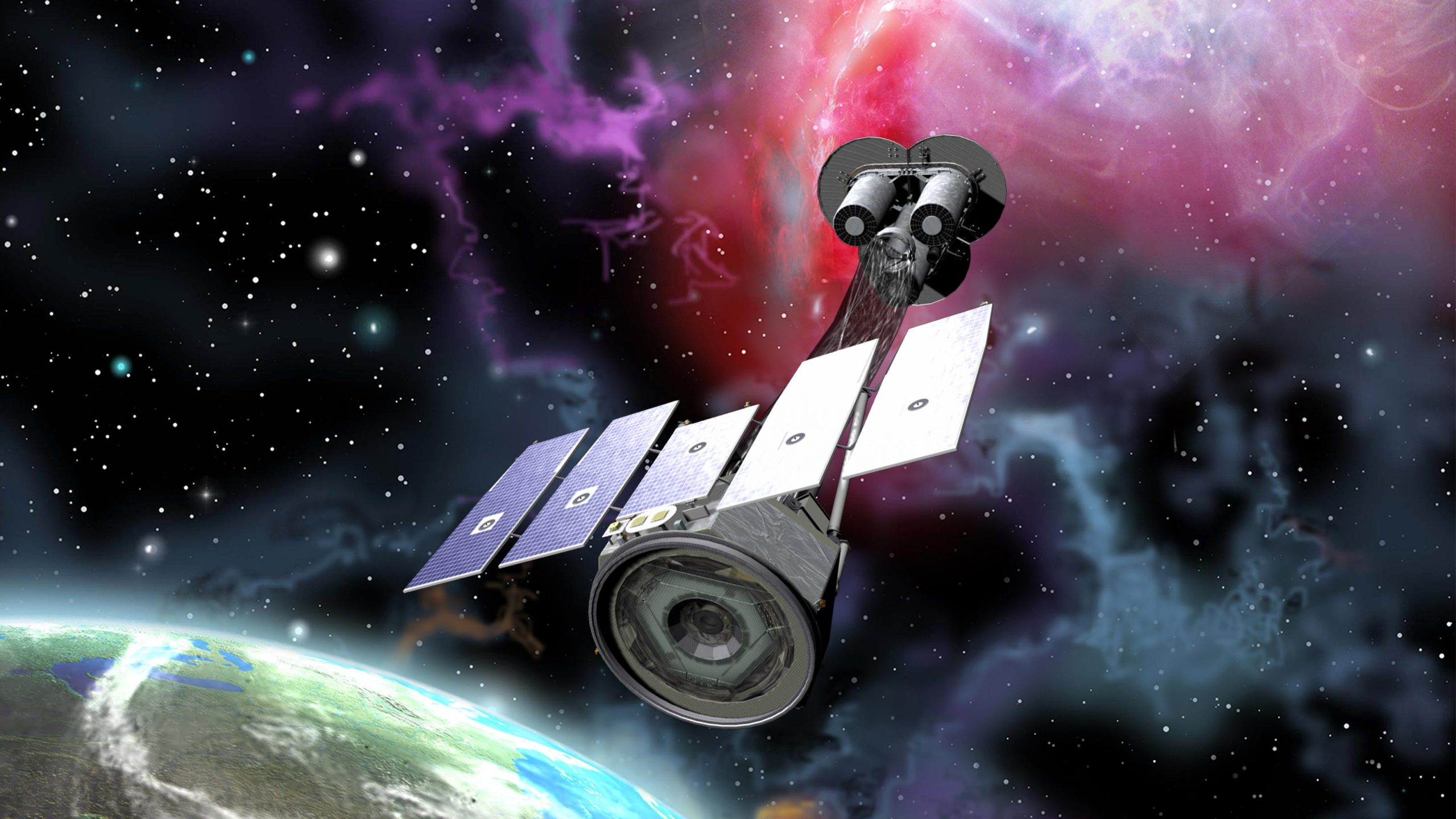
NASA’s IXPE has released its first image, focusing on Cassiopeia A. By studying X-ray polarization, IXPE will offer new insights into supernova remnants, revealing how X-rays are produced and providing key data about extreme cosmic environments.
NASA’s Imaging X-Ray Polarimetry Explorer, which launched December 9, 2021, has delivered its first imaging data since completing its month-long commissioning phase.
All instruments are functioning well aboard the observatory, which is on a quest to study some of the most mysterious and extreme objects in the universe.
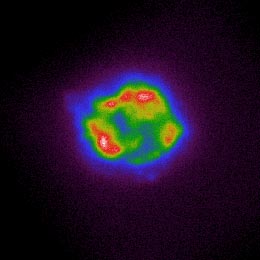
IXPE first focused its X-ray eyes on Cassiopeia A, an object consisting of the remains of a star that exploded in the 17th century. The shock waves from the explosion have swept up surrounding gas, heating it to high temperatures and accelerating cosmic ray particles to make a cloud that glows in X-ray light. Other telescopes have studied Cassiopeia A before, but IXPE will allow researchers to examine it in a new way.

Comparison with Chandra Observatory Data
In the image above, the saturation of the magenta color corresponds to the intensity of X-ray light observed by IXPE. It overlays high-energy X-ray data, shown in blue, from NASA’s Chandra X-Ray Observatory. Chandra and IXPE, with different kinds of detectors, capture different levels of angular resolution, or sharpness. An additional version of this image is available showing only IXPE data. These images contain IXPE data collected from January 11 to 18.
After Chandra launched in 1999, its first image was also of Cassiopeia A. Chandra’s X-ray imagery revealed, for the first time, that there is a compact object in the center of the supernova remnant, which may be a black hole or neutron star.
“The IXPE image of Cassiopeia A is as historic as the Chandra image of the same supernova remnant,” said Martin C. Weisskopf, the IXPE principal investigator based at NASA’s Marshall Space Flight Center in Huntsville, Alabama. “It demonstrates IXPE’s potential to gain new, never-before-seen information about Cassiopeia A, which is under analysis right now.”
Polarization: IXPE’s Key Contribution
A key measurement that scientists will make with IXPE is called polarization, a way of looking at how X-ray light is oriented as it travels through space. The polarization of light contains clues to the environment where the light originated. IXPE’s instruments also measure the energy, the time of arrival, and the position in the sky of the X-rays from cosmic sources.
“The IXPE image of Cassiopeia A is bellissima, and we look forward to analyzing the polarimetry data to learn even more about this supernova remnant,” said Paolo Soffitta, the Italian principal investigator for IXPE at the National Institute of Astrophysics (INAF) in Rome.
With polarization data from Cassiopeia A, IXPE will allow scientists to see, for the first time, how the amount of polarization varies across the supernova remnant, which is about 10 light-years in diameter. Researchers are currently working with the data to create the first-ever X-ray polarization map of the object. This will reveal new clues about how X-rays are produced at Cassiopeia A.
“IXPE’s future polarization images should unveil the mechanisms at the heart of this famous cosmic accelerator,” said Roger Romani, an IXPE co-investigator at Stanford University. “To fill in some of those details, we’ve developed a way to make IXPE’s measurements even more precise using machine learning techniques. We’re looking forward to what we’ll find as we analyze all the data.”
IXPE launched on a Falcon 9 rocket from Cape Canaveral, and now orbits 370 miles (600 kilometers) above Earth’s equator. The mission is a collaboration between NASA and the Italian Space Agency with partners and science collaborators in 12 countries. Ball Aerospace, headquartered in Broomfield, Colorado, manages spacecraft operations.
Never miss a breakthrough: Join the SciTechDaily newsletter.
Follow us on Google and Google News.
2 Comments
Very Interesting.
Some initial thoughts and suggestions for consideration
1. Photons which are a quanta of electromagnetic Radiation (with no Mass) are called X-Rays or Gamma Rays depending on its energy. Instead of vague terms, can we get a more precise andunderstandable measurable scale of these Rongten Rays.
2. While on the subject of Rays from te Universe, we need a well defined and undetandable scale , similarly defined for Cosmic Rays, which are high energy particles with intrinsic mass. They should be called CosmicParticles.
3. In Order to Get a better undersanding of the Cassiopea event, we may need more than just a X-Ray Telescope. We may need a telescope to get a fix on the Cosmic Rays (Particle – Rays) emanating from the same event and measure the eenrgy of the same. I am sure Cosmic Rays Energy intensity will also fall in a range , which too needs to better defined.
4. I still dont undertand the process by which energy becomess matter and matterbecomes energy, Einsstien not withstading. Once we really understand this , Nuclear Fusion energy genertion should be a simple enough task with controlled Nuclear Chain Reactions.
Views espressed are pesonal and not binding on anyone.