
Close Menu
    Facebook X (Twitter) Instagram
    SciTechDaily
    • Biology
    • Chemistry
    • Earth
    • Health
    • Physics
    • Science
    • Space
    • Technology
    Facebook X (Twitter) Pinterest YouTube RSS
    SciTechDaily
    Home»Earth»NASA Maps Surface Changes From Recent California Earthquakes
    Earth

    NASA Maps Surface Changes From Recent California Earthquakes

    By Esprit Smith, Jet Propulsion LaboratoryJuly 10, 2019No Comments3 Mins Read
    Facebook Twitter Pinterest Telegram LinkedIn WhatsApp Email Reddit
    Share
    Facebook Twitter LinkedIn Pinterest Telegram Email Reddit
    NASA Maps Surface Changes From California Quakes
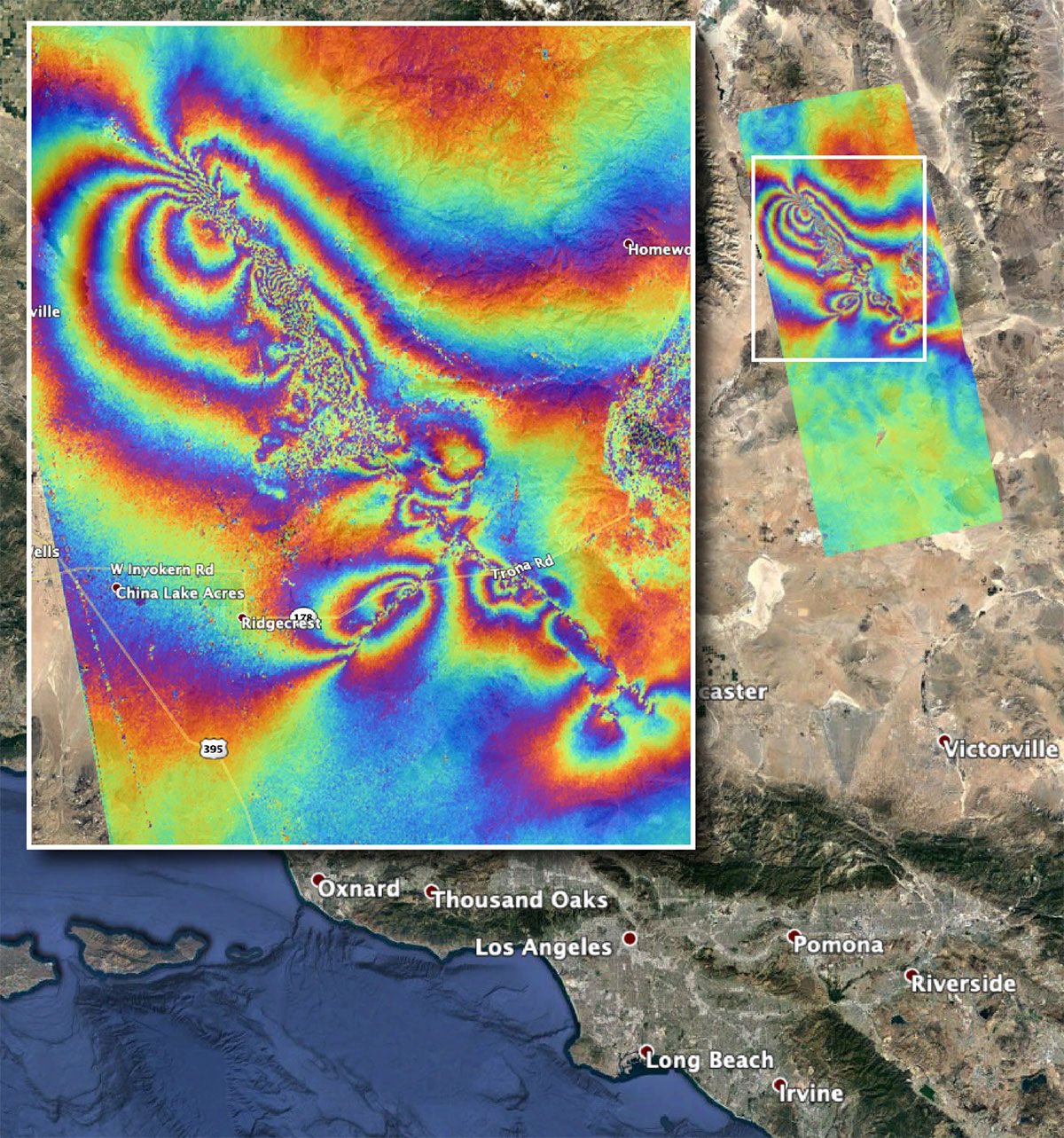
    NASA’s Advanced Rapid Imaging and Analysis (ARIA) team created this co-seismic Interferometric Synthetic Aperture Radar (InSAR) map, which shows surface displacement caused by the recent major earthquakes in Southern California, including the magnitude 6.4 and the magnitude 7.1 events on July 4 and July 5, 2019, respectively. Credit: NASA/JPL-Caltech

    Damage from two strong earthquakes that rattled Southern California on July 4 and July 5 — a magnitude 6.4 and a magnitude 7.1, respectively — can be seen from space. The epicenter of the quakes was near the city of Ridgecrest, about 150 miles (241 kilometers) northeast of Los Angeles. According to the U.S. Geological Survey, the 7.1 quake was one of the largest to hit the region in some 40 years.

    The Advanced Rapid Imaging and Analysis (ARIA) team at NASA’s Jet Propulsion Laboratory in Pasadena, California, used synthetic aperture radar (SAR) data from the ALOS-2 satellite to produce a map showing surface displacement from the earthquakes. The post-quake imagery was acquired on July 8, 2019, and compared with April 8, 2018, data from the same region.

    Each color cycle represents 4.8 inches (12 centimeters) of ground displacement either toward or away from the satellite. The linear features that cut the color fringes in the southeast indicate likely locations of surface rupture caused by the earthquakes, and the “noisy” areas in the northwest may indicate locations where the ground surface was disturbed by them.

    The USGS reported over 1,000 aftershocks in the region following the July 5 earthquake. State and federal scientists, including those from the California Geological Survey and USGS, are using this surface deformation map in the field for assessing the damages and mapping the faults that broke during the two major earthquakes as well as the thousands of aftershocks.

    In the aftermath of the earthquakes, NASA’s Earth Science Disasters Program is in communication with the California Earthquake Clearinghouse, which is coordinating response efforts with the California Air National Guard, the USGS, and the Federal Emergency Management Agency. NASA analysts are using data from satellites to produce visualizations of land deformation and potential landslides, among other earthquake impacts, and are making them available to response agencies. NASA’s Disasters Program promotes the use of satellite observations in predicting, preparing for, responding to, and recovering from disasters around the world.

    The Japanese Aerospace Exploration Agency (JAXA) provided the ALOS-2 data for the production of the map. The ARIA team’s analysis was funded by NASA’s Disasters Program.

    Never miss a breakthrough: Join the SciTechDaily newsletter.
    Follow us on Google and Google News.

    Earth Science
    Share. Facebook Twitter Pinterest LinkedIn Email Reddit

    Related Articles

    Nitrogen Deposits Increased 60% from the 1980s – 2000s in China

    River Formation Due to Interplay Between Incision and Soil Creep

    5-Mile Wide Buried Asteroid Crater Discovered in Canada

    Grand Canyon Thought to Be 65 Million Years Older Than Previous Estimates

    Unusual Indian Ocean Earthquakes May Signal Tectonic Breakup

    Impact of Plants on Cloud Formation and the Atmosphere

    Nitrogen Pollution Is Altering Sensitive Ecosystems

    Tropical Oceans Role in Climate Change

    Defects in Mantle Rocks Slow Down the Passage of Seismic Waves

    Leave A Reply Cancel Reply

    • Facebook
    • Twitter
    • Pinterest
    • YouTube

    Don't Miss a Discovery

    Subscribe for the Latest in Science & Tech!

    Trending News

    Popular Sugar-Free Sweetener Linked to Liver Disease, Study Warns

    What Is Hantavirus? The Deadly Disease Raising Alarm Worldwide

    Scientists Just Discovered How the Universe Builds Monster Black Holes

    Scientists Unveil New Treatment Strategy That Could Outsmart Cancer

    A Simple Vitamin May Hold the Key to Treating Rare Genetic Diseases

    Scientists Think the Real Fountain of Youth May Be Hiding in Your Gut

    Ravens Don’t Follow Wolves, They Predict Them

    This Common Knee Surgery May Be Doing More Harm Than Good

    Follow SciTechDaily
    • Facebook
    • Twitter
    • YouTube
    • Pinterest
    • Newsletter
    • RSS
    SciTech News
    • Biology News
    • Chemistry News
    • Earth News
    • Health News
    • Physics News
    • Science News
    • Space News
    • Technology News
    Recent Posts
    • Popular Supplement Ingredient Linked to Shorter Lifespan in Men
    • Scientists May Have Found a Way To Repair Nerve Damage in Multiple Sclerosis
    • GLP-1 Weight Loss Linked To Dramatically Lower Risk of Sleep Apnea, Kidney Disease and More
    • Scientists Uncover the Surprising Source of Strange Clouds Near the Milky Way’s Supermassive Black Hole
    • This Dazzling Green Snake Was Hiding in Plain Sight for Decades
    Copyright © 1998 - 2026 SciTechDaily. All Rights Reserved.
    • Science News
    • About
    • Contact
    • Editorial Board
    • Privacy Policy
    • Terms of Use

    Type above and press Enter to search. Press Esc to cancel.