
Close Menu
    Facebook X (Twitter) Instagram
    SciTechDaily
    • Biology
    • Chemistry
    • Earth
    • Health
    • Physics
    • Science
    • Space
    • Technology
    Facebook X (Twitter) Pinterest YouTube RSS
    SciTechDaily
    Home»Space»NASA: Progress on Giant SLS Moon Rocket, Close Encounter With Ganymede, and a Ring of Fire Eclipse
    Space

    NASA: Progress on Giant SLS Moon Rocket, Close Encounter With Ganymede, and a Ring of Fire Eclipse

    By NASAJune 14, 20213 Comments4 Mins Read
    Facebook Twitter Pinterest Telegram LinkedIn WhatsApp Email Reddit
    Share
    Facebook Twitter LinkedIn Pinterest Telegram Email Reddit
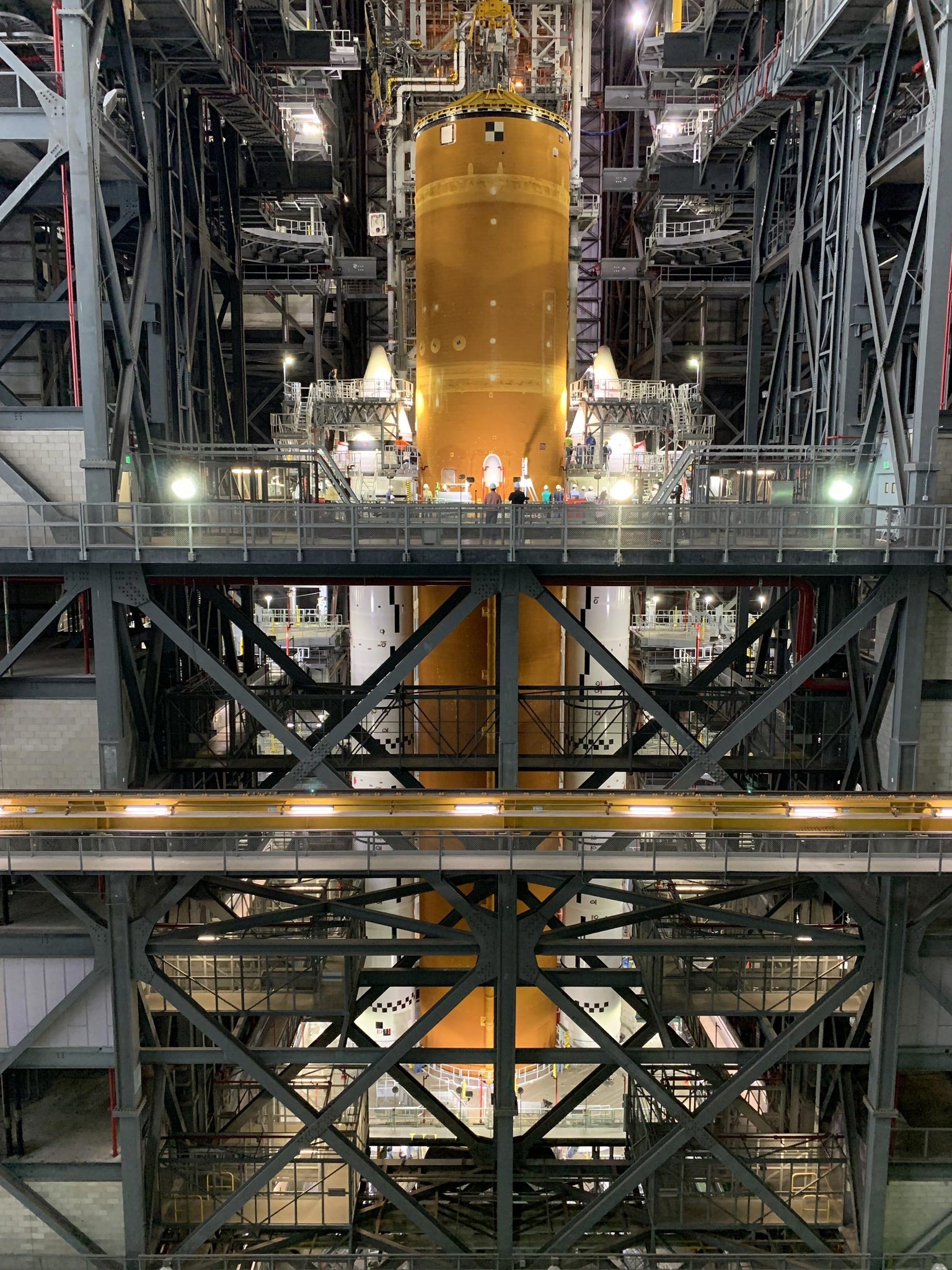
    SLS Core Stage Between Solid Rocket Boosters
    Space Launch System (SLS) rocket’s 188,000-pound core stage has been lifted onto the mobile launcher, in between the two solid rocket boosters. Credit: NASA

    Making progress on our Artemis Moon rocket, images from a close encounter with a Jovian moon, and a ring of fire for our Moon … a few of the stories to tell you about – This Week at NASA!

    Video Transcript:

    Making progress on our Artemis Moon rocket. Images from a close encounter with a Jovian moon. And a ring of fire for our Moon. A few of the stories to tell you about This Week at NASA!

    Stacking and assembly activities for the agency’s uncrewed Artemis I mission continue at our Kennedy Space Center.

    These activities involve lifting the Space Launch System (SLS) rocket’s 188,000-pound (85,000-kilogram) core stage onto the mobile launcher, in between the two solid rocket boosters.
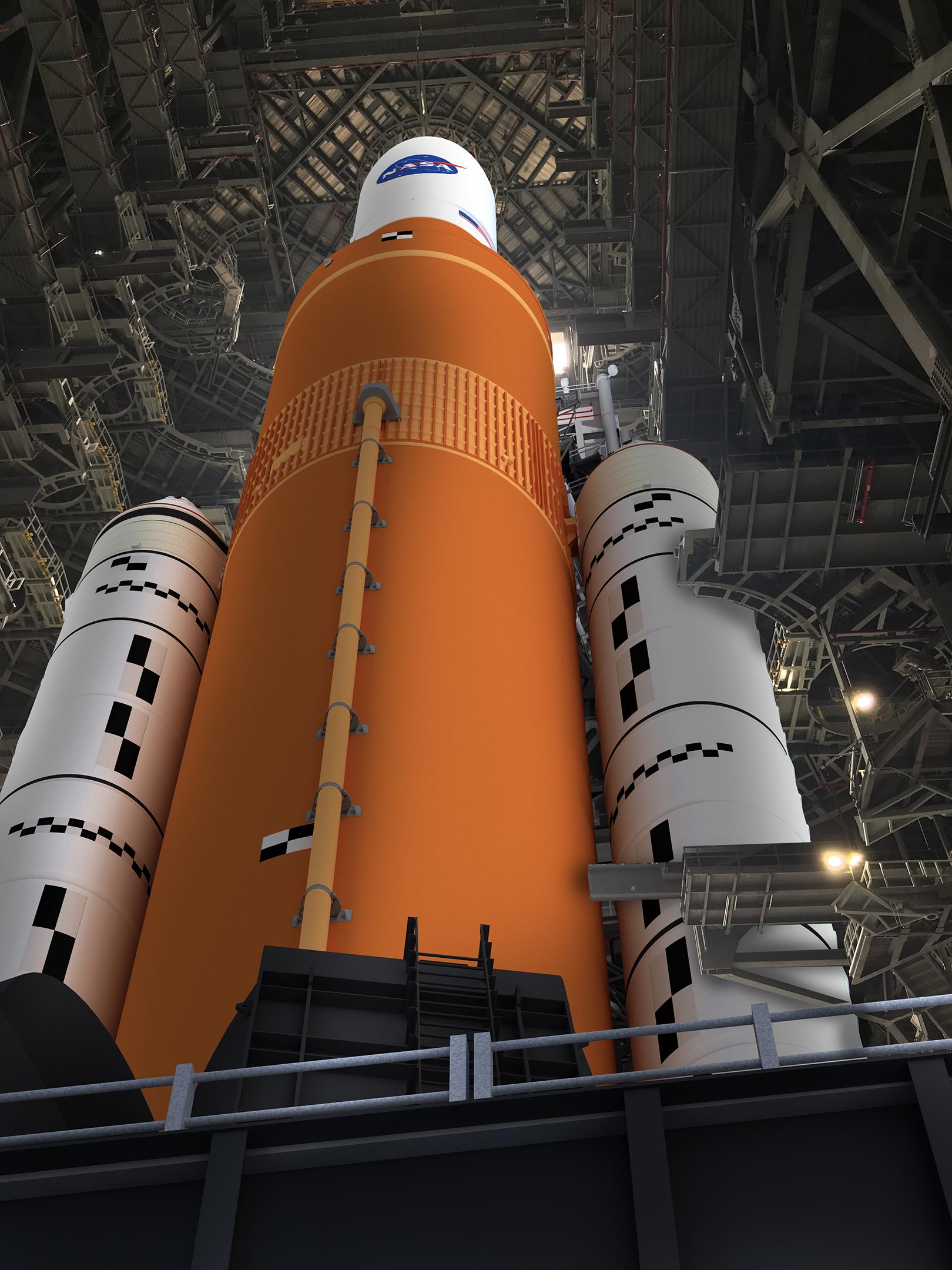
    SLS in Block 1 Cargo Configuration Inside VAB
    This illustration shows NASA’s Space Launch System (SLS) in its Block 1 configuration inside the Vehicle Assembly Building at NASA’s Kennedy Space Center in Florida. From top to bottom, the entire rocket measures about 312 feet high and has the capability of lifting payloads with a mass of more than 26 metric tons (57,000 pounds). Credit: NASA

    That will be followed by the stacking and integration of other elements, and eventually the addition of the Orion spacecraft.

    The twin solid rocket boosters and the core stage will provide more than 8.8 million pounds (4 million kilograms) of thrust during the launch of NASA’s next-generation Artemis Moon missions.
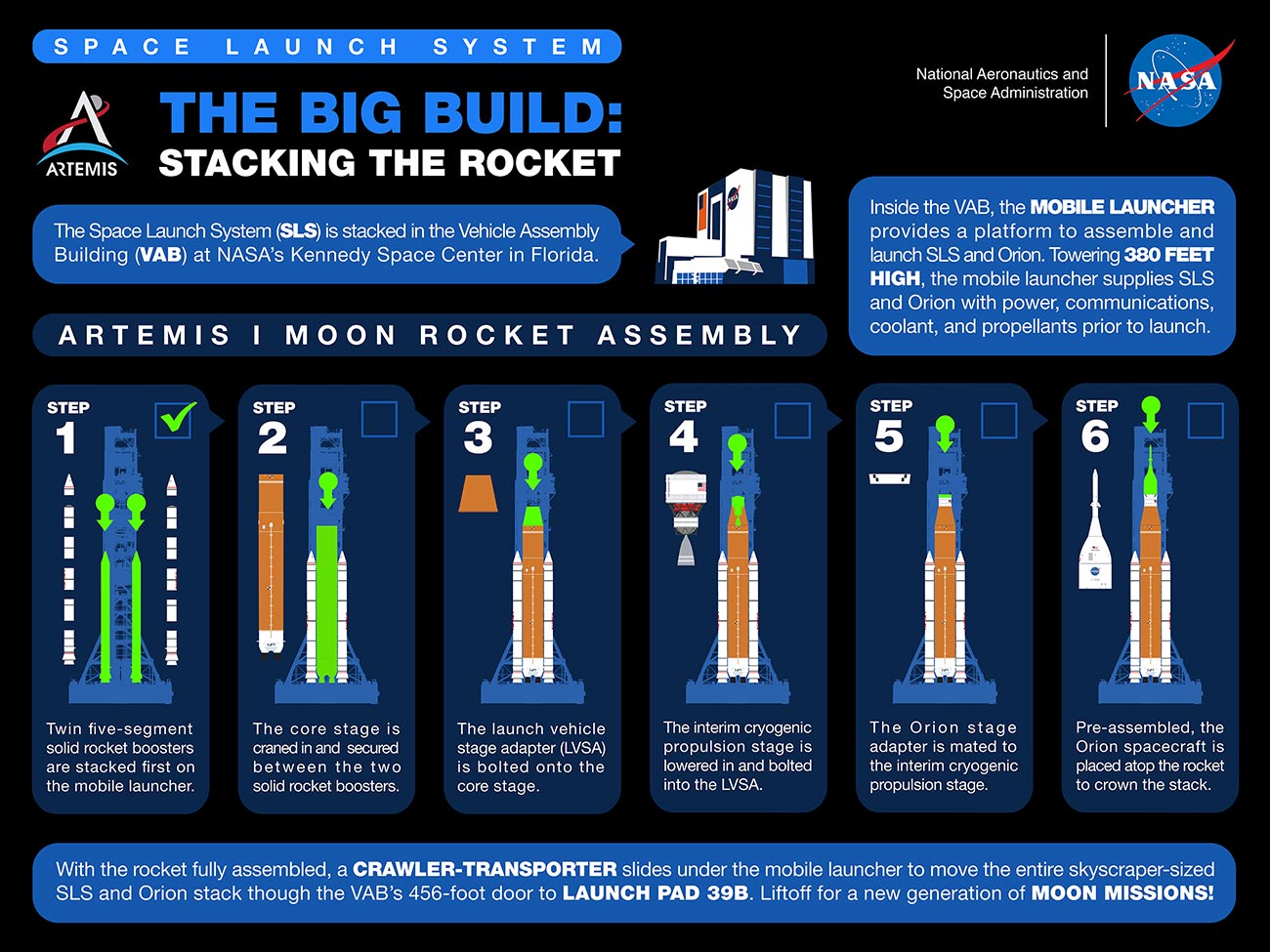
    SLS Big Build Stacking Rocket
    Before it launches from NASA’s Kennedy Space Center in Florida, the agency’s Exploration Ground Systems (EGS) and Jacobs teams at the spaceport stack the different elements of the SLS rocket on top of the mobile launcher inside the iconic Vehicle Assembly Building. So large that it’s a Florida Space Coast landmark, the VAB as well as the mobile launcher have been specially outfitted to accommodate SLS and Orion. Once fully assembled, the upgraded crawler-transporter will carry the skyscraper-sized duo to the launch pad for NASA’s next-generation Moon missions. Credit: NASA

    Our Juno mission sent back images after its June 7 flyby of Jupiter’s moon Ganymede, showing remarkable surface detail, including craters, distinct areas of dark and bright terrain, and features possibly linked to tectonic faults.

    The flyby is expected to yield insights into the moon’s composition and makeup, including measurements of its radiation environment that could benefit future missions to the Jovian system.

    Learn more about the mission at: nasa.gov/juno

    >> See the Dramatic First Images NASA’s Juno Spacecraft Captured As It Sailed by the Icy Orb, Ganymede

    On June 10, people across the northern hemisphere had a chance to experience an annular or a partial eclipse of the Sun.

    Canada, Greenland, and northern Russia experienced an annular eclipse, during which the alignment of the Moon, Sun, and Earth are such that there appears to be a ring of fire around the Moon.

    Elsewhere, including in parts of the eastern U.S. and northern Alaska, the Moon only blocked a smaller portion of the Sun.

    Find out more about eclipses at nasa.gov/eclipse.

    A SpaceX Dragon cargo spacecraft arrived at the International Space Station on June 5, two days after launching from our Kennedy Space Center.

    The Dragon delivered more than 7,300 pounds (3,300 kilometers) of cargo, including the new ISS Roll-out Solar Arrays (iROSA) for the station, a science experiment with squids that could help with protective measures to keep astronauts healthy on long-duration space missions, a study on microscopic organisms called water bears, that might help humans deal with the stress factors of human spaceflight, and more.

    This is SpaceX’s 22nd contracted commercial resupply mission to the station for NASA.

    On June 9, NASA announced that two teams of scientists from the Wake Forest Institute for Regenerative Medicine in Winston-Salem, North Carolina, are the first and second-place winners of the Vascular Tissue Challenge, a prize competition to grow and sustain functioning human tissue in a lab.

    On Earth and in space, improved lab-grown vascularized tissue could be used for better disease modeling and could accelerate related research for organ transplants, as well as the development of new therapeutics for long-term deep-space missions.

    The NASA TechRise Student Challenge is a new STEM education-based competition that will kick off for the 2021-22 school year for teams of sixth through 12th graders.

    The contest aims to inspire a deeper understanding of Earth’s atmosphere, space exploration, coding, and electronics, as well as a broader understanding of the value of test data.

    For more details check out nasa.gov/stem.

    That’s what’s up this week @NASA. For more on these and other stories, follow us on the web at nasa.gov/twan.

    Never miss a breakthrough: Join the SciTechDaily newsletter.
    Follow us on Google and Google News.

    ARTEMIS Mission Astronomy NASA Solar Eclipse Space Launch System
    Share. Facebook Twitter Pinterest LinkedIn Email Reddit

    Related Articles

    NASA’s Artemis II Is on the Launch Pad and the Moon Is Next

    NASA Fires Up RS-25 at 111% Power for Artemis Moon Launches

    212 Feet of Power: NASA’s Artemis II Rocket Fully Stacked for Moon Mission

    A Step Toward the Moon: NASA Gears Up for Artemis II Rocket Integration

    Massive SLS Rocket Test: NASA to Apply Millions of Pounds of Force to Try to Break Oxygen Tank Structure

    First Massive SLS Rocket Core Stage for NASA’s Artemis Completed and Loaded for Transport

    All Four Rocket Engines Attached to the SLS Core Stage for Artemis I Mission

    NASA Video of March 8 Solar Eclipse Totality

    NASA’s Orion Spacecraft Begins Critical Design Review

    3 Comments

    1. allen on June 14, 2021 3:16 pm

      what a terrible waste. we should not be building or using first stages that cannot be reused.

      Reply
    2. Tim on June 15, 2021 6:47 am

      A billion dollar aircraft that’s designed to crash on it’s maiden flight, and they’re so proud.

      Reply
      • William Adama on June 15, 2021 12:11 pm

        A) It’s a rocket, not an aircraft.
        B) Most of that “billion dollar” price tag stays on the ground, doing things like paying wages and salaries and developing new technologies. The actual cost of the hardware that lifts off the pad is a minute fraction of the “billion dollar” price tag.
        When you have a moment, look up “NASA Spin-offs” and see how much space-derived technology has flowed into the public domain since spaceflight began. Then have a think about how quickly our lives would change if all that technology were to suddenly disappear.

        Reply
    Leave A Reply Cancel Reply

    • Facebook
    • Twitter
    • Pinterest
    • YouTube

    Don't Miss a Discovery

    Subscribe for the Latest in Science & Tech!

    Trending News

    Popular Supplement Ingredient Linked to Shorter Lifespan in Men

    Scientists May Have Found a Way To Repair Nerve Damage in Multiple Sclerosis

    “Totally Unexpected” – Scientists Discover Pancreatic Cancer’s Fatal Addiction

    A Strange Quantum Effect May Explain One of Biology’s Greatest Mysteries

    James Webb Telescope Reveals the Universe’s Hidden Cosmic Web in Stunning Detail

    Scientists Identify Simple Supplement That Greatly Reduces Alzheimer’s Damage

    You May Have a Dangerous Type of Cholesterol Even if Your Tests Look Normal

    Your Blood Pressure Reading Could Be Wrong Because of One Simple Mistake

    Follow SciTechDaily
    • Facebook
    • Twitter
    • YouTube
    • Pinterest
    • Newsletter
    • RSS
    SciTech News
    • Biology News
    • Chemistry News
    • Earth News
    • Health News
    • Physics News
    • Science News
    • Space News
    • Technology News
    Recent Posts
    • Scientists Say a 40-Year-Old Childhood Obesity Warning May Be Completely Wrong
    • Marijuana Use May Raise Lung Cancer Risk, Researchers Warn
    • This Common Type of Food May Be Raising Your Risk of Heart Disease
    • Fur Seals’ Hearts Suddenly Spike Hours After Returning to Land
    • Scientists Say Cognitive Decline Isn’t Inevitable — Your Brain Can Improve at Any Age
    Copyright © 1998 - 2026 SciTechDaily. All Rights Reserved.
    • Science News
    • About
    • Contact
    • Editorial Board
    • Privacy Policy
    • Terms of Use

    Type above and press Enter to search. Press Esc to cancel.