
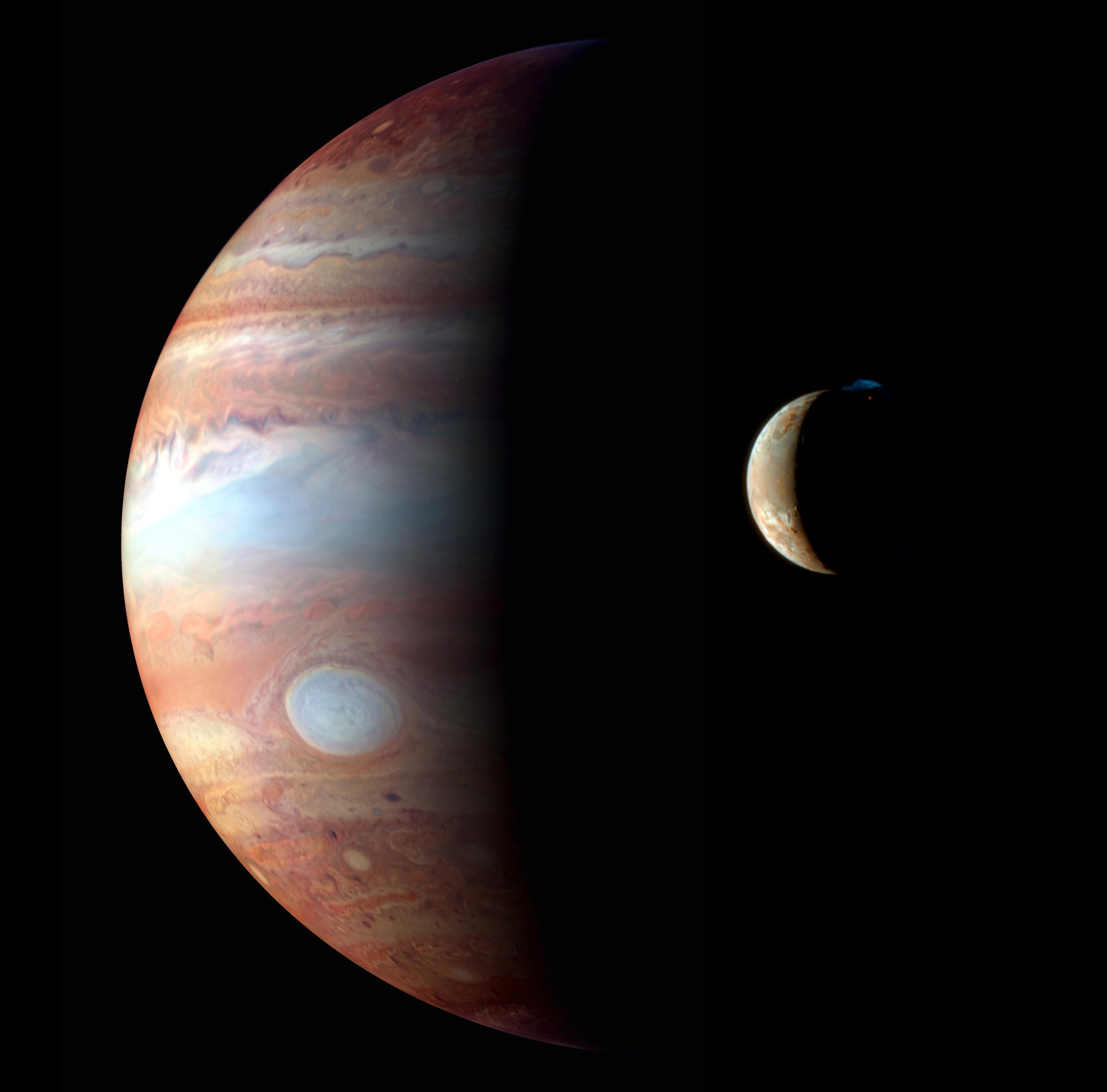
Using data from New Horizons Jupiter flyby, astronomers have discovered evidence of a type of atmospheric wave that had long been proposed but had not been identified in images before now.
In the clouds of Jupiter, scientists have found evidence of a type of atmospheric wave that had long been proposed but had not been identified in images before now.
Researchers consider this kind of wave, called a Kelvin wave, a fundamental part of a planetary atmosphere, so the absence of one on Jupiter has long been a mystery. In Earth’s atmosphere, Kelvin waves are involved in a tropical wind pattern whose influence can reach as far as the polar vortex.
“Scientists had looked for this type of wave in images of Jupiter from other missions, without luck,” said Amy Simon, a planetary scientist at NASA’s Goddard Space Flight Center in Greenbelt, Maryland. “Sometimes, we found a different type of wave. Other times, we couldn’t be sure we had a wave at all.”
The presence of Jupiter’s wave was indicated by a series of banded clouds, spotted in images obtained by the Ralph multispectral imager when NASA’s New Horizons spacecraft flew by the planet in 2007. The striking pattern of light and dark stripes was captured in a series of images, allowing researchers to determine the extent and speed of the wave. At that time, the team determined that the pattern stretched through the entire area visible to the imager (about one-quarter of the circumference at the equator) and probably went all the way around the planet.
In a new analysis of those images, a trio of researchers from NASA and the University of Houston has calculated that the wave was moving at about 367 to 393 miles per hour (164 to 176 meters per second). This is slower than previously thought but still much faster than the already speedy background winds near the equator. The pattern appears to cast shadows, which may indicate that it is higher in the troposphere than the other clouds, or possibly in the stratosphere.

When the New Horizons images were first studied, scientists had classified the feature as a gravity-inertia wave, but the newer analysis indicates that a Kelvin wave is more likely. The wavelength in this case is about 186 miles (300 kilometers), which is short compared to Kelvin waves in Earth’s atmosphere.
The researchers looked for evidence of small-scale waves in Jupiter images from other missions. Such a pattern would not be big enough to show up in images taken by Hubble, the researchers determined. The Cassini spacecraft should have been able to see this kind of feature, but images from those flybys don’t contain evidence of a similar wave. Much smaller groups of waves show up in images taken when the Voyagers flew by and when Galileo orbited the planet, but they occur further from the equator than expected for a Kelvin wave.
The structure of a Kelvin wave is determined by a balance between the Coriolis force generated by the planet’s rotation and a boundary of some kind. In Earth’s oceans, that boundary could be the coastline. In a planet’s atmosphere, the zone near the equator serves as a boundary.
In Earth’s atmosphere, Kelvin waves contribute to the quasi-biennial oscillation, a pattern of tropical winds in the stratosphere. About every two to three years, the wind shifts from easterly to westerly – accompanied by changes in temperature – and back again. The influence of this pattern sometimes can be felt as far away as the northern or southern polar vortex.
An analogous pattern of global winds and temperatures has been found in Jupiter’s stratosphere. This pattern, the quasi-quadrennial oscillation, repeats every four to five Earth years. A similar pattern on Saturn repeats roughly every 15 Earth years.
“The situation is more complicated on Earth because of the large land masses, seasons, and other factors,” said Simon. “But we can use Jupiter almost like a lab experiment in this case. We can show that the oscillating pattern can be forced with the wave motions alone.”
This research is available online in Geophysical Research Letters.
This work was funded in part by NASA’s Planetary Atmospheres Program. The Johns Hopkins University Applied Physics Laboratory (APL) manages the New Horizons mission for NASA’s Science Mission Directorate in Washington. Alan Stern of the Southwest Research Institute, headquartered in San Antonio, is the principal investigator and leads the mission. New Horizons is part of the New Frontiers Program managed by NASA’s Marshall Space Flight Center in Huntsville, Alabama. APL designed, built, and operates the spacecraft.
Reference: “Small-scale waves on Jupiter: A reanalysis of New Horizons, Voyager, and Galileo data” by A. A. Simon, L. Li and D. C. Reuter, 28 March 2015, Geophysical Research Letters.
DOI: 10.1002/2015GL063433
Never miss a breakthrough: Join the SciTechDaily newsletter.
Follow us on Google and Google News.