
Exploring Supermassive Black Hole Jets with NASA Simulations
NASA Goddard Space Flight Center scientists ran 100 sophisticated simulations exploring jets — narrow beams of energetic particles — that emerge at nearly light speed from supermassive black holes. These behemoths sit at the centers of active, star-forming galaxies like our own Milky Way galaxy, and can weigh millions to billions of times the mass of the Sun. To perform the highly complex simulations the scientists leveraged the Discover supercomputer at the NASA Center for Climate Simulation (NCCS).
As jets and winds flow out from these active galactic nuclei (AGN), they “regulate the gas in the center of the galaxy and affect things like the star-formation rate and how the gas mixes with the surrounding galactic environment,” explained study lead Ryan Tanner, a postdoc in NASA Goddard’s X-ray Astrophysics Laboratory.
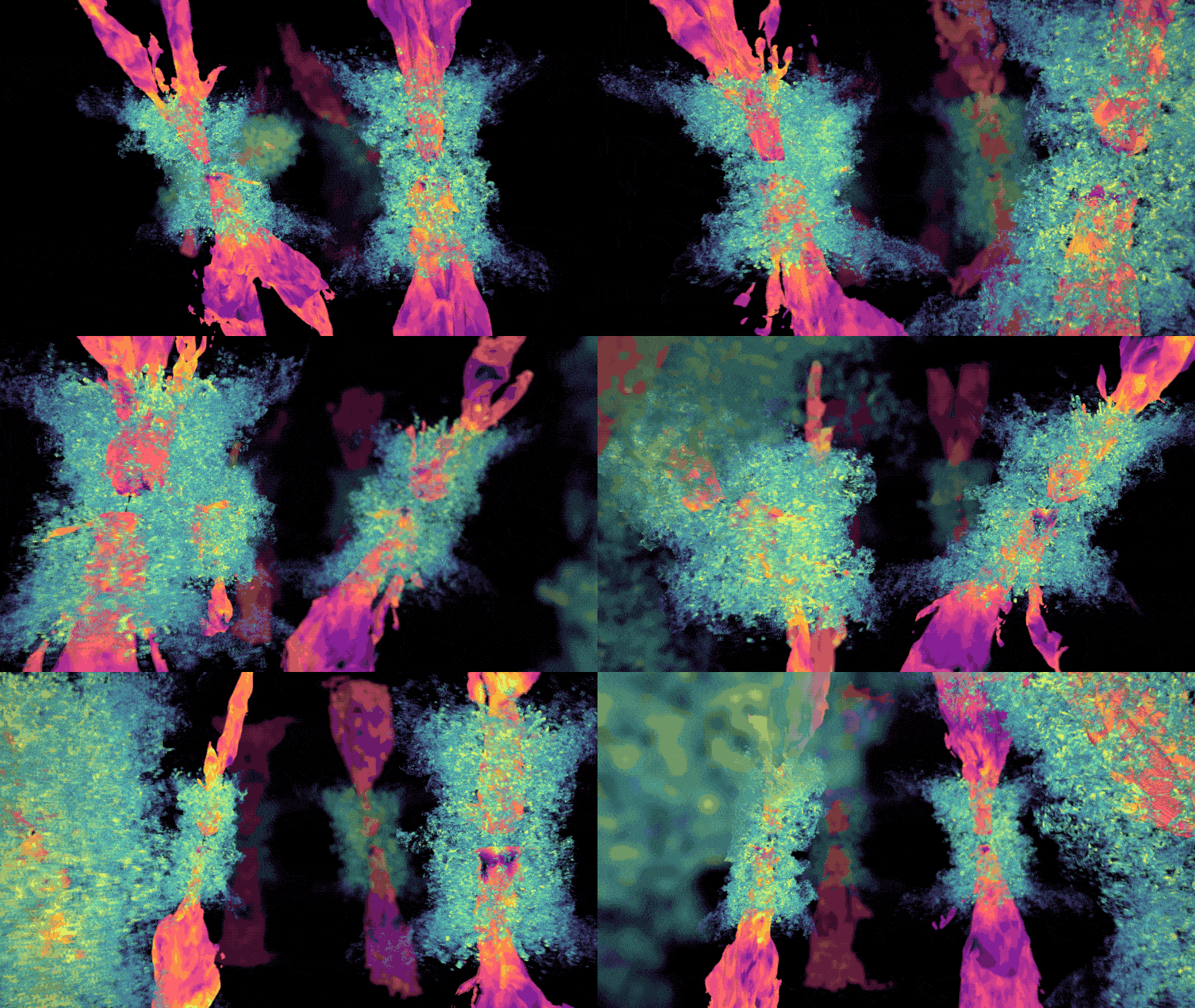
New simulations carried out on the NASA Center for Climate Simulation (NCCS) Discover supercomputer show how weaker, low-luminosity jets produced by a galaxy’s monster black hole interact with their galactic environment. Because these jets are more difficult to detect, the simulations help astronomers link these interactions to features they can observe, such as various gas motions and optical and X-ray emissions. Credit: NASA’s Goddard Space Flight Center
“For our simulations, we focused on less-studied, low-luminosity jets and how they determine the evolution of their host galaxies,” Tanner said. He collaborated with X-ray Astrophysics Laboratory astrophysicist Kimberly Weaver on the computational study, which was published earlier this year in The Astronomical Journal.
Observational evidence for jets and other AGN outflows first came from radio telescopes and later NASA and European Space Agency X-ray telescopes. Over the past 30 to 40 years, astronomers including Weaver have pieced together an explanation of their origin by connecting optical, radio, ultraviolet, and X-ray observations (see the next image below).
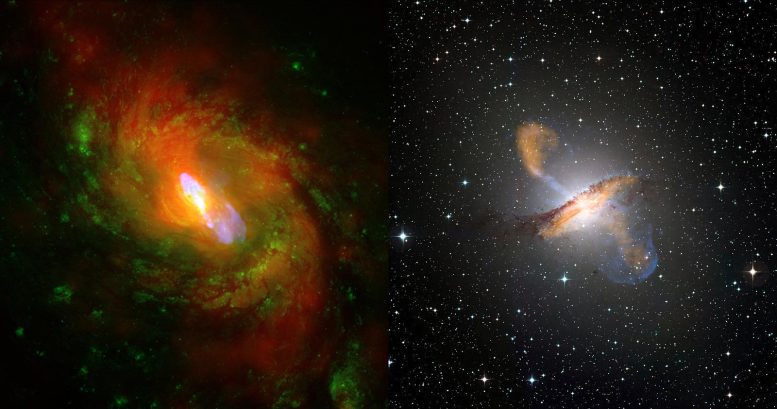
Centaurus A reveals particle jets extending far above and below the galaxy’s disk. Credit: ESO/WFI (optical); MPIfR/ESO/APEX/A.Weiss et al. (submillimeter); and NASA/CXC/CfA/R. Kraft et al. (X-ray)
“High-luminosity jets are easier to find because they create massive structures that can be seen in radio observations,” Tanner explained. “Low-luminosity jets are challenging to study observationally, so the astronomy community does not understand them as well.”
Enter NASA supercomputer-enabled simulations. For realistic starting conditions, Tanner and Weaver used the total mass of a hypothetical galaxy about the size of the Milky Way. For the gas distribution and other AGN properties, they looked to spiral galaxies such as NGC 1386, NGC 3079, and NGC 4945.
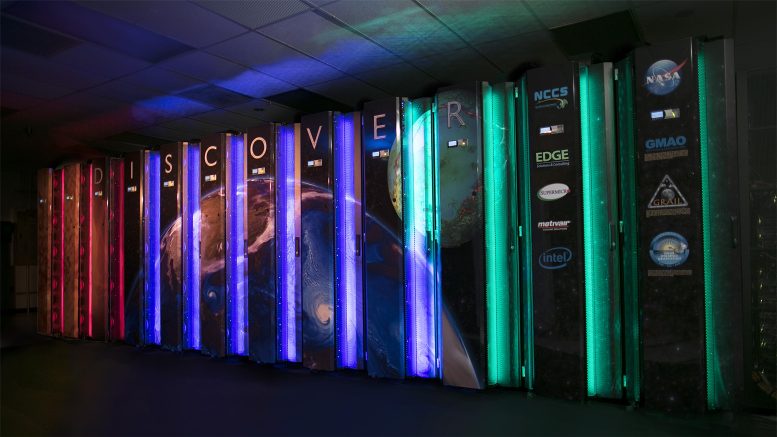
Tanner modified the Athena astrophysical hydrodynamics code to explore the impacts of the jets and gas on each other across 26,000 light-years of space, about half the radius of the Milky Way. From the full set of 100 simulations, the team selected 19 — which consumed 800,000 core hours on the NCCS Discover supercomputer — for publication.
“Being able to use NASA supercomputing resources allowed us to explore a much larger parameter space than if we had to use more modest resources,” Tanner said. “This led to uncovering important relationships that we could not discover with a more limited scope.”

The simulations uncovered two major properties of low-luminosity jets:
- They interact with their host galaxy much more than high-luminosity jets.
- They both affect and are affected by the interstellar medium within the galaxy, leading to a greater variety of shapes than high-luminosity jets.
Impact: These simulations demonstrate that interactions between jets and their host galaxies can explain regions of optical and X-ray emissions, as well as a variety of gas motions, observed in some active galactic nuclei (AGN).
“We have demonstrated the method by which the AGN impacts its galaxy and creates the physical features, such as shocks in the interstellar medium, that we have observed for about 30 years,” Weaver said. “These results compare well with optical and X-ray observations. I was surprised at how well theory matches observations and addresses longstanding questions I have had about AGN that I studied as a graduate student, like NGC 1386! And now we can expand to larger samples.”
This visualization shows the complex structure of an active galaxy’s jet (orange and purple) disrupted by interstellar molecular clouds (blue and green). With the jet oriented 30 degrees toward the galaxy’s central plane, more extensive interaction with the galaxy’s stars and gas clouds has caused the jet to split in two. Credit: Visualization by Ryan Tanner and Kim Weaver, NASA Goddard
Reference: “Simulations of AGN-driven Galactic Outflow Morphology and Content” by Ryan Tanner and Kimberly A. Weaver, 17 February 2022, The Astronomical Journal.
DOI: 10.3847/1538-3881/ac4d23
Never miss a breakthrough: Join the SciTechDaily newsletter.
Follow us on Google and Google News.
1 Comment
Gosh, so much time and energy for something that will be meaningless in 6 months. All of Cosmology is pure bulls***. Waste of money. How about changing your degree to “how to feed the poor” you useless f***