
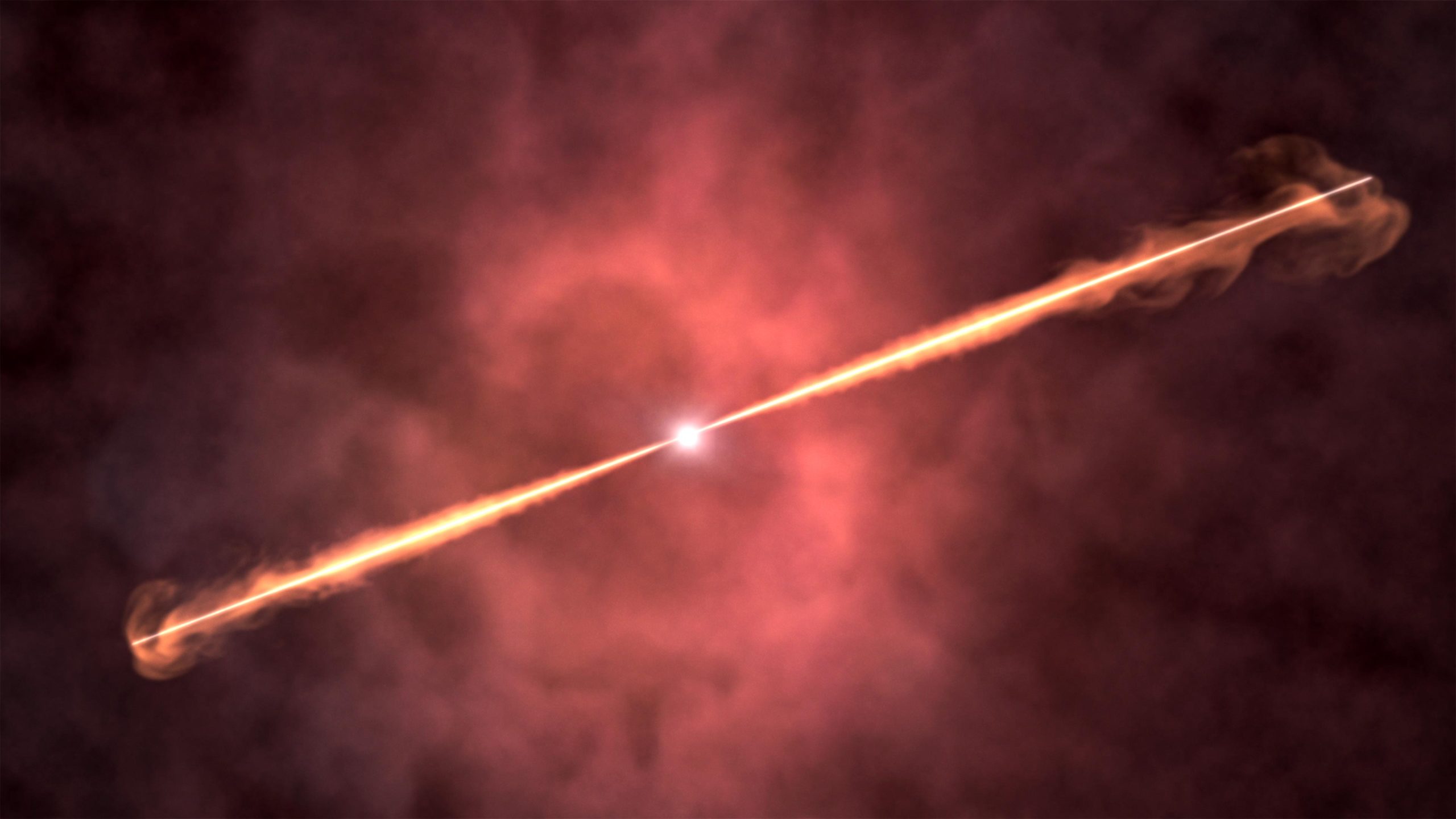
Astronomers witnessed the BOAT, the brightest cosmic event ever recorded, demonstrating the power of Time-Domain and Multimessenger Astronomy. This event and others like it offer insights into the universe’s dynamic processes and the role of collaboration in scientific discovery.
Stephen Lesage’s phone started vibrating just after halftime on October 9, 2022, while he was watching a soccer game in Atlanta with a friend. When Lesage saw the incoming messages, the match no longer seemed important. There had been a rare cosmic event, and he needed to get to his computer immediately.
NASA’s Fermi Gamma-Ray Satellite and Neil Gehrels Swift Observatory had spotted an unusually bright signal in space, and sent automatic alerts to scientists. Lesage’s team’s Fermi chat channel lit up with messages as scientists coordinated their follow-up strategy.
“Everyone in that group was like, ‘this thing’s crazy! Who’s on duty to analyze this? This is what we’ve been waiting for,’” Lesage, a graduate student at the University of Alabama, Huntsville, recalled. “Time to go!”
The unusual event turned out to be a cosmic burst that may have been the brightest at X-ray and gamma-ray energies since civilization began. Astronomers dubbed it the BOAT, “the brightest of all time.” Lesage led an analysis of Fermi data that demonstrated just how bright the BOAT really was. More than 150 telescopes in space and on Earth followed up to get more details of the event including NASA’s IXPE (Imaging X-ray Polarimetry Explorer), Hubble Space Telescope, and James Webb Space Telescope, as well as the European Space Agency’s XMM-Newton telescope.
The Universe Is Changing
The BOAT is an example of what astronomers call Time-Domain and Multimessenger Astronomy. The “Time Domain” part refers to events that happen in the universe that telescopes can observe as they unfold, such as a supernova or the merger of two neutron stars. “Multimessenger Astronomy” refers to the variety of “messengers” that deliver information from the universe, including all forms of light, high-energy particles, and ripples in spacetime called gravitational waves.
While the universe may seem like it changes extremely slowly, over millions or even billions of years, its celestial occupants do sometimes produce dramatic changes on the order of days or even fractions of seconds. Galactic centers brighten as their central black holes eat material. Black holes siphon plasma from nearby stars. Stars explode. Neutron stars collide with black holes, neutron stars collide with neutron stars, and black holes merge with black holes. Even distant crashes of celestial objects can send powerful ripples that can be detected by space- and ground-based telescopes and instruments. Many of these phenomena are unpredictable in terms of both where and when they might happen next.
NASA has two “watchdog” satellites with wide fields of view that send out alerts when they detect a sudden brightening of gamma rays: Fermi and Swift. Fermi’s Gamma-Ray Burst Monitor and Large Area Telescope, and Swift’s Burst Alert Telescope, are key instruments that might be the first to observe these events.
“When something impulsive happens, when something goes boom and explodes or something goes crunch and collapses, they trigger,” said Valerie Connaughton, who leads the high-energy astrophysics portfolio and the Time-Domain and Multimessenger Astronomy Initiative within the Astrophysics Division at NASA Headquarters in Washington.
Once scientists receive an alert on their computers and phones, they may be able to collaborate with other telescopes to follow up on the event. By using a variety of different space-based observatories and instruments to study these largely unpredictable flashes, scientists can piece together what, where, when, and why they observed a “blip” in the usual calm of space.
After comparing observations of the BOAT from numerous telescopes, scientists determined that this unusually bright burst came from a supernova and specifically, the core collapse of a massive star rotating rapidly. Later, with data from NASA’s NuSTAR mission, scientists found that the jet of material shooting out from the exploding star had a more complicated shape than they originally thought.
“A giant star just exploded, and we get to study it and figure out what happened, and reverse engineer the pieces and put it back together,” Lesage said.
“Time-domain astronomy lets us get fundamental answers on the properties of the universe, of fundamental physics itself, and the origin of the elements.”
Eric Burns, Astrophysicist, Louisiana State University
New Bright Signals
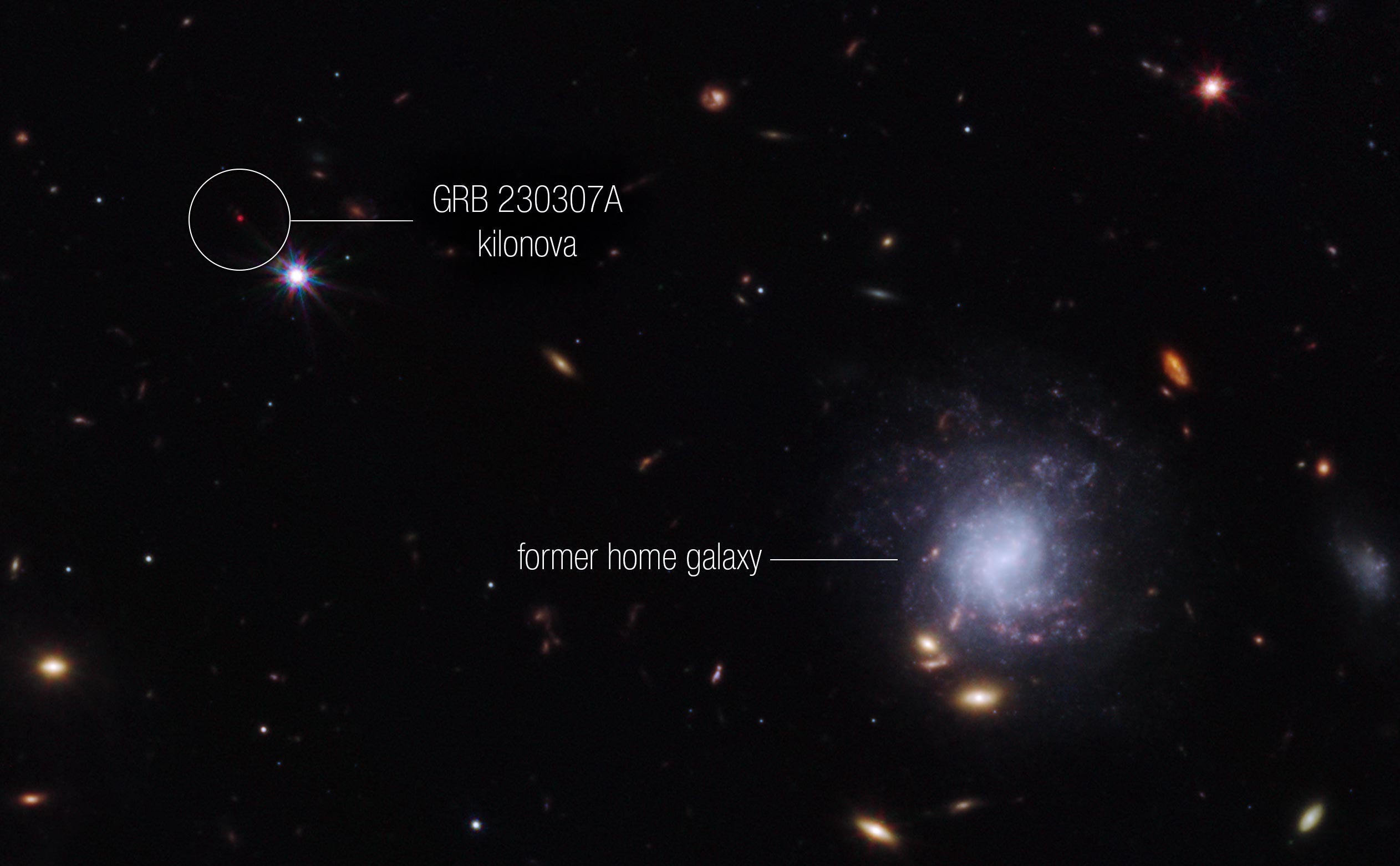
Just five months after the BOAT, scientists received an alert from Fermi about the second-brightest gamma-ray burst seen in the last 50 years. This newer signal, GRB 230307A, which happened in March 2023, joined the BOAT in the category of “long” gamma-ray bursts, lasting 200 seconds, compared to 600 for the BOAT. Thanks to infrared data from NASA’s James Webb Space Telescope, scientists determined that GRB 230307A may have had a very different origin: the merger of two neutron stars about a billion light-years away from Earth. What’s more, Webb detected the rare element tellurium, suggesting that neutron star mergers create heavy elements like this.
This result still puzzles astronomers such as Eric Burns, a co-author of the GRB 230307A paper and member of the Fermi team at Louisiana State University. Merging neutron stars shouldn’t produce such long gamma-ray bursts, and current models of atomic physics do not entirely explain the mid-infrared wavelengths that Webb detected. He hopes Webb will help us learn more about these kinds of events in the next few years.
“Time-domain astronomy lets us get fundamental answers on the properties of the universe, of fundamental physics itself, and the origin of the elements,” Burns said.
A Multitude of Messengers
Cosmic “messengers” associated with fleeting cosmic blips also help scientists reconstruct their origins. The initial 2015 discovery of gravitational waves by LIGO, the Laser Interferometer Gravitational-Wave Observatory, showed that the universe could be observed in a brand new way, and began a new era of possibility for using multiple messengers to study sudden blips in the universe.
In 2017, scientists demonstrated that potential by combining gravitational wave observations with data from many different ground and space-based observatories to study a kilonova, or neutron star merger, called GW170817. Among the insights from the extensive study of this kilonova, Burns and colleagues used it to make the first precise measurement of the speed of gravity, “the last major confirmation of a prediction from Einstein,” he said.
Today, the network of the U.S. NSF (National Science Foundation)-supported LIGO, Europe’s VIRGO, and Japan’s KAGRA looks out for gravitational wave events.
Doomed neutron stars whirl toward their demise in this illustration. Gravitational waves bleed away orbital energy, causing the stars to move closer together and merge. As they collide, some of the debris blasts away in particle jets moving at nearly the speed of light, producing a brief burst of gamma rays. Credit: NASA’s Goddard Space Flight Center/Conceptual Image Lab
Light is the only kind of “messenger” from the universe that has been detected for both the BOAT and the gamma-ray burst that seems to have produced tellurium. An experiment near the South Pole called IceCube, supported by the NSF, looked for high-energy neutrinos coming from the same area of the sky as each event, but did not find any. However, the lack of neutrinos observed helps scientists constrain the possibilities for how these events unfolded.
“This multimessenger approach is important, even when you don’t have a detection,” said Michela Negro, astrophysicist and assistant professor at Louisiana State University. “It really helps rule out some scenarios, on top of telling us something new when we have detections.”
A Bright Future
For Lesage, who is writing his dissertation about the BOAT, time-domain and multimessenger astronomy is an exciting area of study. The BOAT itself is still keeping him and other astronomers busy as they look at all of the processes revealed by the exceptionally bright light from this extreme event. But more transient events are sure to come, and will keep scientists on their toes as they chase after them with a wide variety of telescopes and instruments.
“That’s just transient events — look now or you’re going to miss it,” Lesage said. “Look as quickly as you possibly can.”
Further Reading: Telescopes on the Case
In the next few years, NASA will be launching new “watcher” satellites to help look out for sudden transient events like these. They include several CubeSats, which are a class of miniaturized spacecraft built in standardized units of cubes around 4 inches (10 cm) on a side:
- BurstCube, launching in March 2024, to monitor gamma-ray signals
- BlackCat, launching in 2025, to detect X-ray light
- StarBurst, launching in 2027, to monitor gamma-ray signals
International partnerships also involve this kind of science:
- ULTRASAT (Ultraviolet Transient Astronomy Satellite), a small satellite from the Israeli Space Agency and the Weizmann Institute of Science, with a wide field of view specializing in ultraviolet light, has NASA contributions. Expected to launch in 2026.
- ESA’s LISA (Laser Interferometer Space Antenna) mission, which would be the first time that gravitational waves could be detected from space, has NASA contributions. Expected to launch in the 2030s.
Additionally, NASA telescopes with other primary goals can help look out for these unusual events:
- Psyche, on its way to the metal-rich asteroid Psyche, has a gamma-ray spectrometer that astronomers can use to detect gamma-ray bursts as the spacecraft cruises toward its destination over the next several years.
- WISE, which mapped the sky at infrared wavelengths, found many new distant objects and cosmic phenomena. The NEOWISE mission, which reuses the WISE telescope, surveys near-Earth space for potentially hazardous asteroids.
- NASA’s Nancy Grace Roman Space Telescope, an infrared observatory that will illuminate longstanding mysteries of dark energy and discover thousands of exoplanets, is designed to have a wide view of the sky and will undoubtedly pick up on transient infrared signals. The observatory will do several surveys to look for these phenomena, and the mission will support many teams to study relevant topics ranging from variable stars, the birth of black holes and active galaxies. Roman is scheduled to launch by May 2027, and will also provide alerts about the changes in the sky it discovers.
- The NEO Surveyor mission will use infrared detectors to broaden the search for asteroids and comets that may pose a hazard to the Earth. The images to be taken by NEO Surveyor also are expected to capture many more distant background objects.
Never miss a breakthrough: Join the SciTechDaily newsletter.
Follow us on Google and Google News.
1 Comment
Maybe this answers Fermi’s Question “where are they?” They were exterminated by beams of radiation.