

Close Menu
    Facebook X (Twitter) Instagram
    SciTechDaily
    • Biology
    • Chemistry
    • Earth
    • Health
    • Physics
    • Science
    • Space
    • Technology
    Facebook X (Twitter) Pinterest YouTube RSS
    SciTechDaily
    Home»Science»Beyond Flint and Fire: The True Story of Stone Age Innovators
    Science

    Beyond Flint and Fire: The True Story of Stone Age Innovators

    By Nagoya UniversityFebruary 7, 2024No Comments4 Mins Read
    Facebook Twitter Pinterest Telegram LinkedIn WhatsApp Email Reddit
    Share
    Facebook Twitter LinkedIn Pinterest Telegram Email Reddit
    Neanderthal Stone Tools Concept
    Researchers propose a reevaluation of the cultural evolution of Homo sapiens during their dispersal across Eurasia, suggesting a gradual and complex process rather than a swift revolution. Their study challenges traditional views by focusing on the evolution of stone tool technology, indicating that significant innovations occurred after the initial dispersal of Homo sapiens, particularly with the development of bladelet technology. Credit: SciTechDaily.com

    Contrary to previous beliefs, significant advancements in stone tool technology emerged after, not before, Homo sapiens spread across Eurasia, marking a complex evolutionary journey.

    A study led by researchers at the Nagoya University Museum in Japan may change how we understand the cultural evolution of Homo sapiens at the time of their dispersal across Eurasia about 50,000 to 40,000 years ago. These findings challenge traditional beliefs about the timing and nature of cultural transitions during this critical period in human history.

    Published in Nature Communications, the researchers’ insights into stone tool technology suggest that the commonly held view of a ‘revolution’ in culture and technology that allowed anatomically modern humans to outcompete Neanderthals and other archaic humans was a more nuanced and complicated process of cultural evolution.

    The team of researchers focused on the Middle-Upper Paleolithic (MP-UP) cultural transition, an important boundary between two key phases in our evolution:

    • The Middle Paleolithic period (250,000 to 40,000 years ago) witnessed anatomically modern humans coexisting with Neanderthals and archaic humans existing at the same time. Culturally, anatomically modern humans and Neanderthals had similar stone tool technology, such as making tools using ‘Levallois methods’, which involved striking stones with a hammer-like tool.
    • The Upper Paleolithic period (50,000 and 12,000 years ago) is the period in which anatomically modern humans made wide geographic expansions, and archaic humans went extinct. During this period, new cultural elements emerged in various realms, including tool technology, food acquisition, seafaring, and artistic expression in ornaments and cave art.
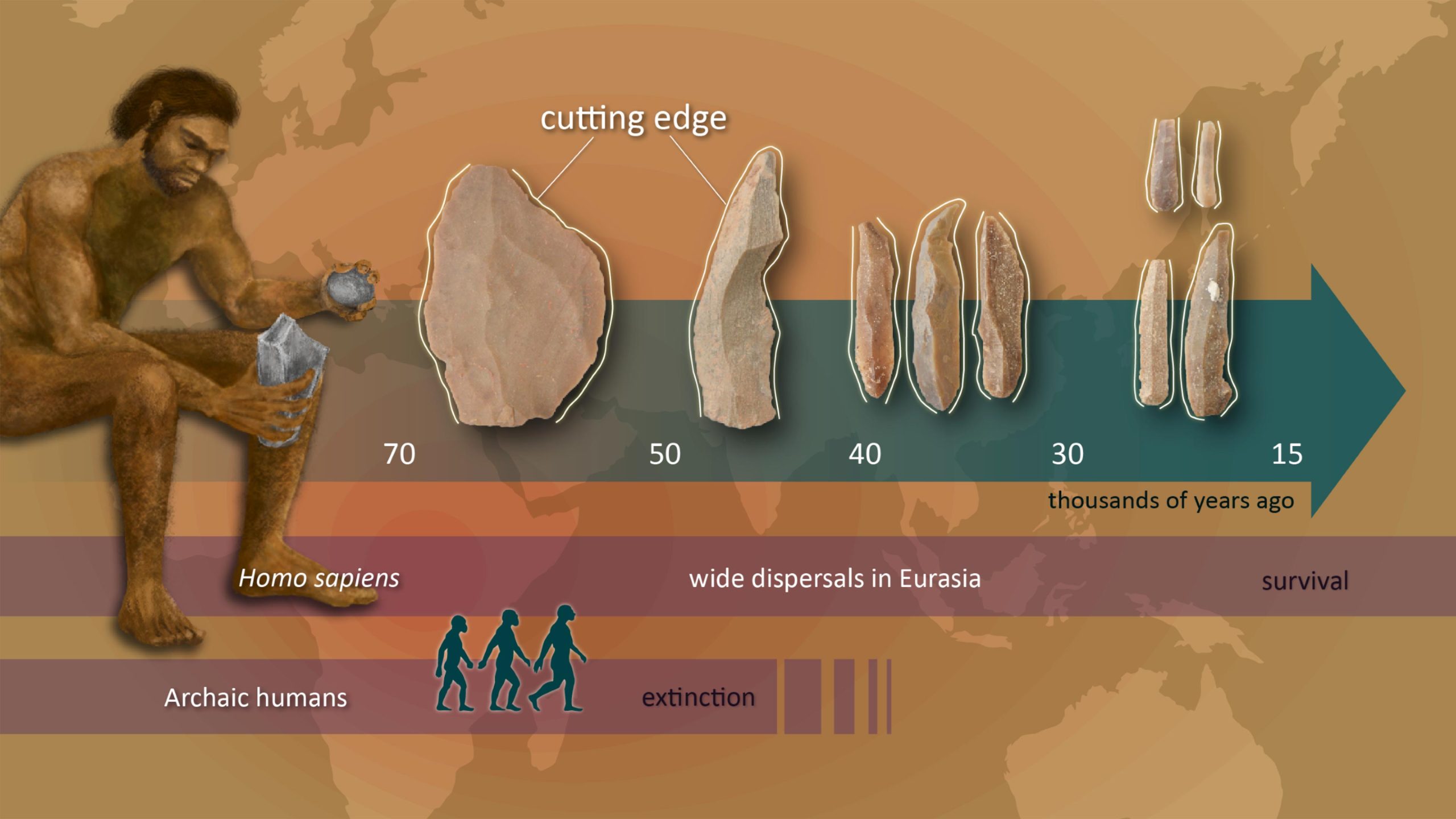
    Stone Tool Cutting-Edge Productivity Increase
    The increase in the productivity of stone tool cutting-edge (shown in white lines) did not occur before or at the beginning of Homo sapiens’ wide dispersals in Eurasia but subsequently occurred after their initial dispersals, coinciding with the development of bladelet technology in the Early Upper Paleolithic. Credit: Reiko Matsushita

    Traditionally, scholars viewed the MP-UP transition as an abrupt change marked by the revolutionary emergence of new cultural elements. An example is the hypothesized sudden neural mutation in Homo sapiens, which resulted in their superior cognitive abilities. This change allowed them to ultimately outcompete other archaic humans and drive the Neanderthals to extinction. However, this study challenges this paradigm.

    The researchers examined the productivity of stone tools with a cutting edge over a 50,000-year span that encompassed six cultural phases from the Late Middle Paleolithic, through the Upper Paleolithic, to the Epipaleolithic period. They discovered that the major increase in innovative productivity did not occur before or at the beginning of the widespread dispersal of Homo sapiens in Eurasia. Rather, it subsequently occurred after their initial dispersals, coinciding with the development of bladelet technology in the Early Upper Paleolithic.

    This result shows a complicated process of cultural change involving multiple stages rather than a single ‘revolution.’

    According to the lead researcher Professor Seiji Kadowaki, the cultural transition from the Middle to the Upper Paleolithic was a complex, evolutionary process involving multiple aspects and changes occurring over an extended period. He said, “In terms of cutting-edge productivity, Homo sapiens did not start to spread to Eurasia after a quick revolution in stone tool technology, but rather the innovation in the ‘cutting-edge’ productivity occurred later, in tandem with the miniaturization of stone tools like bladelets.”

    Reference: “Delayed increase in stone tool cutting-edge productivity at the Middle-Upper Paleolithic transition in southern Jordan” by Seiji Kadowaki, Joe Yuichiro Wakano, Toru Tamura, Ayami Watanabe, Masato Hirose, Eiki Suga, Kazuhiro Tsukada, Oday Tarawneh and Sate Massadeh, 7 February 2024, Nature Communications.
    DOI: 10.1038/s41467-024-44798-y

    Never miss a breakthrough: Join the SciTechDaily newsletter.
    Follow us on Google and Google News.

    Anthropology Nagoya University Neanderthals
    Share. Facebook Twitter Pinterest LinkedIn Email Reddit

    Related Articles

    Neanderthal and Early Modern Human Culture Co-existed Alongside Older Traditions for Over 100,000 Years

    Nuclear DNA From Cave Sediments Helps Unlock Ancient Human History

    Oldest Modern Human Genome Reconstructed Using DNA From 45,000-Year-Old Skull

    Archaeologists Discover Neanderthals and Homo sapiens Used Identical Nubian Technology

    Earliest Interbreeding Between Ancient Human Populations Discovered – Evolutionary Puzzle Solved

    What Caused Neanderthal Extinction and Were Our Human Ancestors to Blame?

    New Evidence Shows Humans Mastered Fire Earlier Than Thought

    Discovery Reveals That Neanderthals Were the First in Europe to Make Specialized Bone Tools

    Caves of Nerja Contain Earliest Human Drawings

    Leave A Reply Cancel Reply

    • Facebook
    • Twitter
    • Pinterest
    • YouTube

    Don't Miss a Discovery

    Subscribe for the Latest in Science & Tech!

    Trending News

    Your Blood Pressure Reading Could Be Wrong Because of One Simple Mistake

    Astronomers Stunned by Ancient Galaxy With No Spin

    Physicists May Be on the Verge of Discovering “New Physics” at CERN

    Scientists Solve 320-Million-Year Mystery of Reptile Skin Armor

    Scientists Say This Daily Walking Habit May Be the Secret to Keeping Weight Off After Dieting

    New Therapy Rewires the Brain To Restore Joy in Depression Patients

    Giant Squid Detected off Western Australia in Stunning Deep-Sea Discovery

    Popular Sugar-Free Sweetener Linked to Liver Disease, Study Warns

    Follow SciTechDaily
    • Facebook
    • Twitter
    • YouTube
    • Pinterest
    • Newsletter
    • RSS
    SciTech News
    • Biology News
    • Chemistry News
    • Earth News
    • Health News
    • Physics News
    • Science News
    • Space News
    • Technology News
    Recent Posts
    • New Stroke Study Challenges Decades-Old Medical Beliefs
    • These Simple Plant Foods Are Linked to Lower Blood Pressure
    • Common Blood Pressure Drug Supercharges Cancer Treatment in Surprising New Study
    • Key Magic Mushroom Ingredient Increases Laziness and Reduces Aggression
    • Researchers Solve 15-Year Mystery Behind Cancer-Causing Gut Toxin
    Copyright © 1998 - 2026 SciTechDaily. All Rights Reserved.
    • Science News
    • About
    • Contact
    • Editorial Board
    • Privacy Policy
    • Terms of Use

    Type above and press Enter to search. Press Esc to cancel.