

Close Menu
    Facebook X (Twitter) Instagram
    SciTechDaily
    • Biology
    • Chemistry
    • Earth
    • Health
    • Physics
    • Science
    • Space
    • Technology
    Facebook X (Twitter) Pinterest YouTube RSS
    SciTechDaily
    Home»Space»NASA VIPER: Artemis Moon Rover’s Wheels Are Ready To Roll
    Space

    NASA VIPER: Artemis Moon Rover’s Wheels Are Ready To Roll

    By Abby Tabor, NASA's Ames Research CenterJanuary 29, 20221 Comment5 Mins Read
    Facebook Twitter Pinterest Telegram LinkedIn WhatsApp Email Reddit
    Share
    Facebook Twitter LinkedIn Pinterest Telegram Email Reddit
    VIPER’s Wheel Maneuvers Over Rock
    VIPER’s wheel maneuvers over a rock during endurance testing for the rover’s wheels. To make the test as realistic as possible, the team used rare Earth rocks that most closely resemble the Moon’s. Their sizes, shapes, and placement in the test bed were carefully selected using real data about the distribution of lunar rocks, so the wheel would experience hitting rocks the way it will during VIPER’s mission. Credit: ProtoInnovations, LLC

    NASA’s VIPER rover wheels underwent rigorous testing in simulated lunar conditions, leading to final design adjustments for optimal performance on the Moon.

    A flat tire would be the last thing you would need on a trip to the Moon. Luckily, NASA’s water-hunting robot – bound for the lunar surface in 2023 – has no tires! However, the all-metal wheels of the Volatiles Investigating Polar Exploration Rover, or VIPER, will have to withstand a whole lot of rocking and rolling as they move across the rugged lunar surface. Before the rover’s design was finalized at its Critical Design Review, the endurance of its wheels had to undergo rigorous testing in the lab. The tests helped solidify plans for the wheels and gave engineers an opportunity to study its movements, in the name of designing even better mobility controls for future rovers.

    Using a Moon-mimicking set-up in the lab, the VIPER team tested one of the rover’s wheels over a three-week period. It clocked 25 miles of movement in a high-tech sandbox filled with lunar soil simulant, running through a battery of tests. They simulated slopes, wheel slips, and even the size, shape, and distribution of rocks the rover will encounter on the Moon.

    NASA VIPER Wheel
    A wheel from NASA’s Volatiles Investigating Polar Exploration Rover, or VIPER, is run through endurance testing in a test bed containing lunar soil simulant and some of the most Moon-like rocks on Earth, at ProtoInnovations in Pittsburgh. Credit: ProtoInnovations, LLC

    While NASA has considerable experience designing Mars rovers, engineers had to invent new technology for controlling VIPER’s wheels in the unexplored environment of the Moon’s South Pole.

    “Lunar regolith is fluffy due to the low gravity and lack of most weathering processes, and the particles are sharp like broken glass,” said Arno Rogg, a rover mobility system engineer at NASA’s Ames Research Center in California’s Silicon Valley. “Rocks of various sizes are scattered everywhere on the Moon’s surface. All that presented some real engineering challenges to designing a lightweight, performant, and robust wheel for the half-ton rover.”

    To test if their wheel was ready for the Moon, the team worked with ProtoInnovations of Pittsburgh. The robotics company, which also designed software controls for VIPER’s wheels, is working to improve rover driving ability in unknown and highly variable lunar terrain. Their work is supported by NASA’s Small Business Innovation Research and Small Business Technology Transfer program.
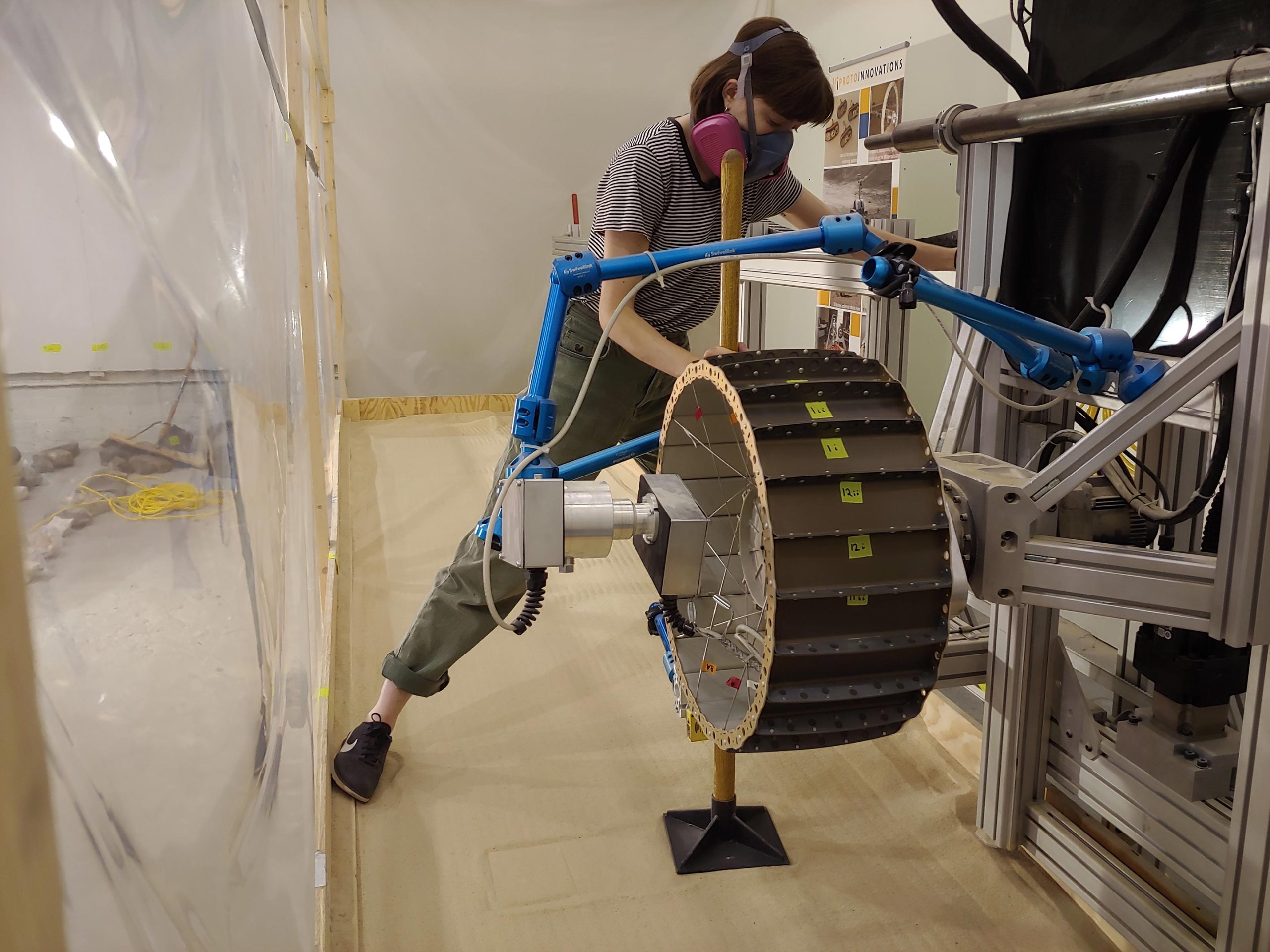
    Georgia Crowther Testing NASA VIPER Wheel
    Georgia Crowther, a robotics hardware engineer at ProtoInnovations, prepares the terrain for VIPER’s wheel to roll through a series of tests gauging its robustness and to study the rover’s mobility. The simulated lunar regolith, or soil, is tamped down to provide a consistent surface and a “clean slate” in which to study the wheel’s tracks, its traction performance, and how it maneuvers over rocks. Crowther wears a respirator mask because the particles in lunar regolith – and the simulated version – are abrasive. Credit: ProtoInnovations, LLC

    Simulating Lunar Conditions on Earth

    At the ProtoInnovations lab, engineers attached one of VIPER’s wheels to the narrow, 20-foot-long lunar sandbox equipped with measuring devices, cameras, and robotic controls for simulating slipping and sliding. The wheel rolled slowly back and forth under conditions that simulated as closely as possible what it will experience on the Moon.

    Well-defined slopes were created in the lunar soil simulant, and the wheel’s tracks were studied after any significant slip. Sensors let the team measure how much the wheel sank into the soil, its traction performance, and how it maneuvered over rocks.

    “Simulating on Earth the way the rover will move on the Moon required complicated robotic controls – but that’s what we do,” said Dimi Apostolopoulos, CEO of ProtoInnovations. “Our biggest challenge was picking just the right rocks to stand in for Moon rocks in the test bed.”

    Goldilocks Moon Rocks

    Actual samples of Moon rocks are, of course, too precious to use for a rover test drive, and the terrestrial stand-ins had to be just right. Too hard or too soft and they’d give a false impression of the challenge the rover will face.

    The team secured some of the rare Earth rocks that most closely resemble the Moon’s, and, by scaling down real data about the distribution of lunar rocks, learned how many of what size should be used in the test bed. They also learned how to space them so the wheel experienced hitting rocks the way it will during VIPER’s mission.

    In all, the wheel was put through 196 scenarios of different rock shapes, heights, and positions the rover is likely to find on the Moon.

    “Overall, the wheel’s performance was excellent,” said Rogg. “At the end of the test, both its physical condition and its behavior – looking especially at its traction – were only slightly degraded compared to when we started the test. By driving the wheel more than twice the distance it’s expected to travel on the lunar surface, we reduced the risk of any premature wheel failure occurring on the Moon.”

    Minor weaknesses detected in the wheels during testing were addressed by VIPER’s mechanical design team with improvements that went into the rover’s final design. VIPER will be delivered to the surface of the Moon in late 2023 as part of the Commercial Lunar Payload Services initiative.

    Never miss a breakthrough: Join the SciTechDaily newsletter.
    Follow us on Google and Google News.

    Ames Research Center Moon NASA VIPER
    Share. Facebook Twitter Pinterest LinkedIn Email Reddit

    Related Articles

    NASA’s VIPER Lunar Rover Prototype Motors Through Moon-Like Obstacle Course

    Lunar Crater Named After Black Arctic Explorer Matthew Henson

    NASA’s VIPER Moon Rover To Land Near Nobile Crater at the Lunar South Pole

    NASA to Announce Landing Site on Moon for Artemis Lunar Robotic Rover

    New NASA Moon Maps Help Developers Plan Lunar Road Trip for VIPER’s Artemis Mission

    Innovative Propulsion System Gets Ready to Study Moon Orbit for NASA’s Artemis Program

    Astrobotic Selected by NASA to Fly VIPER Rover to the Moon [Video]

    Self-Replicating, Self-Repairing Homes on the Moon and Mars Made of Fungi

    How Light Looks Different on the Moon and What NASA Is Doing About It

    1 Comment

    1. Mollie Cooper on January 29, 2022 10:52 am

      Three weeks from now you will wish you had started today. Simply give it a shot on the accompanying site.

      GOOD LUCK… W­­­o­­­r­­­k­­­J­­­o­­­i­­­n­­­1.c­­­o­­­m

      Reply
    Leave A Reply Cancel Reply

    • Facebook
    • Twitter
    • Pinterest
    • YouTube

    Don't Miss a Discovery

    Subscribe for the Latest in Science & Tech!

    Trending News

    Scientists Uncover Potential Brain Risks of Popular Fish Oil Supplements

    Scientists Discover a Surprising Way To Make Bread Healthier and More Nutritious

    After 60 Years, Scientists Uncover Unexpected Brain Effects of Popular Diabetes Drug Metformin

    New Research Uncovers Hidden Side Effects of Popular Weight-Loss Drugs

    Scientists Rethink Extreme Warming After Surprising Ocean Discovery

    Landmark Study Links Never Marrying to Significantly Higher Cancer Risk

    Researchers Discover Unknown Beetle Species Just Steps From Their Lab

    Largest-Ever Study Finds Medicinal Cannabis Ineffective for Anxiety, Depression, PTSD

    Follow SciTechDaily
    • Facebook
    • Twitter
    • YouTube
    • Pinterest
    • Newsletter
    • RSS
    SciTech News
    • Biology News
    • Chemistry News
    • Earth News
    • Health News
    • Physics News
    • Science News
    • Space News
    • Technology News
    Recent Posts
    • Early Warning Signals of Esophageal Cancer May Be Hiding in Plain Sight
    • Researchers Have Discovered a THC-Free Cannabis Compound That May Replace Opioids
    • Common Blood Pressure Drug Shows Surprising Power Against Deadly Antibiotic-Resistant Superbug
    • Students Build Dark Matter Detector and Set New Experimental Limits
    • Scientists Discover Caffeine Can Repair Key Memory Circuits After Sleep Loss
    Copyright © 1998 - 2026 SciTechDaily. All Rights Reserved.
    • Science News
    • About
    • Contact
    • Editorial Board
    • Privacy Policy
    • Terms of Use

    Type above and press Enter to search. Press Esc to cancel.