

NASA’s CODEX experiment, now operating aboard the International Space Station, has just delivered never-before-seen images of the Sun’s outer atmosphere.
- NASA’s CODEX mission has captured stunning new images of the Sun’s outer atmosphere, known as the corona — revealing it’s far from calm, with gusty and uneven streams of hot plasma.
- Installed on the International Space Station, the CODEX instrument uses a special setup to create artificial eclipses, allowing scientists to safely observe the Sun’s faint outer edges.
- By using precise filters, CODEX can measure both the speed and temperature of the solar wind — the constant stream of charged particles flowing out from the Sun.
- These groundbreaking observations mark the first time scientists have been able to gather this kind of data directly, opening the door to better space weather forecasting and deeper insight into how solar activity affects Earth.
First Glimpse of the Sun’s Corona With CODEX
Scientists working with NASA’s Coronal Diagnostic Experiment, or CODEX, have processed the instrument’s first images and measured both the speed and temperature of the material streaming away from our star. The pictures, unveiled at the American Astronomical Society meeting in Anchorage, Alaska, show that the Sun’s outer atmosphere—the corona—is anything but smooth. Instead, it seethes with uneven blasts of million-degree plasma. This fresh view will help researchers refine space-weather models and predict how solar outbursts might affect satellites, power grids, and astronauts.
“We really never had the ability to do this kind of science before,” said Jeffrey Newmark, a heliophysicist at NASA’s Goddard Space Flight Center in Greenbelt, Maryland, and the principal investigator for CODEX. “The right kind of filters, the right size instrumentation — all the right things fell into place. These are brand new observations that have never been seen before, and we think there’s a lot of really interesting science to be done with it.”

Artificial Eclipses From Space: How CODEX Works
CODEX is a solar coronagraph, a telescope that blocks the Sun’s glaring face so cameras can study its faint halo. Mounted on the International Space Station, the instrument uses small disks called occultors—each about the size of a tennis ball—held on three slim arms at the end of a long tube. By mimicking a total eclipse, CODEX reveals the corona’s hidden structure and motion.
Scientists often use coronagraphs to study visible light from the corona, revealing dynamic features, such as solar storms, that shape the weather in space, potentially impacting Earth and beyond.

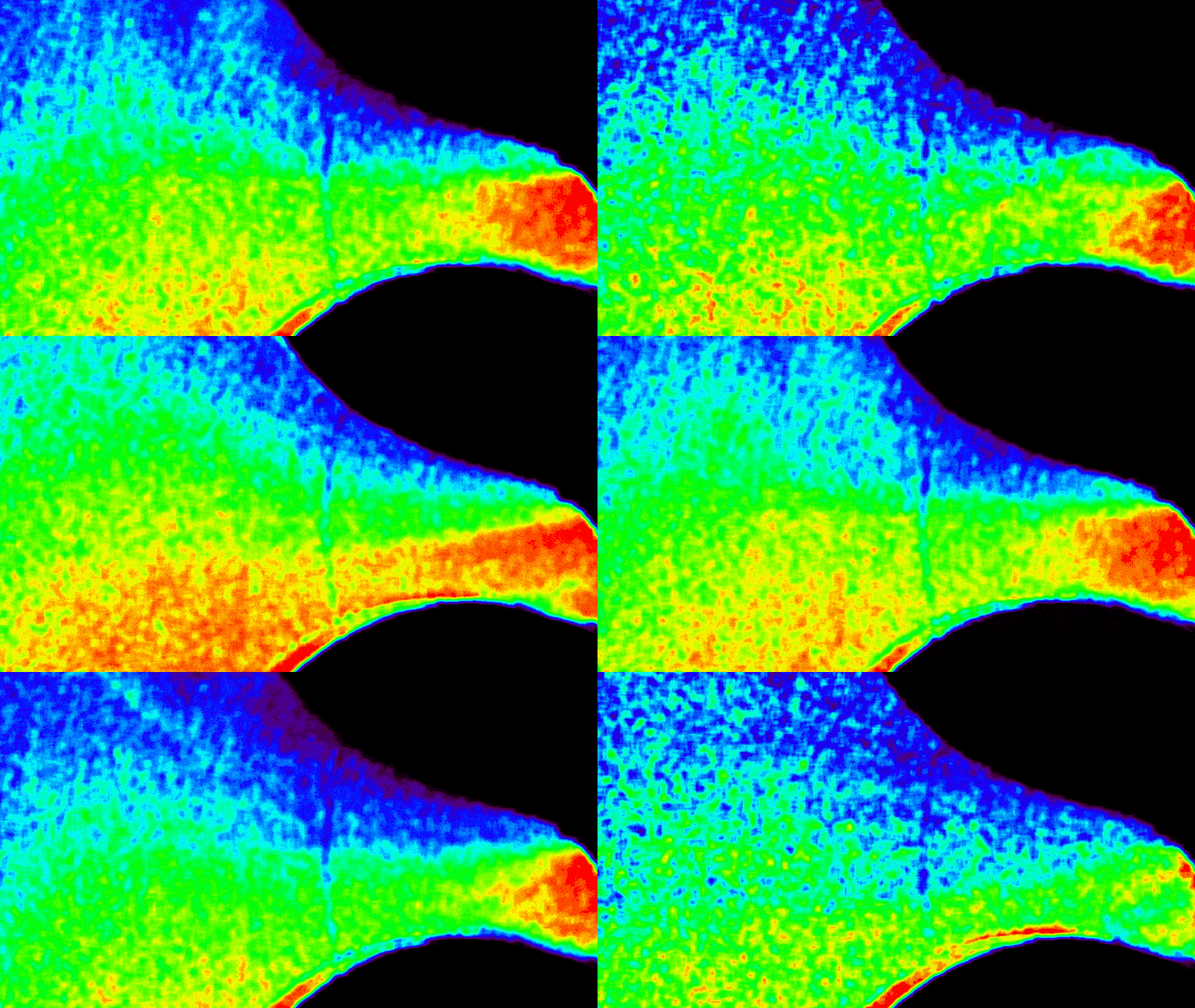
In this composite image of overlapping solar observations, the center and left panels show the field-of-view coverage of the different coronagraphs with overlays and are labeled with observation ranges in solar radii. The third panel shows a zoomed-in, color-coded portion of the larger CODEX image. It highlights the temperature ratios in that portion of the solar corona using CODEX 405.0 and 393.5 nm filters.
Credit: NASA/ESA/SOHO/KASI/INAF/CODEX
A Game-Changer: Measuring Solar Wind in Motion
“The CODEX instrument is doing something new,” said Newmark. “Previous coronagraph experiments have measured the density of material in the corona, but CODEX is measuring the temperature and speed of material in the slowly varying solar wind flowing out from the Sun.”
These new measurements allow scientists to better characterize the energy at the source of the solar wind.
Filters That Decode the Sun’s Secrets
The CODEX instrument uses four narrow-band filters — two for temperature and two for speed — to capture solar wind data. “By comparing the brightness of the images in each of these filters, we can tell the temperature and speed of the coronal solar wind,” said Newmark.
Understanding the speed and temperature of the solar wind helps scientists build a more accurate picture of the Sun, which is necessary for modeling and predicting the Sun’s behaviors.
“The CODEX instrument will impact space weather modeling by providing constraints for modelers to use in the future,” said Newmark. “We’re excited for what’s to come.”
Never miss a breakthrough: Join the SciTechDaily newsletter.
Follow us on Google and Google News.