
Close Menu
    Facebook X (Twitter) Instagram
    SciTechDaily
    • Biology
    • Chemistry
    • Earth
    • Health
    • Physics
    • Science
    • Space
    • Technology
    Facebook X (Twitter) Pinterest YouTube RSS
    SciTechDaily
    Home»Space»Solar Activity Heating Up As New Sunspots Sport the Biggest Solar Flare in Years
    Space

    Solar Activity Heating Up As New Sunspots Sport the Biggest Solar Flare in Years

    By NASA's Goddard Space Flight CenterMay 29, 2020No Comments4 Mins Read
    Facebook Twitter Pinterest Telegram LinkedIn WhatsApp Email Reddit
    Share
    Facebook Twitter LinkedIn Pinterest Telegram Email Reddit
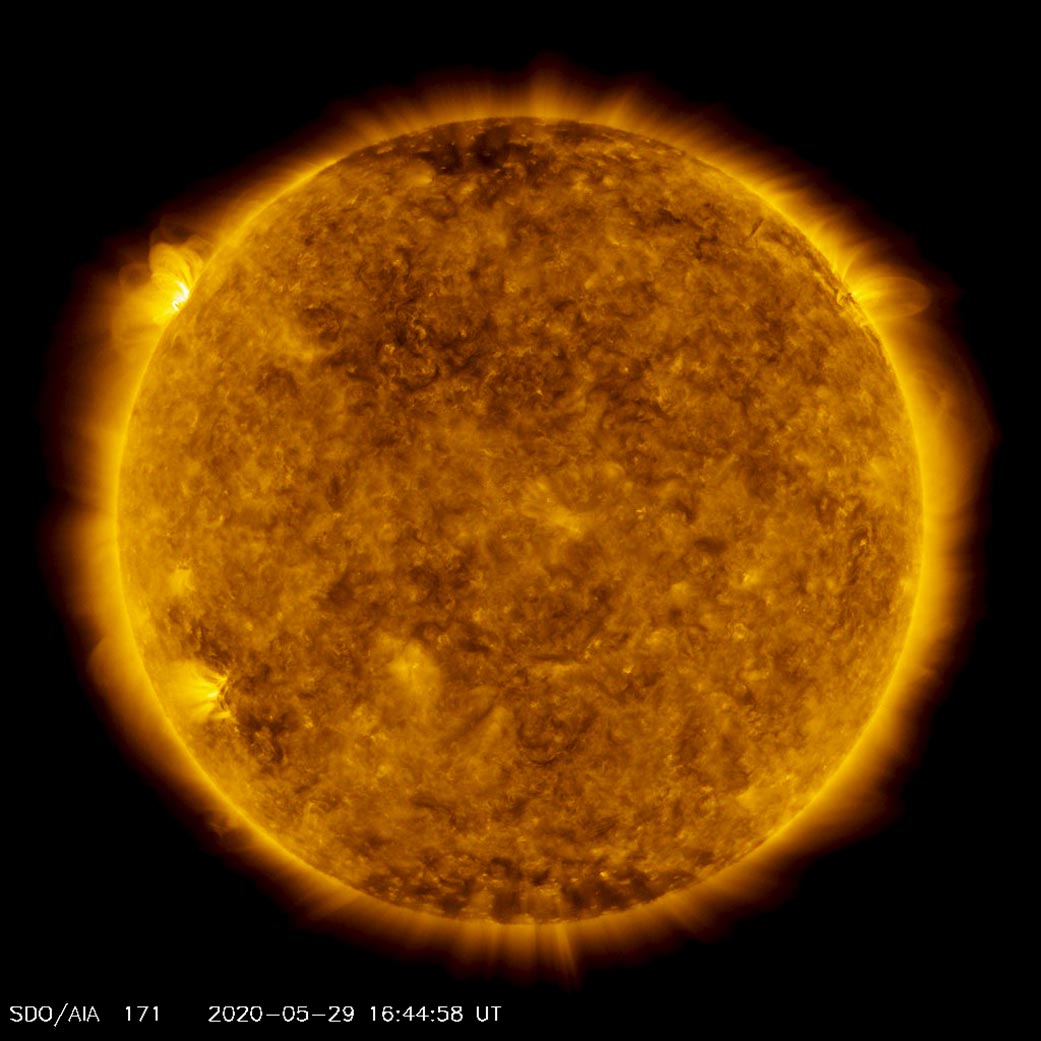
    Sun SDO May 29 2020
    On the upper left side of this image from May 29, 2020, from NASA’s Solar Dynamics Observatory — shown here in the 171-angstrom wavelength, which is typically colorized in gold — one can see a spot of light hovering above the left horizon. This light emanates from solar material tracing out magnetic field lines that are hovering over a set of sunspots about to rotate over the left limb of the Sun. Credit: NASA/Solar Dynamics Observatory/Joy Ng

    On May 29, 2020, a family of sunspots — dark spots that freckle the face of the Sun, representing areas of complex magnetic fields — sported the biggest solar flare since October 2017. Although the sunspots are not yet visible from Earth (they will soon rotate into view over the left limb of the Sun), NASA spacecraft spotted the flares high above them.

    The flares were too weak to pass the threshold at which NOAA’s Space Weather Prediction Center (which is the U.S. government’s official source for space weather forecasts, watches, warnings and alerts) provides alerts. But after several months of very few sunspots and little solar activity, scientists and space weather forecasters are keeping their eye on this new cluster to see whether they grow or quickly disappear. The sunspots may well be harbingers of the Sun’s solar cycle ramping up and becoming more active. 

    Or, they may not. It will be a few more months before we know for sure.

    As the Sun moves through its natural 11-year cycle, in which its activity rises and falls, sunspots rise and fall in number, too. NASA and NOAA track sunspots in order to determine, and predict, the progress of the solar cycle — and ultimately, solar activity. Currently, scientists are paying close attention to the sunspot number as it’s key to determining the dates of solar minimum, which is the official start of Solar Cycle 25. This new sunspot activity could be a sign that the Sun is possibly revving up to the new cycle and has passed through minimum. 

    However, it takes at least six months of solar observations and sunspot-counting after a minimum to know when it’s occurred. Because that minimum is defined by the lowest number of sunspots in a cycle, scientists need to see the numbers consistently rising before they can determine when exactly they were at the bottom. That means solar minimum is an instance only recognizable in hindsight: It could take six to 12 months after the fact to confirm when minimum has actually passed. 

    This is partly because our star is extremely variable. Just because the sunspot numbers go up or down in a given month doesn’t mean it won’t reverse course the next month, only to go back again the month after that. So, scientists need long-term data to build a picture of the Sun’s overall trends through the solar cycle. Commonly, that means the number we use to compare any given month is the average sunspot number from six months both backward and forward in time — meaning that right now, we can confidently characterize what October 2019 looks like compared to the months before it (there were definitely fewer sunspots!), but not yet what November looks like compared to that.

    On May 29, at 3:24 a.m. EST, a relatively small M-class solar flare blazed from these sunspots. Solar flares are powerful bursts of radiation. Harmful radiation from a flare cannot pass through Earth’s atmosphere to physically affect humans on the ground, however — when intense enough — they can disturb the atmosphere in the layer where GPS and communications signals travel. The intensity of this flare was below the threshold that could affect geomagnetic space and below the threshold for NOAA to create an alert.

    Nonetheless, it was the first M-class flare since October 2017 — and scientists will be watching to see if the Sun is indeed beginning to wake up.

    Never miss a breakthrough: Join the SciTechDaily newsletter.
    Follow us on Google and Google News.

    NASA NASA Goddard Space Flight Center Popular Sun
    Share. Facebook Twitter Pinterest LinkedIn Email Reddit

    Related Articles

    NASA’s CODEX Unveils the Sun’s Fiery Secrets With Stunning New Solar Wind Images

    Massive Solar Storm Unleashes Mysterious New Radiation Belts

    NASA’s CURIE Mission To Unravel the Sun’s Cryptic Radio Riddles

    NASA Uncovers the Hidden Forces Behind the Sun’s Mysterious Moss

    Astronomers Discover Surprising Radio Signals Emanating From the Sun

    Intensely Powerful X1.0 Solar Flare Witnessed by NASA’s Solar Dynamics Observatory

    Don’t Miss Eclipses: NASA Releases New Map of Upcoming Solar Eclipses

    New Clues To Predict When and Where the Sun’s Next Flare Might Explode

    What Mercury’s Unusual Orbit Reveals About the Sun [Video]

    Leave A Reply Cancel Reply

    • Facebook
    • Twitter
    • Pinterest
    • YouTube

    Don't Miss a Discovery

    Subscribe for the Latest in Science & Tech!

    Trending News

    First-of-Its-Kind Discovery: Homer’s Iliad Found Embedded in a 1,600-Year-Old Egyptian Mummy

    Beyond Inflammation: Scientists Uncover New Cause of Persistent Rheumatoid Arthritis

    A Simple Molecule Could Unlock Safer, Easier Weight Loss

    Scientists Just Built a Quantum Battery That Charges Almost Instantly

    Researchers Unveil Groundbreaking Sustainable Solution to Vitamin B12 Deficiency

    Millions of People Have Osteopenia Without Realizing It – Here’s What You Need To Know

    Researchers Discover Boosting a Single Protein Helps the Brain Fight Alzheimer’s

    World-First Study Reveals Human Hearts Can Regenerate After a Heart Attack

    Follow SciTechDaily
    • Facebook
    • Twitter
    • YouTube
    • Pinterest
    • Newsletter
    • RSS
    SciTech News
    • Biology News
    • Chemistry News
    • Earth News
    • Health News
    • Physics News
    • Science News
    • Space News
    • Technology News
    Recent Posts
    • After Decades, MIT Researchers Capture the First 3D Atomic View of a Mysterious Material
    • Your Favorite Fishing Spot Is Turning Brown – and the Fish Are Changing
    • 380-Million-Year-Old Fish Fossil Reveals Secrets of Life’s First Steps Onto Land
    • Mezcal “Worm” in a Bottle Mystery: DNA Testing Reveals a Surprise
    • Scientists Turn Red Lettuce Green, Unlocking Hidden Nutrients
    Copyright © 1998 - 2026 SciTechDaily. All Rights Reserved.
    • Science News
    • About
    • Contact
    • Editorial Board
    • Privacy Policy
    • Terms of Use

    Type above and press Enter to search. Press Esc to cancel.