
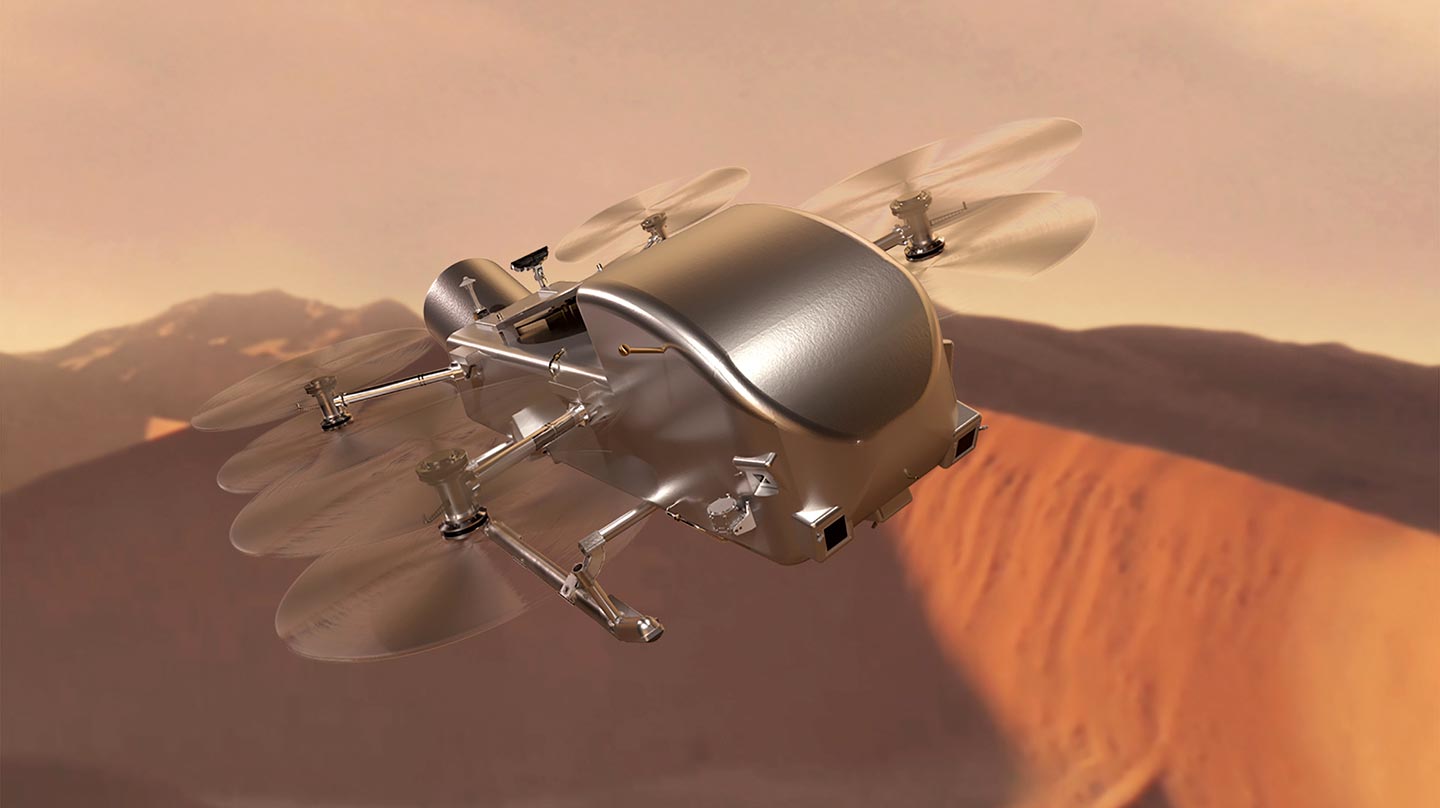
NASA’s Dragonfly mission, launching in 2028, aims to explore the habitability and organic chemistry of Saturn’s moon Titan using a novel rotorcraft lander.
NASA has chosen SpaceX to handle the launch for its Dragonfly mission, an ambitious project under the New Frontiers Program. Dragonfly is a rotorcraft lander designed to explore Saturn’s moon Titan, where it will collect samples and analyze surface compositions across various geologic environments. The mission aims to deepen our understanding of the building blocks of life.
The contract, valued at approximately $256.6 million, covers launch services and related mission costs. The mission is scheduled to launch between July 5 and July 25, 2028, aboard a SpaceX Falcon Heavy rocket from Launch Complex 39A at NASA’s Kennedy Space Center in Florida.
Dragonfly centers on a novel approach to planetary exploration, employing a rotorcraft lander to travel between and sample diverse sites on Saturn’s largest moon. With contributions from partners around the globe, Dragonfly’s scientific payload will characterize the habitability of Titan’s environment, investigate the progression of prebiotic chemistry on Titan, where carbon-rich material and liquid water may have mixed for an extended period, and search for chemical indications of whether water-based or hydrocarbon-based life once existed on Saturn’s moon.
NASA’s Launch Services Program at the agency’s Kennedy Space Center is responsible for managing the launch service. Managed for NASA at Johns Hopkins Applied Physics Laboratory in Laurel, Maryland, the Dragonfly team comprises scientists, engineers, technologists, managers, and more who have deep experience on missions that have explored the solar system from the Sun to Pluto and beyond, as well as experts in rotorcraft, autonomous flight, and space systems from around the globe. Dragonfly is the fourth mission in NASA’s New Frontiers Program, managed by NASA’s Marshall Space Flight Center in Huntsville, Alabama, for the agency’s Science Mission Directorate in Washington.
Never miss a breakthrough: Join the SciTechDaily newsletter.
Follow us on Google and Google News.
1 Comment
Titan the only place where life may exist or existed it is an exciting mystery waiting to be solved.I believe there is something there.😎