
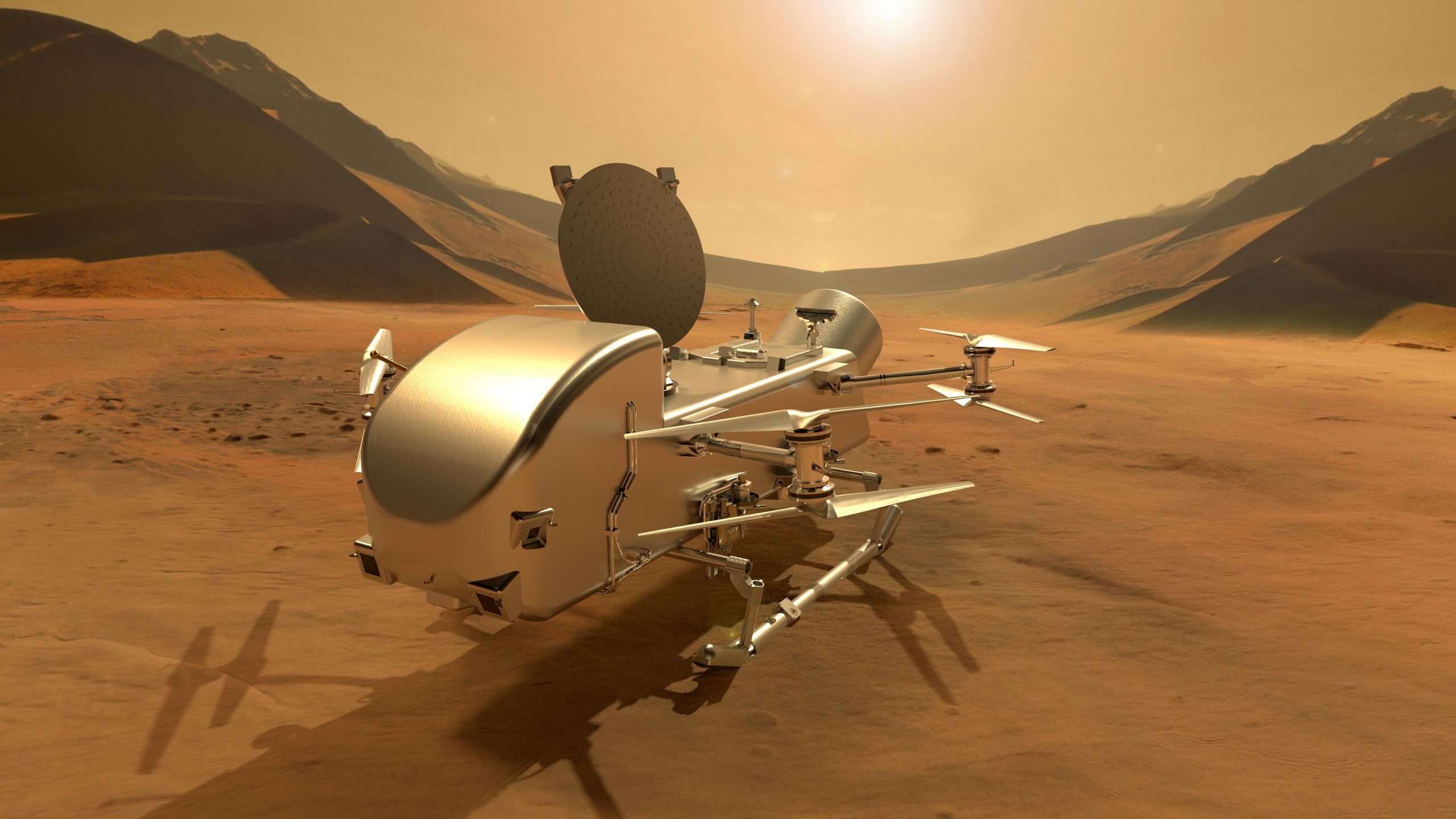
The Dragonfly mission, set for a 2028 launch by SpaceX, will explore Saturn’s moon Titan, focusing on its unique hydrocarbon liquids and potential for prebiotic chemical processes.
Dragonfly will study the moon’s chemistry and geology from its landing site near the Selk crater, using an octocopter design optimized for Titan’s conditions.
Launching the Dragonfly Mission
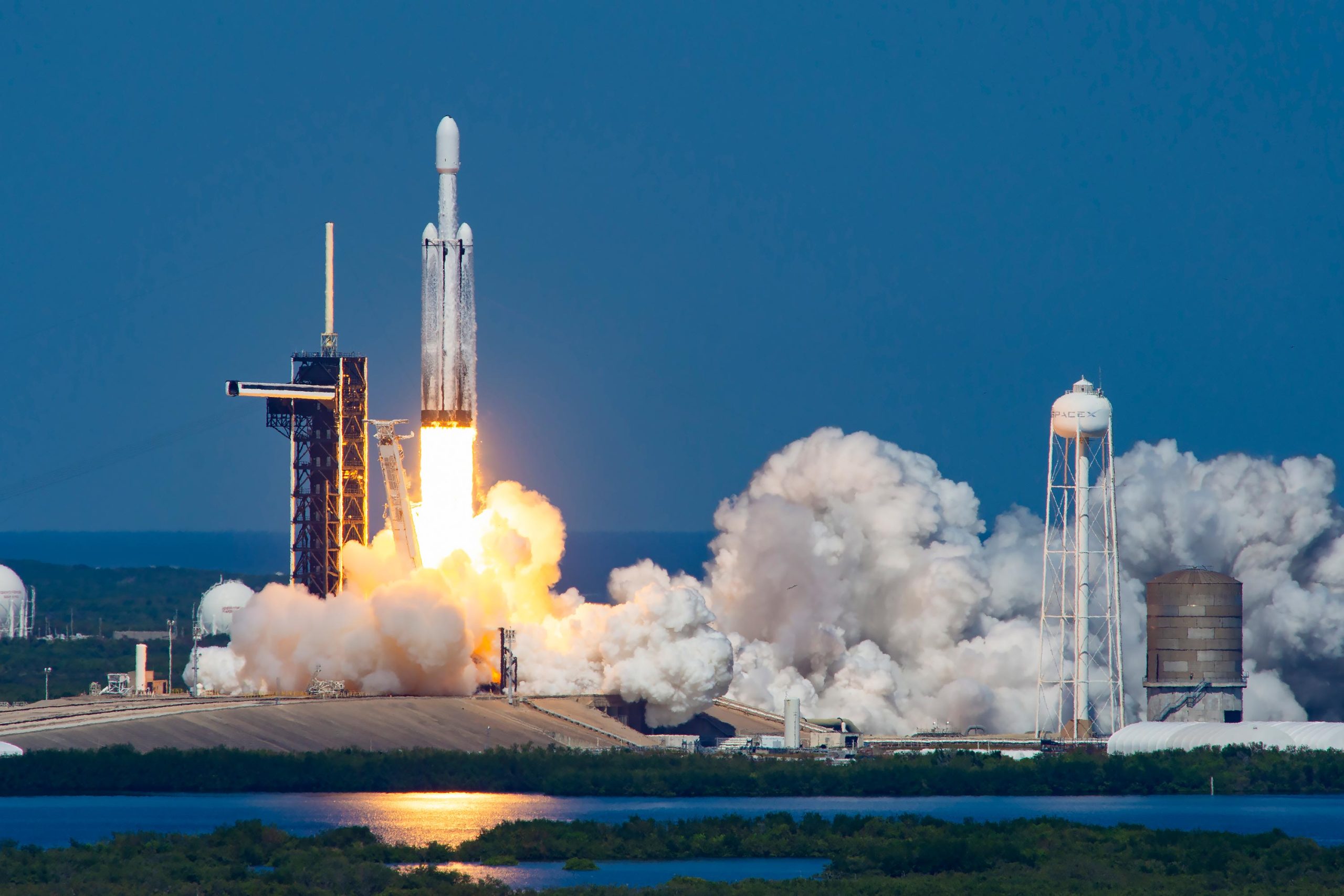
NASA has awarded SpaceX the contract to launch the Dragonfly mission to Saturn’s moon Titan. The mission, set to launch aboard a Falcon Heavy rocket in 2028, aims to reach Titan by 2034. Dragonfly is an astrobiology mission designed to analyze the chemical composition of the frigid moon’s surface and explore its potential for prebiotic activity.
This will mark the second visit to Titan, following the brief mission of the European Space Agency’s Huygens probe in 2005.
Exploring Titan’s Unique Environment
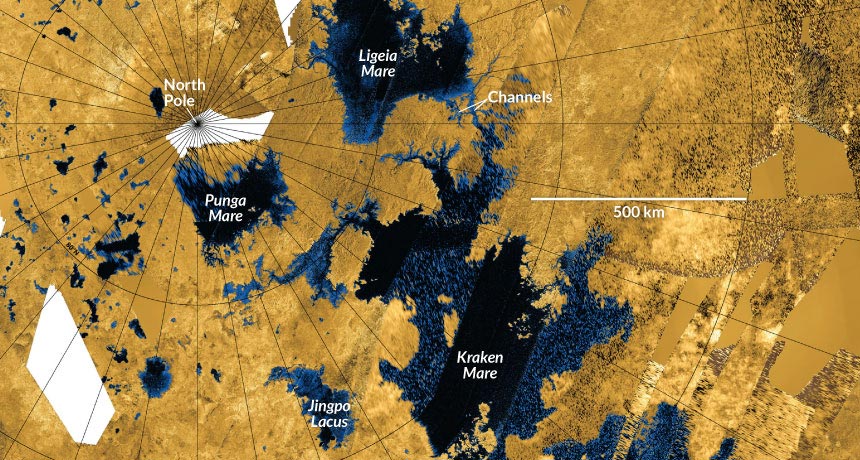
Titan stands out in the Solar System as the only celestial body besides Earth with surface liquids. However, these liquids are hydrocarbons, not water. There may also be surface deposits of water ice, possibly from impacts or cryovolcanic activity. Scientists believe Titan could host prebiotic chemicals, making it a key destination for studying the origins of life and the progression of prebiotic chemistry.
Titan is benign when it comes to powered flight; its atmosphere is dense and its gravity is weak, compared to Earth. Dragonfly is an octocopter, a large quadcopter with double rotors, that can take advantage of Titan’s flight-friendly conditions. It will travel at about 36 kph (22 mph) and will be powered by a Radioisotope Thermoelectric Generator (RTG), a type of engine proven in multiple missions. The craft is designed to be redundant; it can lose one of its motors or rotors and still function.
Landing and Initial Studies at Titan
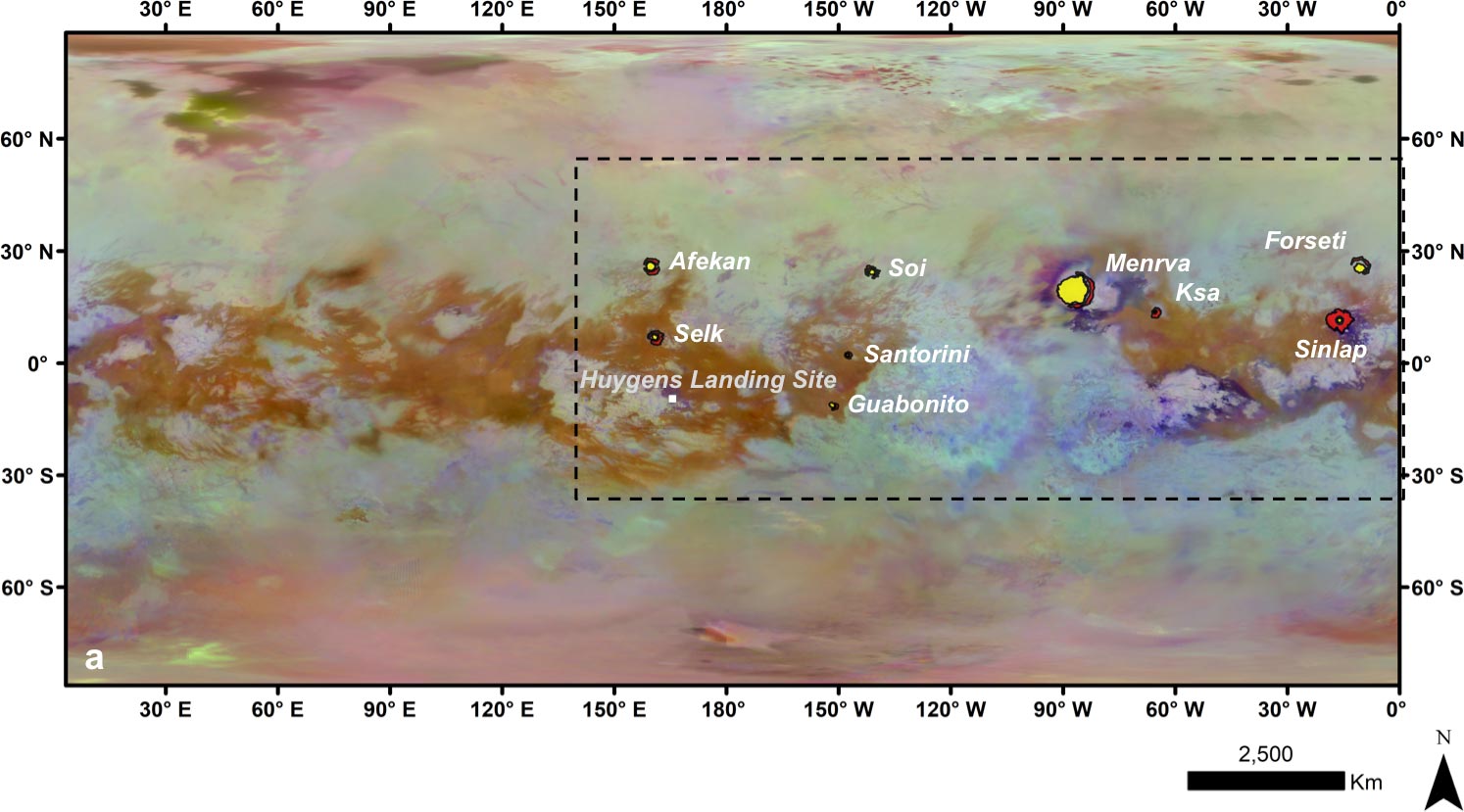
Dragonfly will land near a feature on Titan called Shangri-La, east of where the Huygens probe landed. Shangri-La is one of three large sand seas near the moon’s equator.
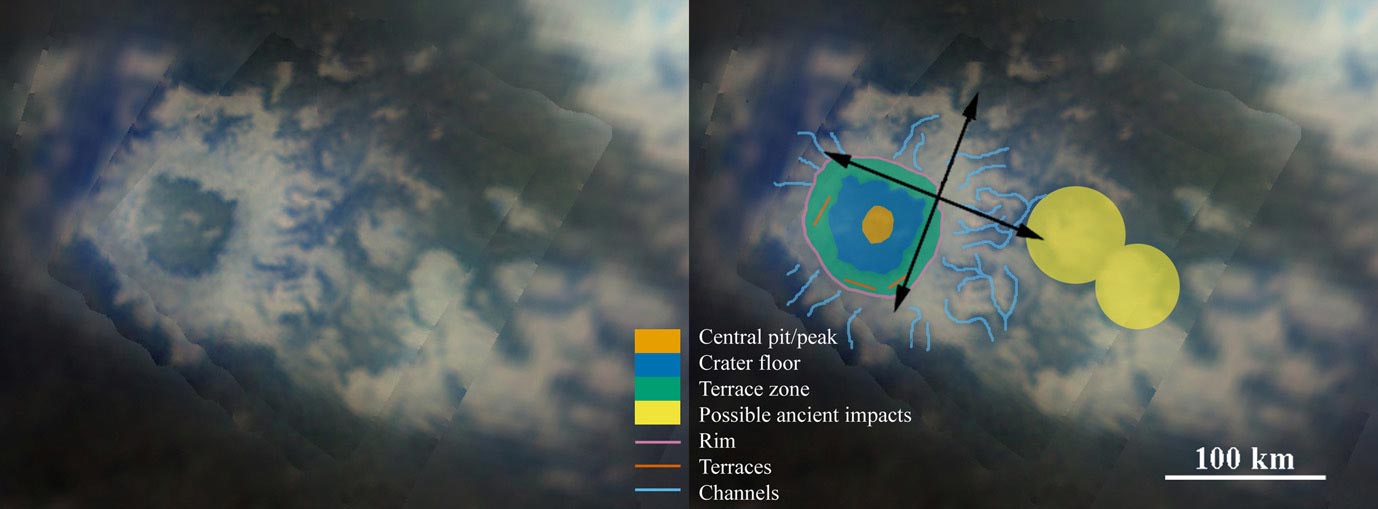
Dragonfly’s target is the Selk impact structure, near the edge of Shangri-La. Selk is a young impact crater about 90 km (56 mi) in diameter that features melt pools, sites where liquid water and organics could mix together to form amino acids or other biomolecules. Dragonfly will initially land at some dunes near the structure then begin exploring the region and its chemistry.
Analyzing Titan’s Geological Features
Thanks largely to Cassini and Huygens, researchers have made progress in understanding Titan. In a 2020 paper, researchers examined two types of craters on the moon: dune craters and plains craters. Selk is a dune crater, and in the paper, researchers said that the dune craters are richer in organics than plains craters, and in fact are almost entirely composed of organics. However, Titan’s thick atmosphere makes it difficult to observe, and these findings stem from interpreting albedo and emissivity.
Selk and the other dune craters may have originally had more water ice, according to the research, but much of it’s been eroded away. However, there was a long period of time when the water ice was present, and Dragonfly is heading for Selk to examine the chemistry in the crater and to try and determine if water and organics interacted and if prebiotic chemistry made any headway.
The Role of Falcon Heavy in Dragonfly’s Journey
It’s up to SpaceX’s Falcon Heavy to send Dragonfly on its way to Titan. Falcon Heavy has 11 launches under its belt, including the launch of the Europa Clipper in October. After Falcon Heavy launches Dragonfly, the spacecraft will perform one flyby of Earth to gain additional velocity.
It’ll take six years for Dragonfly to reach Titan, and just as it arrives, the entry capsule will separate from the cruise module. With the help of an aeroshell and two chutes, the lander will endure an approximately 105-minute descent. At approximately 1.2 km above the surface, the lander will deploy its skids, and based on its lidar and radar data, will perform an autonomous landing.
From its landing site, Dragonfly will deploy itself and perform a series of flights up to 8km (5 mi) long. There’s diverse geology in the region, and the rotorcraft will acquire samples and then analyze them during Titan’s nights, which last about 8 Earth days or about 192 hours. After that, it will head to the Selk crater.
The Significance of Titan in Astrobiology
Titan is an important astrobiology target in our Solar System, and unlike the frozen ocean moons Europa and Enceladus, there’s no added complexity of somehow working its way through thick ice before its potentially biological environment can be examined.
But for all of this to succeed, it needs a successful launch first. NASA is paying SpaceX about $256 million to launch Dragonfly, and it the launch goes off without a hitch, it’ll be money well spent.
Adapted from an article originally published on Universe Today.
Never miss a breakthrough: Join the SciTechDaily newsletter.
Follow us on Google and Google News.
3 Comments
Could there be discreet protection for rotar blades in the event of a collision?
“unlike the frozen ocean moons Europa and Enceladus, there’s no added complexity of somehow working its way through thick ice before its potentially biological environment can be examined.”
Enceladus is simpler yet though, a probe can sample its organic ejecta in orbit around Saturn.
It’s a little strange how launch providers are still given as much mission credit as they do for delivering a parcel 1% of the way to its intended destination. Imagine if article writers had to include their ISP in the byline because it transmitted packets when they clicked submit.