
Close Menu
    Facebook X (Twitter) Instagram
    SciTechDaily
    • Biology
    • Chemistry
    • Earth
    • Health
    • Physics
    • Science
    • Space
    • Technology
    Facebook X (Twitter) Pinterest YouTube RSS
    SciTechDaily
    Home»Space»NASA’s Interstellar Mapping and Acceleration Probe Completes Critical Design Review
    Space

    NASA’s Interstellar Mapping and Acceleration Probe Completes Critical Design Review

    By Lindsay Bartolone, Princeton UniversityFebruary 5, 2023No Comments3 Mins Read
    Facebook Twitter Pinterest Telegram LinkedIn WhatsApp Email Reddit
    Share
    Facebook Twitter LinkedIn Pinterest Telegram Email Reddit
    Interstellar Mapping and Acceleration Probe (IMAP)
    Artist’s impression of the Interstellar Mapping and Acceleration Probe (IMAP). The mission will help us better understand the flow of particles from the Sun called the solar wind — and how those particles interact with space within the solar system and beyond. Credit: NASA/Johns Hopkins APL/Princeton University/Steve Gribben

    NASA’s Interstellar Mapping and Acceleration Probe (IMAP) mission held a critical design review (CDR) last week with a NASA Standing Review Board (SRB). This mission-level review was the culmination of individual CDRs conducted for all the instruments and subsystems. While there are still challenges ahead to face as a team, the review board is confident that IMAP has a plan to succeed.

    Although CDR is often a gate to spacecraft construction, IMAP has already begun building important components such as instrument engineering and flight models as well as parts of the structure. With 10 instruments designed and built globally, the complicated dance of testing, cross-calibrating, and integrating these pieces is carefully choreographed so that the completed observatory will be ready for launch in 2025.
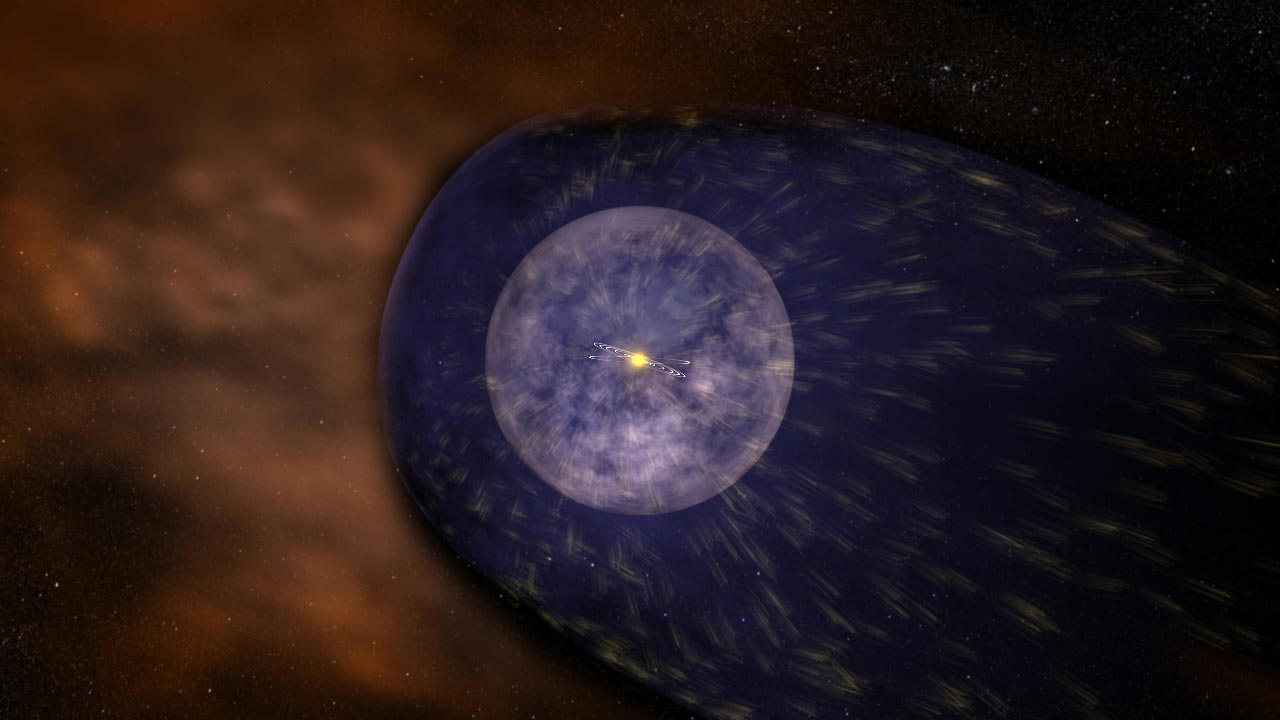
    NASA Interstellar Mapping and Acceleration Probe IMAP
    As a modern-day celestial cartographer, IMAP will chart the very boundaries of the heliosphere – the bubble surrounding the Sun and planets that is inflated by the solar wind – and study how it interacts with the local galactic neighborhood beyond. Credit: NASA/Goddard Space Flight Center Conceptual Image Lab

    IMAP will explore our solar neighborhood, known as the heliosphere, and decode the messages in particles from the Sun and beyond. Three of the instrument suites will work together to build detailed maps of the boundaries of the solar system using energetic neutral atoms, which travel from the edge to Lagrange point 1 (L1), the point between the Sun and Earth where gravitational forces balance. IMAP’s other instruments collect information from the Sun’s solar wind and provide timely updates about space weather conditions.

    The SRB chair noted that IMAP was “good to go” and had a lot of work to do.

    Princeton University professor and IMAP Principal Investigator David J. McComas expressed his gratitude to the board for the good questions and said, “New challenges will surely emerge between now and launch, but I have every confidence in the awesome, committed, and resilient team that we have assembled to carry out this challenging mission.”

    “We’re finally starting to see the integration of all these efforts, which is absolutely remarkable for me,” said Deputy Principal Investigator Nathan Schwadron. “We started with an idea. We proposed the concept, and then there’s this shift of momentum into actually making the hardware, building the spacecraft, getting them to work together. It really is our commitment to discovery as a team that helps make the transition from concept to reality.”

    McComas leads the mission with an international team of 24 partner institutions. The Johns Hopkins Applied Physics Laboratory in Laurel, Maryland, is building the spacecraft and will operate the mission. IMAP is the fifth mission in NASA’s Solar Terrestrial Probes (STP) Program portfolio. The Explorers and Heliophysics Project Division at NASA’s Goddard Space Flight Center in Greenbelt, Maryland, manages the STP Program for the agency’s Heliophysics Division of NASA’s Science Mission Directorate.

    Never miss a breakthrough: Join the SciTechDaily newsletter.
    Follow us on Google and Google News.

    Astronomy Johns Hopkins APL NASA NASA IMAP Princeton University
    Share. Facebook Twitter Pinterest LinkedIn Email Reddit

    Related Articles

    NASA’s High-Energy Ion Telescope Ready for Installation on IMAP Spacecraft

    Advanced Particle Imager Ready for Installation on NASA’s IMAP Spacecraft

    Cosmic Cartography Mission: NASA’s IMAP To Set Sail for Interstellar Mapping

    Parker Solar Probe Captures Stunning New Images of Venus – Faint Glow Detected From the Planet’s Surface

    Spacecraft Enters the Sun’s Blistering Hot Corona for the First Time in History

    NASA’s DART Spacecraft Opens Its “Eye” and Returns First Images From Space

    Parker Solar Probe: For the First Time in History, a Spacecraft Has Touched the Sun

    Major 6-Year Search of the Outer Solar System Turns Up 461 New Objects (but No Planet 9)

    Celestial Geometry Posed a Special Opportunity During Parker Solar Probe’s 7th Solar Encounter

    Leave A Reply Cancel Reply

    • Facebook
    • Twitter
    • Pinterest
    • YouTube

    Don't Miss a Discovery

    Subscribe for the Latest in Science & Tech!

    Trending News

    Popular Vitamin B3 Supplements May Help Cancer Cells Survive, Scientists Warn

    Scientists Discover Strange Property of Rice and Turn It Into a Smart Material

    NASA Artemis II Skips Burn As Astronaut Captures Stunning View of Earth

    NASA’s Artemis II: Humans Just Left Earth Orbit for the First Time Since 1972

    What Causes Chronic Pain? Scientists Identify Key Culprit in the Brain

    Semaglutide Shows Surprising Mental Health Benefits in Massive 100,000-Person Study

    This Liquid Snapped Instead of Flowing and Scientists Were Shocked

    Breakthrough Alzheimer’s Drug Rewires the Brain Instead of Just Clearing Plaques

    Follow SciTechDaily
    • Facebook
    • Twitter
    • YouTube
    • Pinterest
    • Newsletter
    • RSS
    SciTech News
    • Biology News
    • Chemistry News
    • Earth News
    • Health News
    • Physics News
    • Science News
    • Space News
    • Technology News
    Recent Posts
    • Why Antarctic Sea Ice Suddenly Collapsed After Decades of Growth
    • Astronomers Discover the Most Pristine Star Ever Found
    • New Study Suggests Gravitational Waves May Have Created Dark Matter
    • Scientists Solve 60-Year-Old Mystery of Strange Magnetic Surges Above the Moon
    • Scientists Discover How Multiple Sclerosis Kills Brain Cells
    Copyright © 1998 - 2026 SciTechDaily. All Rights Reserved.
    • Science News
    • About
    • Contact
    • Editorial Board
    • Privacy Policy
    • Terms of Use

    Type above and press Enter to search. Press Esc to cancel.