
Close Menu
    Facebook X (Twitter) Instagram
    SciTechDaily
    • Biology
    • Chemistry
    • Earth
    • Health
    • Physics
    • Science
    • Space
    • Technology
    Facebook X (Twitter) Pinterest YouTube RSS
    SciTechDaily
    Home»Space»NASA’s Juno Captures Two Active Volcanic Plumes on Jupiter’s Moon Io
    Space

    NASA’s Juno Captures Two Active Volcanic Plumes on Jupiter’s Moon Io

    By SciTechDaily.comFebruary 8, 2024No Comments4 Mins Read
    Facebook Twitter Pinterest Telegram LinkedIn WhatsApp Email Reddit
    Share
    Facebook Twitter LinkedIn Pinterest Telegram Email Reddit
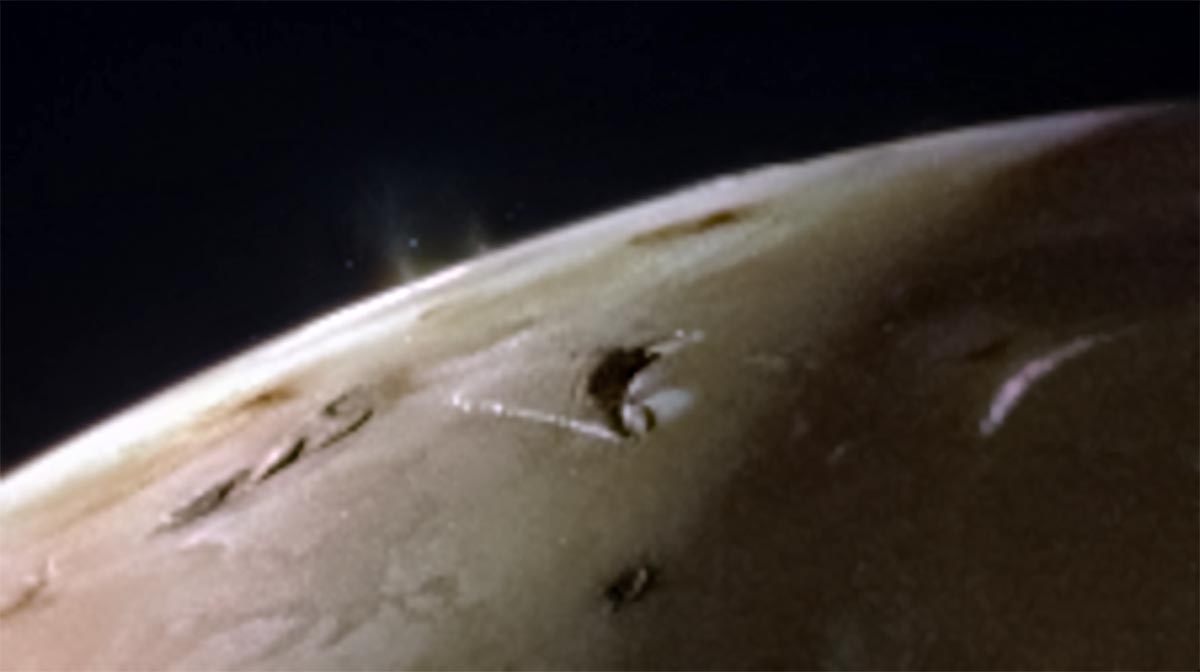
    Juno Captures Two Active Volcanic Plumes on Jupiter’s Moon Io
    On February 3, NASA’s Juno spacecraft captured images of two volcanic plumes on Jupiter’s moon Io, possibly indicating activity from either two vents of a single volcano or two separate volcanoes. The Juno team plans to analyze this event in conjunction with data from previous missions to enhance our understanding of Io’s volcanic dynamics. Credit: NASA/JPL-Caltech/SwRI/MSSS, AndreaLuck © CC BY

    NASA’s Juno spacecraft observed two volcanic plumes on Io, suggesting significant volcanic activity on Jupiter’s moon.

    In a significant astronomical achievement, NASA’s Juno spacecraft has once again broadened our understanding of the solar system’s dynamics by capturing two volcanic plumes rising above the horizon of Jupiter’s moon Io.

    This event, recorded on February 3, presents a fascinating glimpse into the volcanic activity that characterizes Io, one of the most geologically active bodies in our solar system. The images, captured by Juno’s JunoCam instrument from a distance of approximately 2,400 miles (3,800 kilometers), showcase plumes that could have originated from two vents belonging to a single massive volcano or from two distinct volcanoes located in proximity to each other.

    This discovery opens new avenues for analysis, as the Juno team plans to compare these observations with other data gathered by Juno and previous missions to deepen our understanding of Io’s volcanic nature.
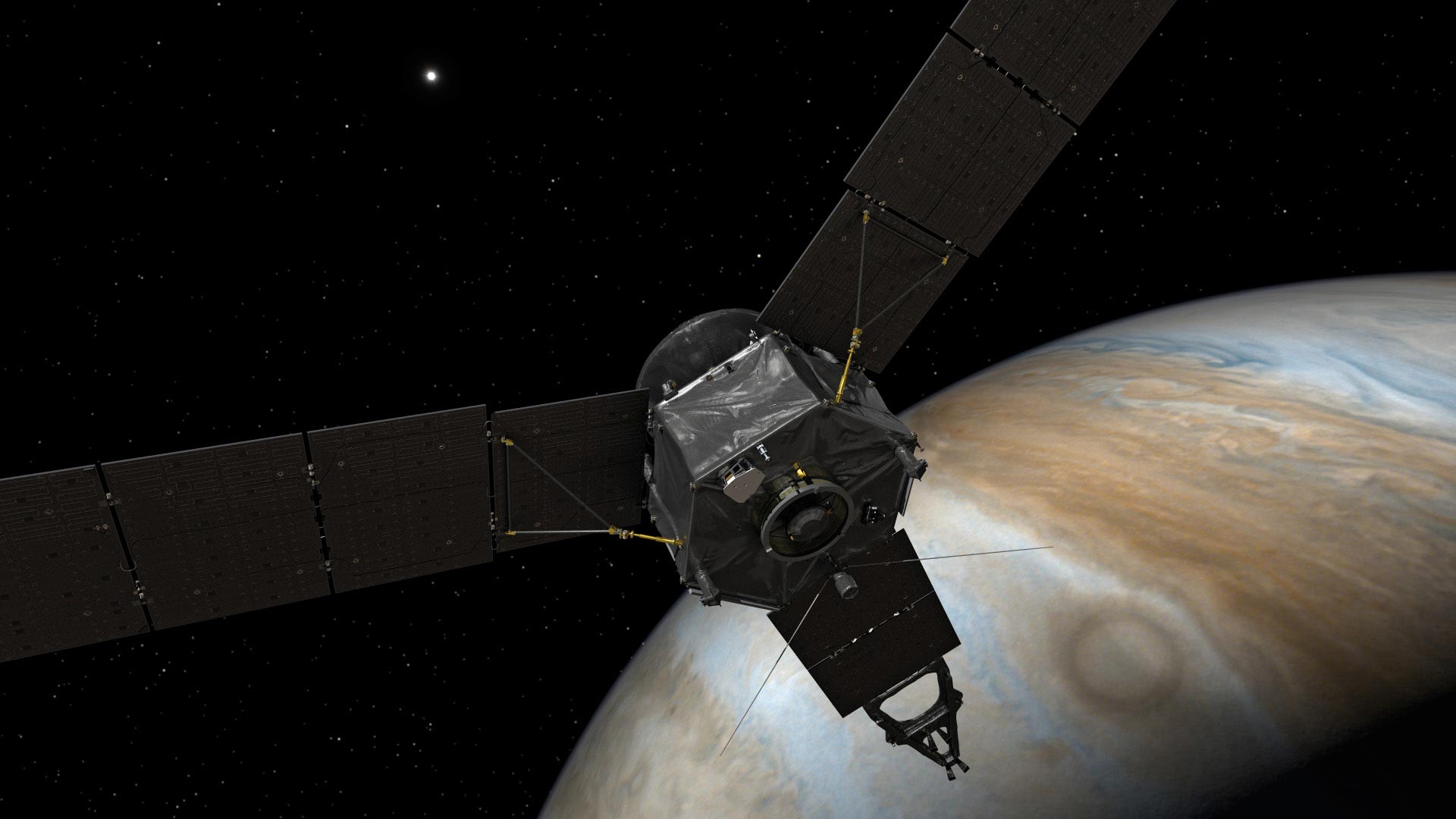
    NASA's Juno Spacecraft Entering Orbit of Jupiter
    An illustration shows NASA’s Juno spacecraft as it entered orbit of Jupiter on July 4, 2016, after traveling for nearly five years and more than 1.7 billion miles. Credit: NASA/JPL/SwRI

    Background on Juno’s Mission

    Launched on August 5, 2011, the Juno spacecraft embarked on a mission to explore Jupiter, the largest planet in our solar system. Juno’s objectives are multifaceted, aiming to unveil the secrets of Jupiter’s atmosphere, magnetic environment, and structure.

    By studying Jupiter, scientists hope to gain insights into the formation of the solar system, understanding how gas giants form and the role these massive planets play in constructing planetary systems.

    After a journey of nearly five years, Juno entered Jupiter’s orbit on July 4, 2016, and has since been conducting close-up observations of the planet and its moons. Juno’s suite of scientific instruments, including the JunoCam, a color, visible-light camera, has provided unprecedented views of Jupiter’s atmosphere and detailed images of its moons, including Io.
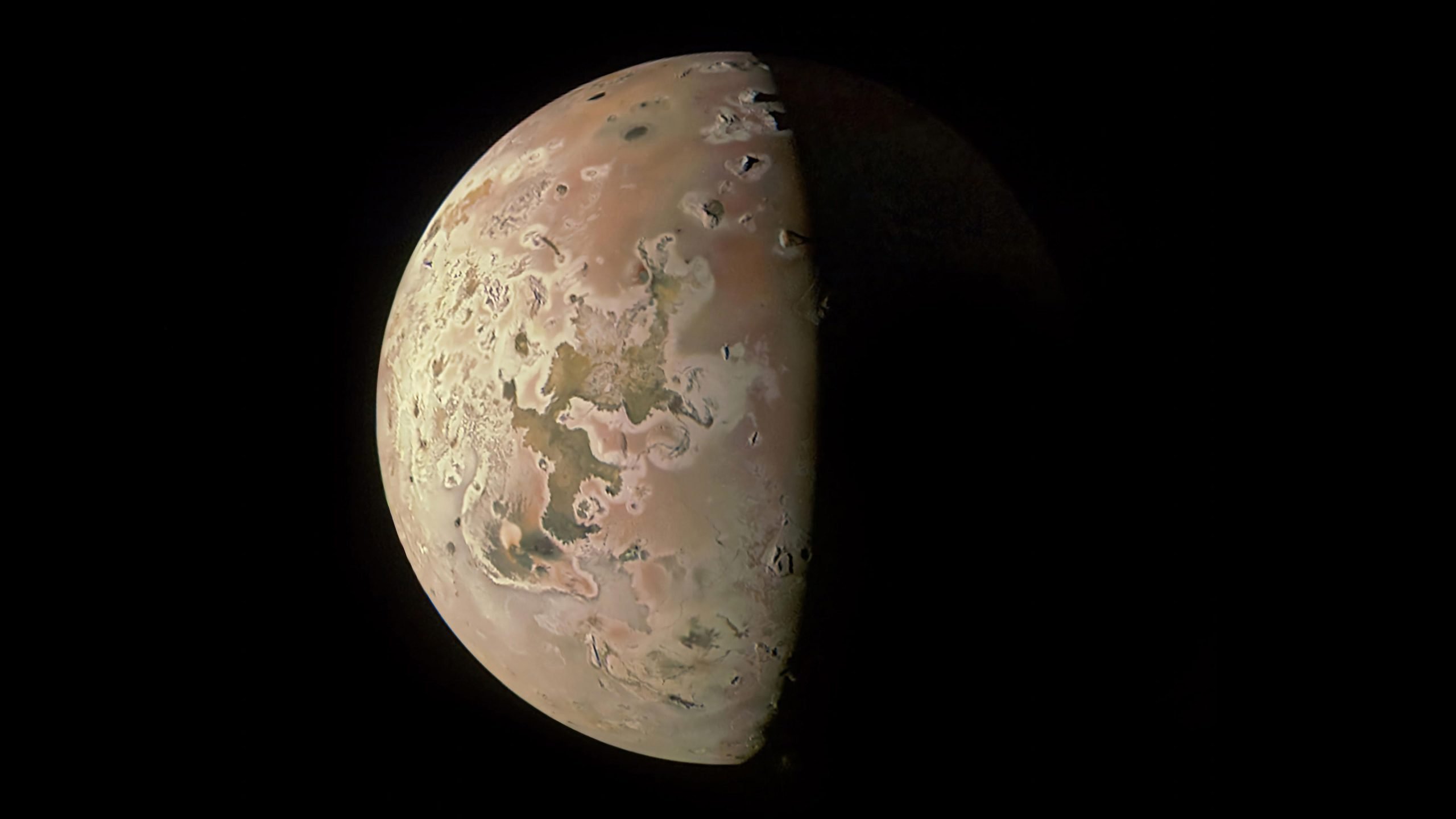
    North Polar Region of the Jovian Moon Io
    This image revealing the north polar region of the Jovian moon Io was taken on October 15, 2023, by NASA’s Juno. Three of the mountain peaks visible in the upper part of image, near the day-night dividing line, were observed here for the first time by the spacecraft’s JunoCam. Credit: Image data: NASA/JPL-Caltech/SwRI/MSSS, Image processing by Ted Stryk

    Io: A Volcanic Powerhouse

    Io stands out as the most volcanically active moon in the solar system, a distinction that has fascinated scientists since its volcanic nature was first revealed by the Voyager spacecraft in 1979.

    This innermost moon of Jupiter is slightly larger than Earth’s moon and is subject to intense gravitational interactions with Jupiter and its other large moons. These interactions generate tidal heating, which is responsible for Io’s geological activity, including its hundreds of volcanoes, some of which eject plumes of sulfur and sulfur dioxide gas and dust high into space.

    The volcanic activity on Io continuously reshapes its surface, making it a primary subject of study for understanding extraterrestrial volcanism.

    The Significance of Juno’s Discovery

    The observation of volcanic plumes on Io by Juno’s JunoCam adds a vital piece of evidence to our understanding of Io’s volcanic dynamics. These plumes can rise hundreds of kilometers above Io’s surface, offering a spectacular display of nature’s power beyond Earth. The analysis of these plumes, in conjunction with other data collected by Juno and previous missions, has the potential to reveal new insights into the mechanisms driving Io’s volcanism, the composition of its interior, and how its activity influences the Jovian system. This discovery underscores the importance of continuous exploration and study of our solar system’s celestial bodies, as each finding brings us closer to unraveling the mysteries of the cosmos.

    As the Juno mission continues to explore Jupiter and its moons, its findings, such as the volcanic plumes on Io, not only enhance our understanding of the universe but also inspire future missions to further investigate these distant worlds. Through the lens of Juno, we gain a more comprehensive view of the solar system, reminding us of the dynamic and ever-changing nature of space.

    Never miss a breakthrough: Join the SciTechDaily newsletter.
    Follow us on Google and Google News.

    Io JPL Juno Spacecraft Moons NASA Popular
    Share. Facebook Twitter Pinterest LinkedIn Email Reddit

    Related Articles

    NASA’s Juno Exposes Sizzling Lava Lakes Beneath Io and Cyclonic Chaos on Jupiter

    NASA’s Juno Uncovers Io’s 80 Trillion Watt Volcanic Monster That Shatters Records

    Inside Io: NASA’s Juno Reveals Hidden Magma Chambers Fueling Endless Eruptions

    NASA’s Juno Uncovers the Fire-Breathing Lakes of Jupiter’s Volcanic Moon Io

    NASA’s Juno Unlocks Secrets of Io’s Volcanic Fury and Jupiter’s Storms

    Fiery Flyby: Juno’s Close Encounter With Jupiter’s Volcanic Moon, Io

    Hear the Eerie Radio Emissions NASA’s Juno Spacecraft Recorded From Jupiter and Its Moon Io

    “Beautiful!” – Ride With NASA’s Juno Spacecraft As It Flies Past the Solar System’s Biggest Moon and Jupiter

    Close Encounters of the Jovian Kind: NASA’s Juno to Get a Close Look at Jupiter’s Moon Ganymede

    Leave A Reply Cancel Reply

    • Facebook
    • Twitter
    • Pinterest
    • YouTube

    Don't Miss a Discovery

    Subscribe for the Latest in Science & Tech!

    Trending News

    Mezcal “Worm” in a Bottle Mystery: DNA Testing Reveals a Surprise

    New Research Reveals That Your Morning Coffee Activates an Ancient Longevity Switch

    This Is What Makes You Irresistible to Mosquitoes

    Shockingly Powerful Giant Octopuses Ruled the Seas 100 Million Years Ago

    Scientists Stunned by New Organic Molecules Found on Mars

    Rewriting Dinosaur Evolution: Scientists Unearth Remarkable 150-Million-Year-Old Stegosaur Skull

    Omega-3 Supplements Linked to Cognitive Decline in Surprising New Study

    First-of-Its-Kind Discovery: Homer’s Iliad Found Embedded in a 1,600-Year-Old Egyptian Mummy

    Follow SciTechDaily
    • Facebook
    • Twitter
    • YouTube
    • Pinterest
    • Newsletter
    • RSS
    SciTech News
    • Biology News
    • Chemistry News
    • Earth News
    • Health News
    • Physics News
    • Science News
    • Space News
    • Technology News
    Recent Posts
    • Scientists Map Thousands of Brain Connections With RNA Barcodes
    • This Gene Tweak Turns Strawberries Into Healthier, Tastier Superfruit
    • This New Chip Could Make GPUs Far More Efficient
    • This Tiny World in the Outer Solar System Should Be Airless, but It Has an Atmosphere
    • NASA’s Webb Space Telescope Reveals a Dark Airless Super-Earth That Looks Like Mercury
    Copyright © 1998 - 2026 SciTechDaily. All Rights Reserved.
    • Science News
    • About
    • Contact
    • Editorial Board
    • Privacy Policy
    • Terms of Use

    Type above and press Enter to search. Press Esc to cancel.