
Close Menu
    Facebook X (Twitter) Instagram
    SciTechDaily
    • Biology
    • Chemistry
    • Earth
    • Health
    • Physics
    • Science
    • Space
    • Technology
    Facebook X (Twitter) Pinterest YouTube RSS
    SciTechDaily
    Home»Space»NASA’s Juno Reveals Two Massive Storms in Latest Flyby of Jupiter
    Space

    NASA’s Juno Reveals Two Massive Storms in Latest Flyby of Jupiter

    By Tony Greicius, NASAJanuary 19, 20191 Comment2 Mins Read
    Facebook Twitter Pinterest Telegram LinkedIn WhatsApp Email Reddit
    Share
    Facebook Twitter LinkedIn Pinterest Telegram Email Reddit
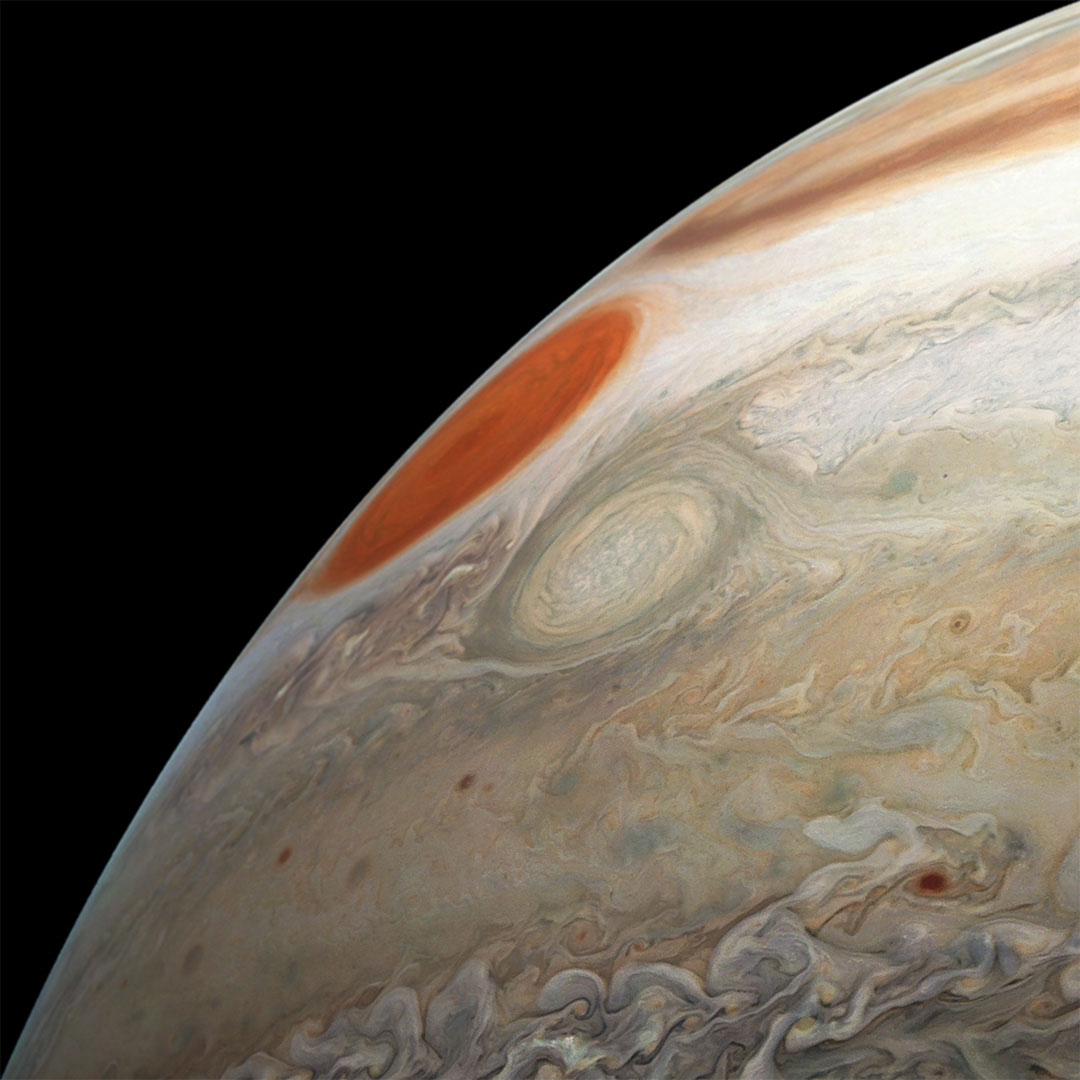
    Juno’s Latest Flyby Shows Two Massive Storms
    NASA’s Juno spacecraft captured the notable Great Red Spot, as well as a massive storm called Oval BA. The storm reached its current size when three smaller spots collided and merged in the year 2000. Credit: NASA/JPL-Caltech/SwRI/MSSS/Gerald Eichstädt/Seán Doran

    This image of Jupiter’s turbulent southern hemisphere was captured by NASA’s Juno spacecraft as it performed its most recent close flyby of the gas giant planet on December 21, 2018.

    This new perspective captures the notable Great Red Spot, as well as a massive storm called Oval BA. The storm reached its current size when three smaller spots collided and merged in the year 2000. The Great Red Spot, which is about twice as wide as Oval BA, may have formed from the same process centuries ago.

    Juno captured Oval BA in another image earlier on in the mission on February 7, 2018. The turbulent regions around, and even the shape of, the storm have significantly changed since then. Oval BA further transformed in recent months, changing color from reddish to a more uniform white.

    Juno took the three images used to produce this color-enhanced view on December 21, between 9:32 a.m. PST (12:32 p.m. EST) and 9:42 a.m. PST (12:42 p.m. EST). At the time the images were taken, the spacecraft was between approximately 23,800 miles (38,300 kilometers) to 34,500 miles (55,500 kilometers) from the planet’s cloud tops above southern latitudes spanning 49.15 to 59.59 degrees.

    Citizen scientists Gerald Eichstädt and Seán Doran created this image using data from the spacecraft’s JunoCam imager.

    JunoCam’s raw images are available for the public to peruse and to process into image products at: http://missionjuno.swri.edu/junocam.   

    More information about Juno is at: http://www.nasa.gov/juno and http://missionjuno.swri.edu.

    Never miss a breakthrough: Join the SciTechDaily newsletter.
    Follow us on Google and Google News.

    Astronomy Juno Spacecraft Jupiter Planetary Science
    Share. Facebook Twitter Pinterest LinkedIn Email Reddit

    Related Articles

    Jupiter Handles the Solar Wind in a Way Scientists Didn’t Expect

    Juno Images Provide an Unprecedented View of Jupiter

    A Billion or More Jupiter-Like Worlds Could Be Orbiting Stars in the Milky Way

    First In-orbit View from NASA’s Juno Spacecraft

    Juno Spacecraft in Orbit Around Jupiter

    Hubble Telescope Views Vivid Auroras in Jupiter’s Atmosphere

    NASA Juno Mission Trailer – Jupiter: Into the Unknown

    ScienceCasts Video: Close Encounters with Jupiter

    NASA’s Juno Spacecraft Adjusts Flight Path for Jupiter

    1 Comment

    1. Mr.Jupiter on January 21, 2019 5:16 am

      Jupiter: juno i see salad over our solar system

      Reply
    Leave A Reply Cancel Reply

    • Facebook
    • Twitter
    • Pinterest
    • YouTube

    Don't Miss a Discovery

    Subscribe for the Latest in Science & Tech!

    Trending News

    “Crawzilla” – Scientists Just Found North America’s Biggest Known Crayfish

    Scientist Reveals 7 of the Strangest Things Coffee Does to Your Body

    Great News From Enceladus: Saturn’s Icy Moon Just Became Even More Promising for Life

    Scientists Just Built the World’s Most Accurate Clock

    Scientists Find a “Pain Switch” That Could Shut Down Arthritis Pain

    Scientists Reveal What Could Happen if Yellowstone Erupted Now

    Scientists Discover a Molecular “Memory” That Could Make Lost Weight Come Back

    This Strange Planet Is Going Backwards – and Scientists Don’t Know Why

    Follow SciTechDaily
    • Facebook
    • Twitter
    • YouTube
    • Pinterest
    • Newsletter
    • RSS
    SciTech News
    • Biology News
    • Chemistry News
    • Earth News
    • Health News
    • Physics News
    • Science News
    • Space News
    • Technology News
    Recent Posts
    • A Century-Old Archaeological Mystery in Florida May Finally Be Solved
    • These Feline Brothers Are the First Cats Ever Documented With Marfan Syndrome
    • Spinosaurus May Have Spent Most of Its Life Underwater, New Study Finds
    • The Secret to Better Magnetic Memory May Be the Light, Not the Material
    • Einstein Probe Discovers a Secret Phase of Neutron Star Collisions
    Copyright © 1998 - 2026 SciTechDaily. All Rights Reserved.
    • Science News
    • About
    • Contact
    • Editorial Board
    • Privacy Policy
    • Terms of Use

    Type above and press Enter to search. Press Esc to cancel.