
Close Menu
    Facebook X (Twitter) Instagram
    SciTechDaily
    • Biology
    • Chemistry
    • Earth
    • Health
    • Physics
    • Science
    • Space
    • Technology
    Facebook X (Twitter) Pinterest YouTube RSS
    SciTechDaily
    Home»Space»NASA’s LRO Views Solar Eclipse as Seen From the Moon
    Space

    NASA’s LRO Views Solar Eclipse as Seen From the Moon

    By Elizabeth Zubritsky, NASA's Goddard Space Flight CenterAugust 30, 2017No Comments4 Mins Read
    Facebook Twitter Pinterest Telegram LinkedIn WhatsApp Email Reddit
    Share
    Facebook Twitter LinkedIn Pinterest Telegram Email Reddit
    Solar Eclipse as Seen From the Moon
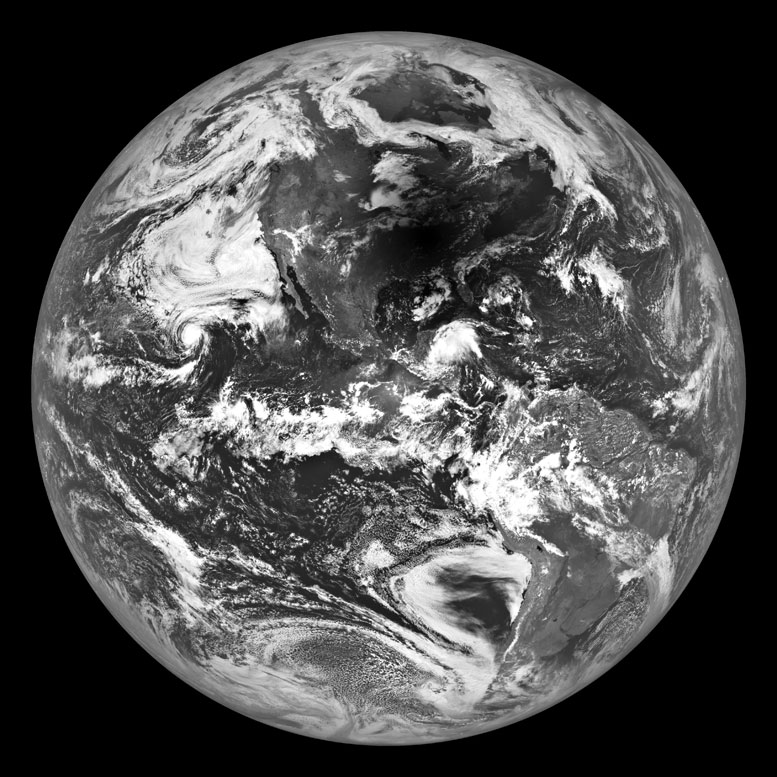
    NASA’s Lunar Reconnaissance Orbiter shows the shadow of the Moon cast on the United States during the August 21, 2017, total solar eclipse. Credit: NASA/GSFC/Arizona State University

    NASA’s Lunar Reconnaissance Orbiter (LRO) captured an image of the Moon’s shadow over a large region of the United States during the total solar eclipse on August 21.

    As LRO crossed the lunar south pole heading north at 3,579 mph (1,600 meters per second), the shadow of the Moon was racing across the United States at 1,500 mph (670 meters per second).

    A few minutes later, LRO began a slow 180-degree turn to look back at Earth, capturing an image of the eclipse very near the location where totality lasted the longest. The spacecraft’s Narrow Angle Camera began scanning Earth at 2:25:30 p.m. EDT (18:25:30 UTC) and completed the image 18 seconds later.

    The Narrow Angle Camera is part of the Lunar Reconnaissance Orbiter Camera system. Two Narrow Angle Cameras capture high-resolution black and white images, and a third, the Wide Angle Camera, captures moderate-resolution images using filters to provide information about the properties and color of the lunar surface.

    The Narrow Angle Camera builds up an image line by line rather than the more typical “instantaneous” framing that occurs with digital or cell-phone cameras. Each line of the image is exposed for less than one-thousandth of a second; the exposure time was set as low as possible to prevent bright clouds from saturating the sensor. It takes about 18 seconds to acquire all 52,224 lines for the image.

    NASA’s Lunar Mission Captures Solar Eclipse as Seen From the Moon
    This animation begins with the black-and-white image of the Moon’s shadow on Earth, as seen by NASA’s Lunar Reconnaissance Orbiter, or LRO. The levels of gray in the image are gradually adjusted, saturating the background until the features of the landscape disappear. At that point, it’s possible to see the edge of the total solar eclipse. As the gray levels are restored, the umbra, or the completely shadowed area, becomes visible, followed by the penumbra, or partial shadow where part of the Sun peaks over the edge of the Moon.LRO’s Narrow Angle Camera can record 3600 gray levels, whereas most digital cameras record only 255 levels of gray. The camera was designed this way because the Moon is a high-contrast target, with very bright materials next to dark materials. In these images, those 3,600 levels of gray were squeezed into 255 levels because that’s what a typical computer screen is capable of displaying. Credit: NASA/GSFC/Arizona State University

    While the thrill of the total eclipse was in experiencing the shadow of the Moon sweep across us on Earth, on the Moon this was just another day. The lunar nearside was one week into its two-week night, while the Sun shone on the far side in the middle of its two-week day. Because solar eclipses do not affect the health or power supply of the spacecraft, LRO operated normally during the total solar eclipse.

    Launched on June 18, 2009, LRO has collected a treasure trove of data with its seven powerful instruments, making an invaluable contribution to our knowledge about the Moon and reminding us, through these eclipse images, of the beauty of our Earth.

    LRO is managed by NASA’s Goddard Space Flight Center in Greenbelt, Maryland, as a project under NASA’s Discovery Program. The Discovery Program is managed by NASA’s Marshall Spaceflight Center in Huntsville, Alabama, for the Science Mission Directorate at NASA Headquarters in Washington.

    The Lunar Reconnaissance Orbiter Camera was developed at Malin Space Science Systems in San Diego, California and Arizona State University.

    For more information about the LRO eclipse image, visit: http://lroc.sese.asu.edu/posts/980

    Never miss a breakthrough: Join the SciTechDaily newsletter.
    Follow us on Google and Google News.

    Astronomy Eclipse Moon NASA's Lunar Reconnaissance Orbiter Planetary Science
    Share. Facebook Twitter Pinterest LinkedIn Email Reddit

    Related Articles

    Scientists Observe Water Molecules Moving Around the Moon

    LRO Spacecraft Reveals Earth’s Moon Hit by Surprising Number of Meteoroids

    LRO Reveals Lunar Hydrogen More Abundant on Moon’s Pole-Facing Slopes

    Lunar Reconnaissance Orbiter Finds Evidence of “Recent” Lunar Volcanism

    Researchers Explain Metamorphosis of Moon’s Water Ice

    New Theoretical Models Salvage Moon-Forming Impact Theory

    Simulation May Explain Saturnian System

    Catalog of Moon’s Craters May Reveal Ice Beyond Moon’s Poles

    LRO Radar Data Indicates That the Walls of Shackleton Crater on the Moon May Hold Ice

    Leave A Reply Cancel Reply

    • Facebook
    • Twitter
    • Pinterest
    • YouTube

    Don't Miss a Discovery

    Subscribe for the Latest in Science & Tech!

    Trending News

    Breakthrough Bowel Cancer Trial Leaves Patients Cancer-Free for Nearly 3 Years

    Natural Compound Shows Powerful Potential Against Rheumatoid Arthritis

    100,000-Year-Old Neanderthal Fossils in Poland Reveal Unexpected Genetic Connections

    Simple “Gut Reset” May Prevent Weight Gain After Ozempic or Wegovy

    2.8 Days to Disaster: Scientists Warn Low Earth Orbit Could Suddenly Collapse

    Common Food Compound Shows Surprising Power Against Superbugs

    5 Simple Ways To Remember More and Forget Less

    The Atomic Gap That Could Cost the Semiconductor Industry Billions

    Follow SciTechDaily
    • Facebook
    • Twitter
    • YouTube
    • Pinterest
    • Newsletter
    • RSS
    SciTech News
    • Biology News
    • Chemistry News
    • Earth News
    • Health News
    • Physics News
    • Science News
    • Space News
    • Technology News
    Recent Posts
    • After 37 Years, the World’s Longest-Running Soil Warming Experiment Uncovers a Startling Climate Secret
    • NASA Satellite Captures First-Ever High-Res View of Massive Pacific Tsunami
    • ADHD Isn’t Just a Deficit: Study Reveals Powerful Hidden Strengths
    • Scientists Uncover “Astonishing” Hidden Property of Light
    • Scientists Discover Stem Cells That Could Regrow Teeth and Bone
    Copyright © 1998 - 2026 SciTechDaily. All Rights Reserved.
    • Science News
    • About
    • Contact
    • Editorial Board
    • Privacy Policy
    • Terms of Use

    Type above and press Enter to search. Press Esc to cancel.