
Close Menu
    Facebook X (Twitter) Instagram
    SciTechDaily
    • Biology
    • Chemistry
    • Earth
    • Health
    • Physics
    • Science
    • Space
    • Technology
    Facebook X (Twitter) Pinterest YouTube RSS
    SciTechDaily
    Home»Space»NASA’s Mars Reconnaissance Orbiter Views Seasonal Terrain on Mars
    Space

    NASA’s Mars Reconnaissance Orbiter Views Seasonal Terrain on Mars

    By SciTechDailyJanuary 12, 20162 Comments2 Mins Read
    Facebook Twitter Pinterest Telegram LinkedIn WhatsApp Email Reddit
    Share
    Facebook Twitter LinkedIn Pinterest Telegram Email Reddit
    New Mars Reconnaissance Orbiter Image
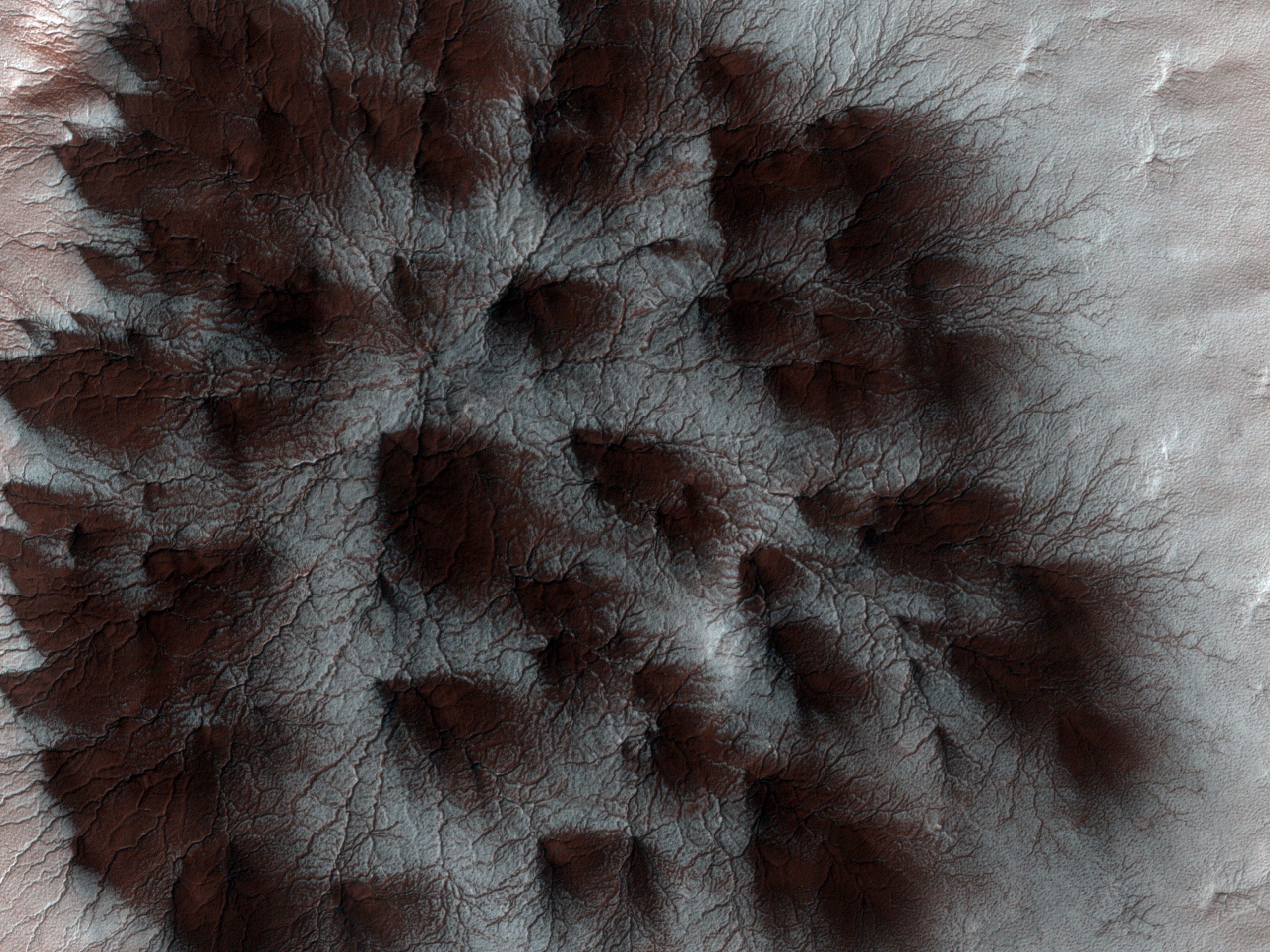
    Every spring, the magnificent landscapes on Mars undergo erosion as the seasonal carbon dioxide ice cap sublimates, transitioning directly from solid to vapor form. Credit: NASA/JPL-Caltech/University of Arizona

    This newly released image shows radial troughs on the surface of Mars.

    Mars’ seasonal cap of carbon dioxide ice has eroded many beautiful terrains as it sublimates (goes directly from ice to vapor) every spring. In the region where the High Resolution Imaging Science Experiment (HiRISE) camera on NASA’s Mars Reconnaissance Orbiter took this image, we see troughs that form a starburst pattern. In other areas, these radial troughs have been referred to as spiders, simply because of their shape. In this region, the pattern looks more dendritic as channels branch out numerous times as they get further from the center.

    The troughs are believed to be formed by gas flowing beneath the seasonal ice to openings where the gas escapes, carrying along dust from the surface below. The dust falls to the surface of the ice in fan-shaped deposits.

    This image, covering an area about 1 kilometer (0.6 miles) across, is a portion of the HiRISE observation cataloged as ESP_011842_0980, taken on February 4, 2009. The observation is centered at 81.8 degrees south latitude, and 76.2 degrees east longitude. The image was taken at a local Mars time of 4:56 p.m. and the scene is illuminated from the west with a solar incidence angle of 78 degrees, thus the sun was about 12 degrees above the horizon. At a solar longitude of 203.6 degrees, the season on Mars is northern autumn.

    Never miss a breakthrough: Join the SciTechDaily newsletter.
    Follow us on Google and Google News.

    Astronomy Mars Mars Reconnaissance Orbiter NASA Planetary Science
    Share. Facebook Twitter Pinterest LinkedIn Email Reddit

    Related Articles

    Ten Years and Counting, Mars Orbiter Still Going Strong

    New NASA Image of the Northern Plains of Mars

    Mars Orbiter Preparing for Mars InSight Lander’s 2016 Arrival

    NASA’s Mars Reconnaissance Orbiter Completes 40,000 Mars Orbits

    Orbiter Examines Clues to Possible Water Flows on Mars

    Mars Reconnaissance Orbiter Examines a New Impact Crater

    Scientists Find Evidence for Granite on Mars

    Data Indicates Temperatures Rise and Fall Twice a Day on Mars

    Mars Orbiter Shows McLaughlin Crater May Have Once Held a Groundwater-Fed Lake

    2 Comments

    1. joe vandevere on January 12, 2016 8:44 pm

      More Nasa lies, fake cgi s, Satanic ties, psychopaths of every sort, playing with little boys for sport, bow to the ball, the balls tell all, selling you a lie, making a haul, bubbles in water, bubbles in space, bubbles in the big old fish tank where it alllll takes place, wake from your slumber, wake from your sleep, my o my the s#!t is getting deep, open your eyes, is it real, are you still, or are you spinning, it’s been known sense the beginning, Pedophile fraud scientists poisoning your brain! Don’t distain, don’t run with the insane, and live free on this glorious plane.

      Reply
    2. Madanagopal.V.C. on January 15, 2016 9:33 am

      Mars is also experiencing seasons like earth. One difference is that in Earth water to cloud bearing rain hover between tropics to beget trade winds and monsoon. Here in Mars since it is already in very cold atmosphere where the gas carbon-di-oxide sublimates directly from solid (ice) form to gas and that is why this putrefaction of soil through which the ice sublimes to gas emanates when weather changes. The age of the water flowing is gone long back and any water is found only as sub-terrain ice in the polar caps of Mars. Thank You.

      Reply
    Leave A Reply Cancel Reply

    • Facebook
    • Twitter
    • Pinterest
    • YouTube

    Don't Miss a Discovery

    Subscribe for the Latest in Science & Tech!

    Trending News

    The Universe Is Expanding Too Fast and Scientists Can’t Explain Why

    “Like Liquid Metal”: Scientists Create Strange Shape-Shifting Material

    Early Warning Signals of Esophageal Cancer May Be Hiding in Plain Sight

    Common Blood Pressure Drug Shows Surprising Power Against Deadly Antibiotic-Resistant Superbug

    Scientists Uncover Dangerous Connection Between Serotonin and Heart Valve Disease

    Scientists Discover a “Protector” Protein That Could Help Reverse Hair Loss

    Bone-Strengthening Discovery Could Reverse Osteoporosis

    Scientists Uncover Hidden Trigger Behind Stem Cell Aging

    Follow SciTechDaily
    • Facebook
    • Twitter
    • YouTube
    • Pinterest
    • Newsletter
    • RSS
    SciTech News
    • Biology News
    • Chemistry News
    • Earth News
    • Health News
    • Physics News
    • Science News
    • Space News
    • Technology News
    Recent Posts
    • Scientists Overcome Major Quantum Bottleneck, Potentially Transforming Teleportation and Computing
    • Quantum Physics’ Strangest Problem May Hold the Key to Time Itself
    • Scientists Create “Liquid Gears” That Spin Without Touching
    • The Simple Habit That Could Help Prevent Cancer
    • Forgotten Medicinal Plant Shows Promise in Fighting Dangerous Superbugs
    Copyright © 1998 - 2026 SciTechDaily. All Rights Reserved.
    • Science News
    • About
    • Contact
    • Editorial Board
    • Privacy Policy
    • Terms of Use

    Type above and press Enter to search. Press Esc to cancel.