
Close Menu
    Facebook X (Twitter) Instagram
    SciTechDaily
    • Biology
    • Chemistry
    • Earth
    • Health
    • Physics
    • Science
    • Space
    • Technology
    Facebook X (Twitter) Pinterest YouTube RSS
    SciTechDaily
    Home»Space»Dawn Images Reveal New Details on Dwarf Planet Ceres
    Space

    Dawn Images Reveal New Details on Dwarf Planet Ceres

    By Elizabeth Landau, Jet Propulsion LaboratoryJanuary 12, 20166 Comments3 Mins Read
    Facebook Twitter Pinterest Telegram LinkedIn WhatsApp Email Reddit
    Share
    Facebook Twitter LinkedIn Pinterest Telegram Email Reddit
    New Details On Ceres Seen in Dawn Images
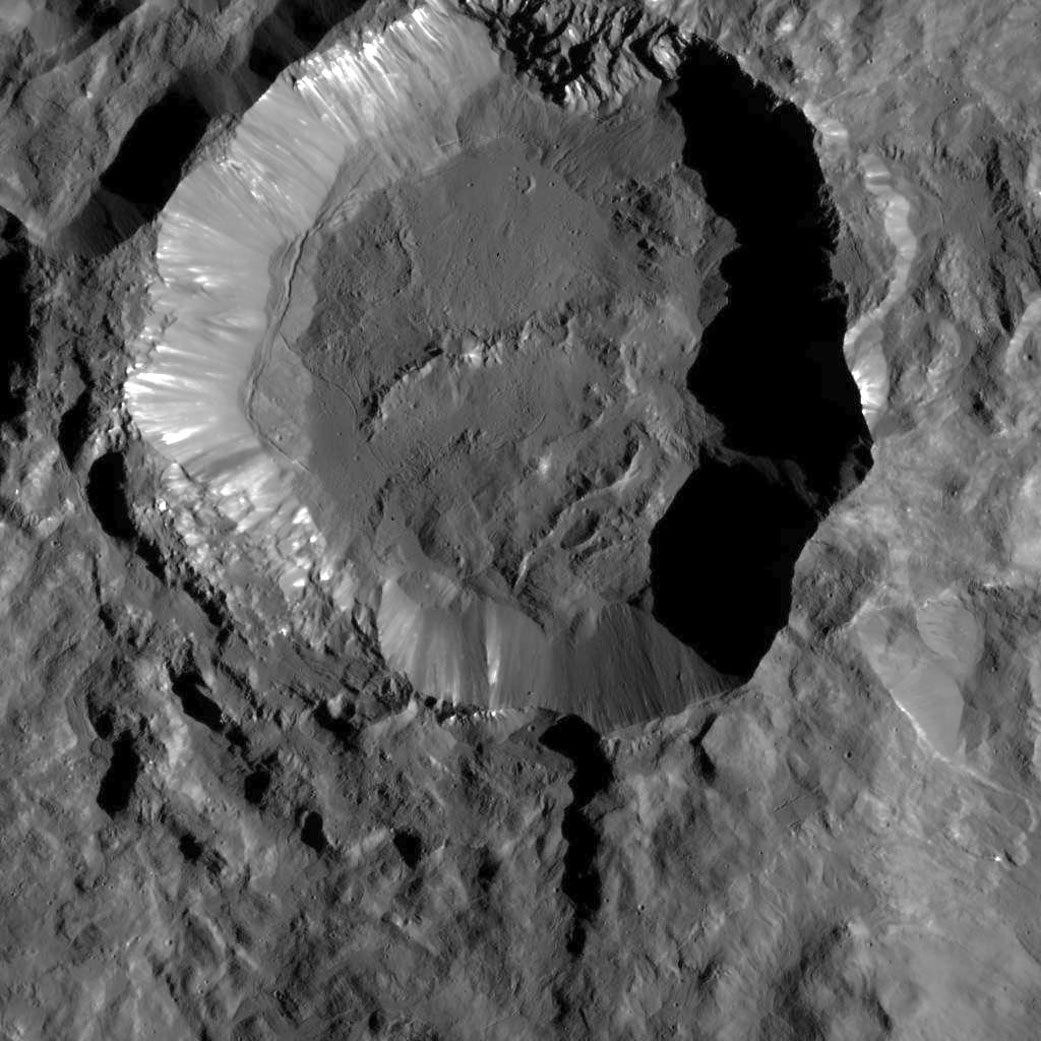
    This image from NASA’s Dawn spacecraft shows Kupalo Crater, one of the youngest craters on Ceres. The crater has bright material exposed on its rim and walls, which could be salts. Its flat floor likely formed from impact melt and debris. Credit: NASA/JPL-Caltech/UCLA/MPS/DLR/IDA

    New images NASA’s Dawn Spacecraft reveal surface features of dwarf planet Ceres in exquisite detail.

    Dawn took these images near its current altitude of 240 miles (385 kilometers) from Ceres, between December 19 and 23, 2015.

    Kupalo Crater, one of the youngest craters on Ceres, shows off many fascinating attributes at the high image resolution of 120 feet (35 meters) per pixel. The crater has bright material exposed on its rim, which could be salts, and its flat floor likely formed from impact melt and debris. Researchers will be looking closely at whether this material is related to the “bright spots” of Occator Crater. Kupalo, which measures 16 miles (26 kilometers) across and is located at southern mid-latitudes, is named for the Slavic god of vegetation and harvest.

    “This crater and its recently-formed deposits will be a prime target of study for the team as Dawn continues to explore Ceres in its final mapping phase,” said Paul Schenk, a Dawn science team member at the Lunar and Planetary Institute, Houston.

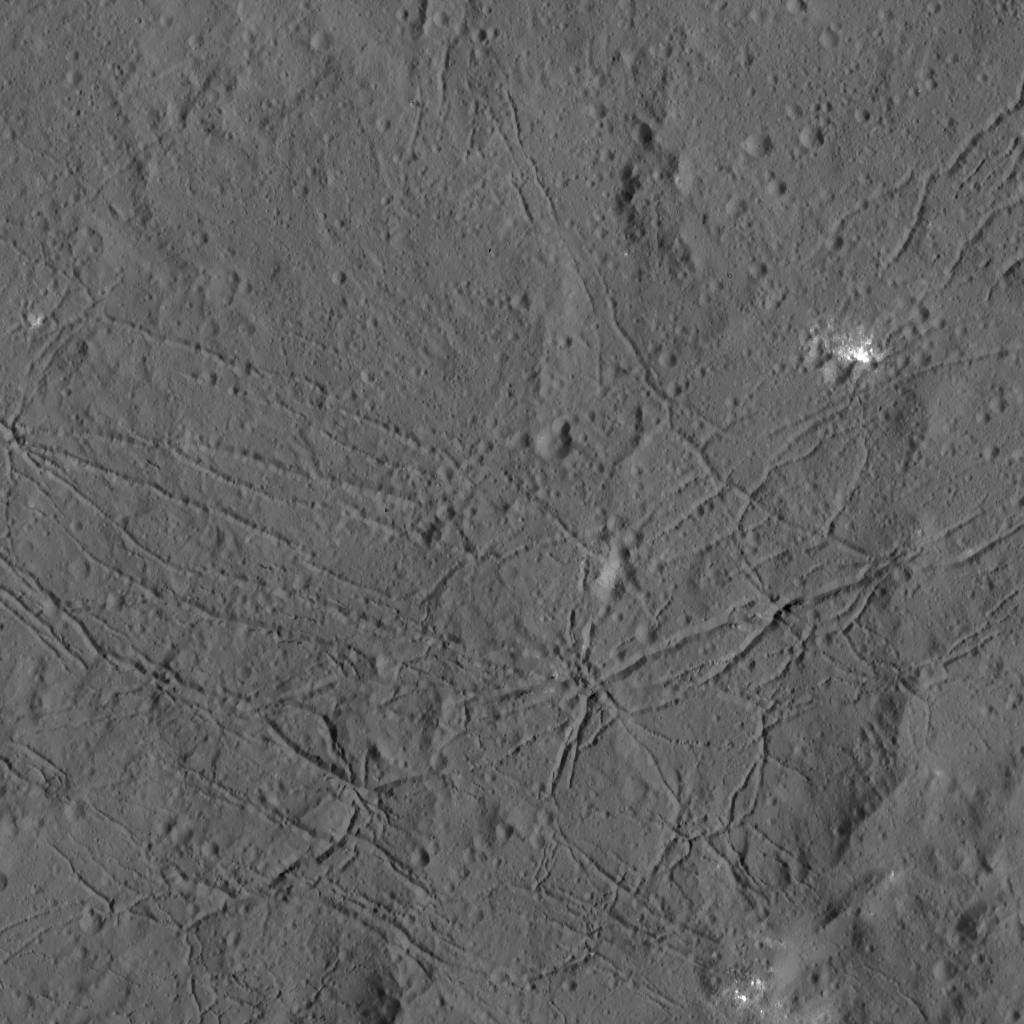
    Dawn’s low vantage point also captured the dense network of fractures on the floor of 78-mile-wide (126-kilometer-wide) Dantu Crater. One of the youngest large craters on Earth’s moon, called Tycho, has similar fractures. This cracking may have resulted from the cooling of impact melt, or when the crater floor was uplifted after the crater formed.
    Cerean Crater on Ceres
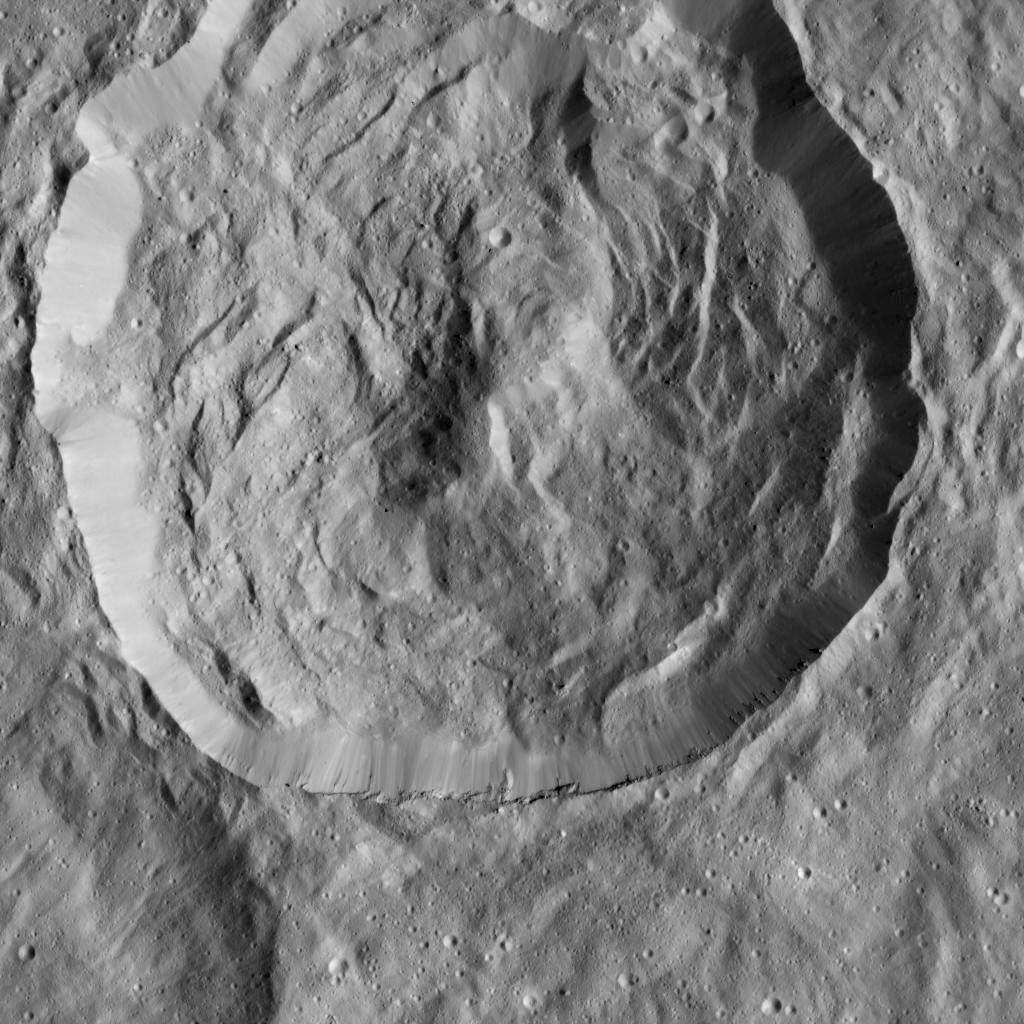
    NASA’s Dawn spacecraft viewed this Cerean crater, which is covered in ridges and steep slopes, called scarps on December 23, 2015. These features likely resulted when the crater partly collapsed during its formation. The curvilinear nature of the scarps resembles those on the floor of Rheasilvia, the giant impact crater on Vesta, which Dawn orbited from 2011 to 2012.
    Image of the Fractured Floor of Dantu Crater on Ceres
    The fractured floor of Dantu Crater on Ceres is seen in this image from NASA’s Dawn spacecraft. Similar fractures are seen in Tycho, one of the youngest large craters on Earth’s moon. This cracking may have resulted from the cooling of impact melt, or when the crater floor was uplifted after the crater formed.
    Dawn Spacecraft Shows Part of Messor Crater
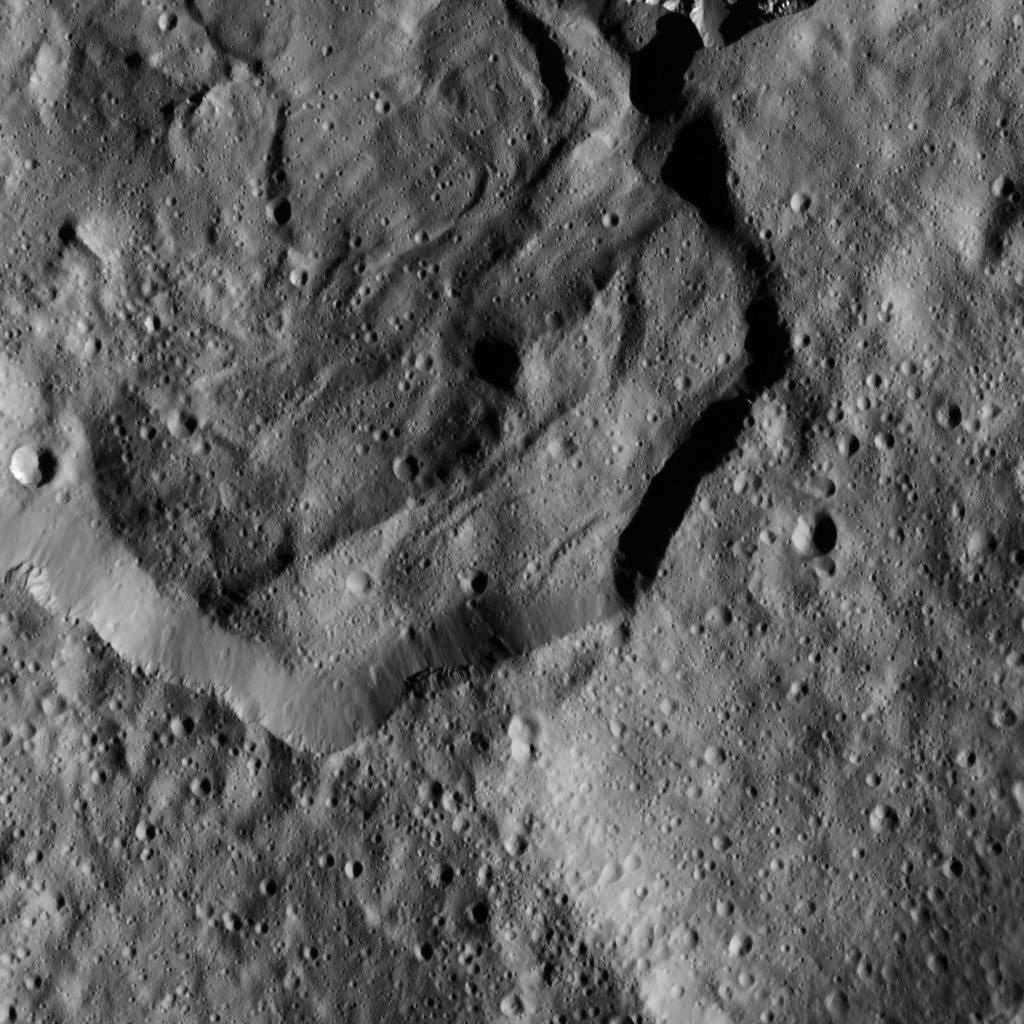
    This image from NASA’s Dawn spacecraft shows part of Messor Crater (25 miles or 40 kilometers, wide), located at northern mid-latitudes on Ceres. The scene shows an older crater in which a large lobe-shaped flow partly covers the northern (top) part of the crater floor. The flow is a mass of material ejected when a younger crater formed just north of the rim.

    A 20-mile (32-kilometer) crater west of Dantu is covered in steep slopes, called scarps, and ridges. These features likely formed when the crater partly collapsed during the formation process. The curvilinear nature of the scarps resembles those on the floor of Rheasilvia, the giant impact crater on protoplanet Vesta, which Dawn orbited from 2011 to 2012.

    Dawn’s other instruments also began studying Ceres intensively in mid-December. The visible and infrared mapping spectrometer is examining how various wavelengths of light are reflected by Ceres, which will help identify minerals present on its surface.

    Dawn’s gamma ray and neutron detector (GRaND) is also keeping scientists busy. Data from GRaND help researchers understand the abundance of elements in Ceres’ surface, along with details of the dwarf planet’s composition that hold important clues about how it evolved.

    The spacecraft will remain at its current altitude for the rest of its mission, and indefinitely afterward. The end of the prime mission will be June 30, 2016.

    “When we set sail for Ceres upon completing our Vesta exploration, we expected to be surprised by what we found on our next stop. Ceres did not disappoint,” said Chris Russell, principal investigator for the Dawn mission, based at the University of California, Los Angeles. “Everywhere we look in these new low-altitude observations, we see amazing landforms that speak to the unique character of this most amazing world.”

    Dawn is the first mission to visit a dwarf planet, and the first mission outside the Earth-moon system to orbit two distinct solar system targets. After orbiting Vesta for 14 months in 2011 and 2012, it arrived at Ceres on March 6, 2015.

    Never miss a breakthrough: Join the SciTechDaily newsletter.
    Follow us on Google and Google News.

    Astronomy Ceres Dawn Spacecraft NASA Planetary Science
    Share. Facebook Twitter Pinterest LinkedIn Email Reddit

    Related Articles

    Dawn Spacecraft Reveals New Maps and Insights about Ceres

    New Up-Close View of the Bright Spots on Ceres

    NASA’s Dawn Spacecraft Delivers Sharper Images Ceres

    New NASA Video Highlights Dwarf Planet Ceres

    NASA’s Dawn Reveals Topography of Dwarf Planet Ceres

    Ceres Spots Remain a Mystery in Latest Dawn Images

    New Fly Over Video Shows a Unique Perspective of Ceres

    A New View of Ceres, Dawn Shows Finer Detail

    New Images by NASA’s Dawn Spacecraft Show Mysterious Bright Spots on Ceres

    6 Comments

    1. HENRY T. PAISTE, III on January 12, 2016 8:13 pm

      PERFECTLY AMAZING – TAKES ME BACK TO MY HIGH-SCHOOL/COLLEGE DAYS WHEN I WAS ABLE TO STUDY PHYSICS, MINERALOGY/ETC.

      SO GLAD I FOUND THIS SITE – AND WILL KEY IN MY FRIENDS WITH INTERESTS IN
      THIS AREA.

      H.T.PAISTE, III

      Reply
    2. HENRY T. PAISTE, III on January 12, 2016 8:16 pm

      THIS INFORMATION SHOULD BE MADE AVAILABLE TO EVERY HIGH SCHOOL/COLLEGE IN THE UNITED STATES – FOR BENEFIT OF THE KIDS WHO ARE STUDYING PHYSICS, SPACE, SCIENCE, ETC ETC.

      VERY EXITING – THANKS FOR PRESENTING IT !

      Reply
    3. joe vandevere on January 12, 2016 8:38 pm

      More Nasa lies, fake cgi s, Satanic ties, psychopaths of every sort, playing with little boys for sport, bow to the ball, the balls tell all, selling you a lie, making a haul, bubbles in water, bubbles in space, bubbles in the big old fish tank where it alllll takes place, wake from your slumber, wake from your sleep, my o my the s#!t is getting deep, open your eyes, is it real, are you still, or are you spinning, it’s been known sense the beginning, Pedophile fraud scientists poisoning your brain! Don’t distain, don’t run with the insane, and live free on this glorious plane.

      Reply
    4. Zellbug on January 13, 2016 5:20 am

      Better resolution than what we have of the moon. So what is NASA hiding about the moon.

      Reply
    5. Loren Avey on January 13, 2016 7:42 am

      Looks suspiciously like a mining operation.

      Reply
    6. Madanagopal.V.C. on January 15, 2016 9:39 am

      Sublimation of some gas like CO2, directly from solid ice form to gas form may also be reason for this strange craters of the planet Ceres. This may be due to some ice volcano as what we may call? Normal spitting of volcanic material should spread evenly in a circular smooth crater only. Only if some cold gas from sublimation gushes out of the surface can create these strange phenomena. Thank You.

      Reply
    Leave A Reply Cancel Reply

    • Facebook
    • Twitter
    • Pinterest
    • YouTube

    Don't Miss a Discovery

    Subscribe for the Latest in Science & Tech!

    Trending News

    Scientists Warn That This Common Pet Fish Can Wreck Entire Ecosystems

    Scientists Make Breakthrough in Turning Plastic Trash Into Clean Fuel Using Sunlight

    This Popular Supplement May Interfere With Cancer Treatment, Scientists Warn

    Scientists Finally Solved One of Water’s Biggest Mysteries

    Could This New Weight-Loss Pill Disrupt the Entire Market? Here’s What You Should Know About Orforglipron

    Earth’s Crust Is Tearing Open in Africa, and It Could Form a New Ocean

    Breakthrough Bowel Cancer Trial Leaves Patients Cancer-Free for Nearly 3 Years

    Natural Compound Shows Powerful Potential Against Rheumatoid Arthritis

    Follow SciTechDaily
    • Facebook
    • Twitter
    • YouTube
    • Pinterest
    • Newsletter
    • RSS
    SciTech News
    • Biology News
    • Chemistry News
    • Earth News
    • Health News
    • Physics News
    • Science News
    • Space News
    • Technology News
    Recent Posts
    • Ancient Roman Ship Coating Reveals Secrets Hidden for 2,200 Years
    • Enormous Prehistoric Insects Puzzle Scientists
    • College Student Identifies Bizarre New Carnivorous Dinosaur Three Times Older Than T. rex
    • The Most Effective Knee Arthritis Treatments Aren’t What You Expect
    • Scientists Develop Bioengineered Chewing Gum That Could Help Fight Oral Cancer
    Copyright © 1998 - 2026 SciTechDaily. All Rights Reserved.
    • Science News
    • About
    • Contact
    • Editorial Board
    • Privacy Policy
    • Terms of Use

    Type above and press Enter to search. Press Esc to cancel.