

Close Menu
    Facebook X (Twitter) Instagram
    SciTechDaily
    • Biology
    • Chemistry
    • Earth
    • Health
    • Physics
    • Science
    • Space
    • Technology
    Facebook X (Twitter) Pinterest YouTube RSS
    SciTechDaily
    Home»Space»NASA’s Mars Sample Return Mission Shields Up for Tests
    Space

    NASA’s Mars Sample Return Mission Shields Up for Tests

    By Rani Gran, NASA's Goddard Space Flight CenterOctober 17, 2022No Comments4 Mins Read
    Facebook Twitter Pinterest Telegram LinkedIn WhatsApp Email Reddit
    Share
    Facebook Twitter LinkedIn Pinterest Telegram Email Reddit
    NASA's Mars Earth Entry System
     The Earth Entry System would contain the orbiting sample inside a disk-shaped vehicle with a heat shield for safe entry through the Earth’s atmosphere. Credit: NASA/GSFC

    NASA is testing shields against micrometeorite impacts for the Mars Sample Return mission using high-speed projectiles.

    A potential hazard for any space mission, including NASA’s Mars Sample Return, is micrometeorites. These tiny rocks can travel up to 50 miles per second (180,000 mph). At these extreme speeds, “even dust could cause damage to a spacecraft,” said Bruno Sarli, NASA engineer at NASA’s Goddard Space Flight Center in Greenbelt, Maryland.

    Sarli leads a team designing shields to protect NASA’s Mars Earth Entry System from micrometeorites and space debris. To test the team’s shields and computer models, he recently traveled to a NASA lab, designed to safely recreate dangerous impacts.

    Set far away from residents and surrounded by dunes, the Remote Hypervelocity Test Laboratory at NASA’s White Sands Test Facility in Las Cruces, New Mexico, has supported every human spaceflight program from the Space Shuttle to Artemis. The lab also supports testing for the International Space Station (ISS), Commercial Crew, and Commercial Resupply programs.

    2-stage light gas guns are used by the lab to accelerate objects to speeds up to 27,500 feet per second (18,750 mph) that simulate micrometeorite and orbital debris impacts on spacecraft shielding. The first stage uses gunpowder as a propellent the way a standard gun does. The second stage uses highly compressed hydrogen gas that pushes gas into a smaller tube, increasing pressure in the gun, like a car piston. The gun’s pressure gets so high that it would level the building if it were to explode. “That is why we hung out in the bunker during the test,” said Sarli.


    NASA’s Remote Hypervelocity Test Laboratory is equipped with four 2-stage light gas guns; two 0.17-caliber (0.177-inch bore diameter), a 0.50-caliber (0.50″ bore diameter), and a 1-Inch (1.00″ bore diameter) gun at the facility. The 1-Inch range is 160 feet long, from the gunpowder breech to the end of the target chamber outside. Credit: NASA’s Goddard Space Flight Center

    Engineers spent three days preparing for an experiment that lasted just one second. They used the lab’s mid-sized high-pressure (50-caliber range) 2-stage light gas gun that shoots small pellets at speeds of 16,000 to 22,000 feet per second (11,000 to 15,000 mph). “At that speed, you could travel from San Francisco to New York in five minutes,” said Dennis Garcia, the .50-caliber test conductor at White Sands.

    Simulating Micrometeorite Speeds and Shield Testing

    While the pellet’s speed is incredibly fast, micrometeorites actually travel six to seven times faster in space. As a result, the team relies on computer models to simulate the actual velocities of micrometeorites. The slower rate will test their computer model’s ability to simulate impacts on their shield designs and allows the research team to study the material reaction to such energy.
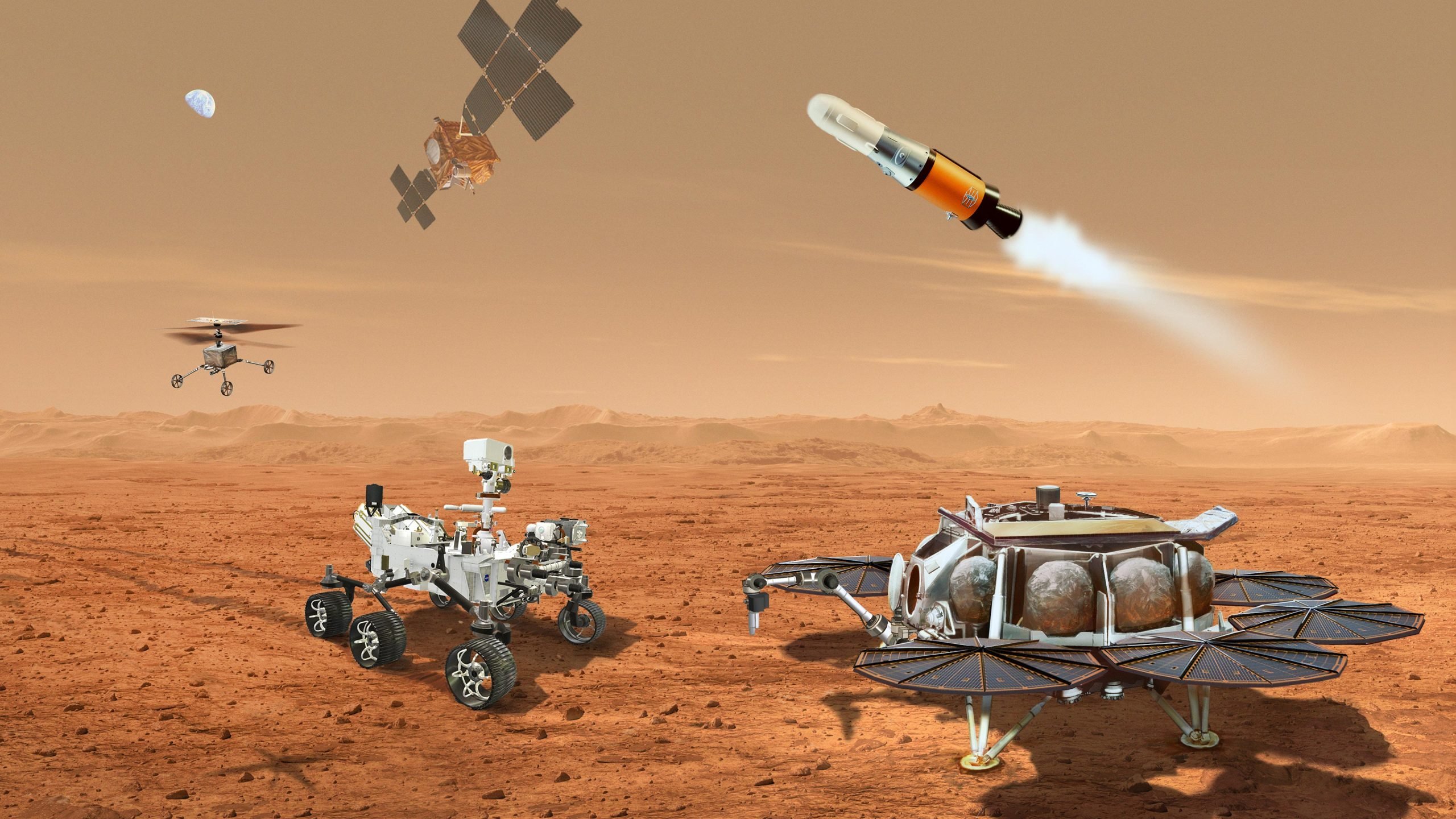
    Multiple Robots NASA Mars Sample Return Mission
    This illustration shows a concept for multiple robots that would team up to ferry to Earth samples collected from the Mars surface by NASA’s Mars Perseverance rover. Credit: NASA/JPL-Caltech

    Mars Sample Return is a multi-mission campaign designed to retrieve scientifically selected samples of rock and sediment that NASA’s Perseverance rover is currently collecting on the surface of the Red Planet. Bringing those samples to Earth would allow scientists to study them using the most advanced laboratory instruments-those that will exist in the coming decade and those in the decades to follow. The campaign is one of the most ambitious endeavors in spaceflight history, involving multiple spacecraft, multiple launches, and multiple government agencies. Goddard is currently designing and developing the Capture, Containment, and Return System that would deliver the Mars sample tubes back to Earth.

    Never miss a breakthrough: Join the SciTechDaily newsletter.
    Follow us on Google and Google News.

    Mars Mars Sample Return NASA NASA Goddard Space Flight Center
    Share. Facebook Twitter Pinterest LinkedIn Email Reddit

    Related Articles

    NASA’s Curiosity Rover Finds Organic Molecules on Mars That Meteorites Can’t Explain

    Life on Mars? NASA’s Curiosity Rover Finds Prebiotic Clues in a 3.7-Billion-Year-Old Rock

    Evidence of Life on Mars? NASA’s Bold Strategy to Recover the Proof

    Mars Revealed: NASA’s Curiosity Rover Uncovers the Red Planet’s Shocking Climate Shift

    NASA’s MAVEN at 10: Unveiling the Red Planet’s Hidden Atmosphere

    The Great Escape: NASA’s Hubble and MAVEN Help Solve Mystery of Mars’ Vanishing Water

    Atmospheric Time Capsules: Why Scientists Are Intrigued by Air in NASA’s Mars Sample Tubes

    “Mind Boggling” Mars Mystery As Oxygen Doesn’t Behave by Known Chemistry

    Mars’ Moon Phobos Shows Signs of Structural Failure

    Leave A Reply Cancel Reply

    • Facebook
    • Twitter
    • Pinterest
    • YouTube

    Don't Miss a Discovery

    Subscribe for the Latest in Science & Tech!

    Trending News

    Your Blood Pressure Reading Could Be Wrong Because of One Simple Mistake

    Astronomers Stunned by Ancient Galaxy With No Spin

    Physicists May Be on the Verge of Discovering “New Physics” at CERN

    Scientists Solve 320-Million-Year Mystery of Reptile Skin Armor

    Scientists Say This Daily Walking Habit May Be the Secret to Keeping Weight Off After Dieting

    New Therapy Rewires the Brain To Restore Joy in Depression Patients

    Giant Squid Detected off Western Australia in Stunning Deep-Sea Discovery

    Popular Sugar-Free Sweetener Linked to Liver Disease, Study Warns

    Follow SciTechDaily
    • Facebook
    • Twitter
    • YouTube
    • Pinterest
    • Newsletter
    • RSS
    SciTech News
    • Biology News
    • Chemistry News
    • Earth News
    • Health News
    • Physics News
    • Science News
    • Space News
    • Technology News
    Recent Posts
    • New Stroke Study Challenges Decades-Old Medical Beliefs
    • These Simple Plant Foods Are Linked to Lower Blood Pressure
    • Common Blood Pressure Drug Supercharges Cancer Treatment in Surprising New Study
    • Key Magic Mushroom Ingredient Increases Laziness and Reduces Aggression
    • Researchers Solve 15-Year Mystery Behind Cancer-Causing Gut Toxin
    Copyright © 1998 - 2026 SciTechDaily. All Rights Reserved.
    • Science News
    • About
    • Contact
    • Editorial Board
    • Privacy Policy
    • Terms of Use

    Type above and press Enter to search. Press Esc to cancel.