

NASA’s upcoming Pandora mission, poised for launch later this year, promises to revolutionize our understanding of exoplanet atmospheres by studying at least 20 distant planets.
With a dedicated spacecraft capable of long-duration observations, Pandora aims to provide critical data that will complement insights from the James Webb Space Telescope, focusing particularly on the analysis of hazes, clouds, and water in these alien worlds.
Pandora Mission Takes Shape
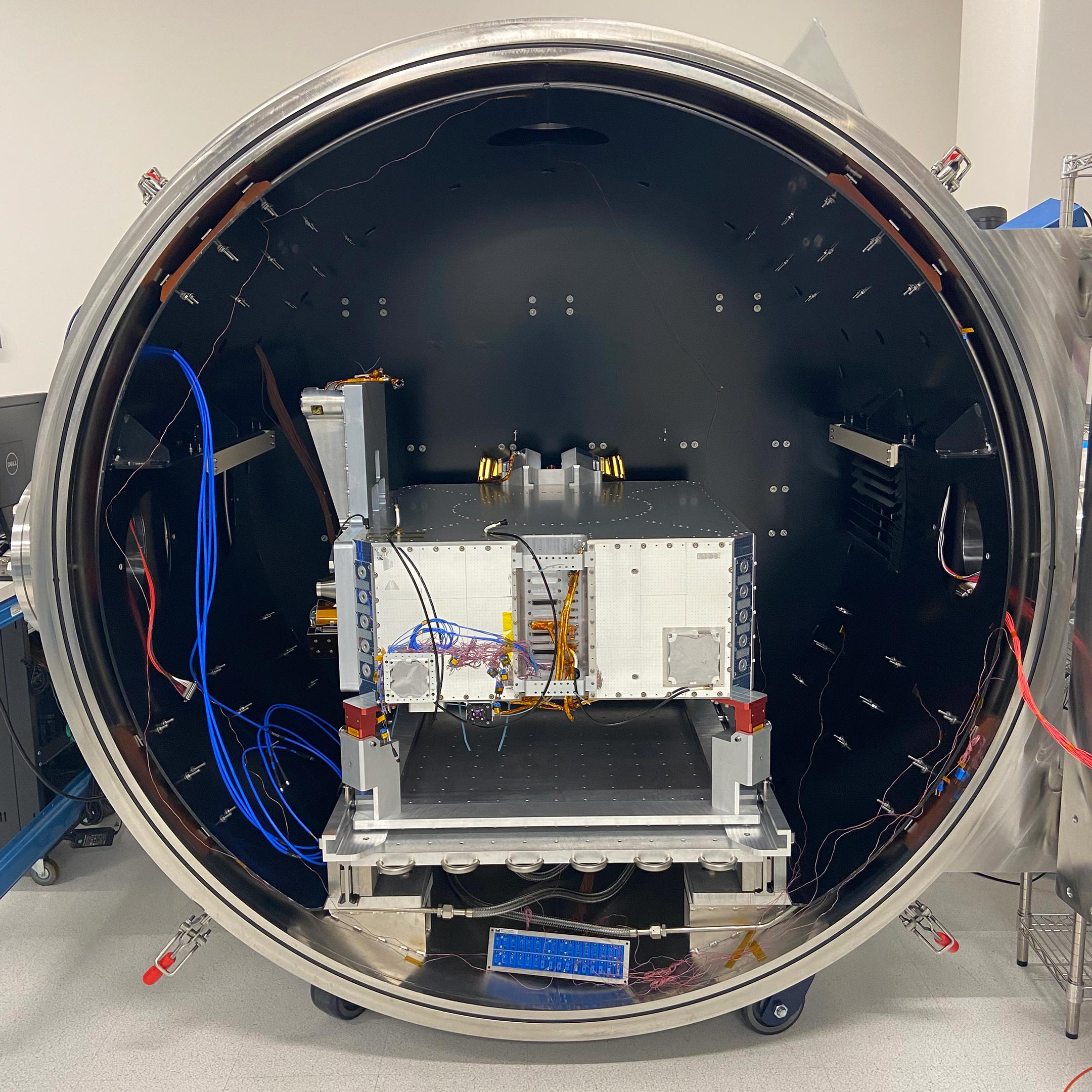
Pandora, NASA’s latest exoplanet-focused mission, has moved closer to launch with the completion of its spacecraft bus. This critical component provides the structure, power, and essential systems needed for the mission’s operations. The exoplanet science working group for Pandora is led by the University of Arizona, marking it as the first mission to operate from the U of A Space Institute.
The milestone was officially announced today (January 16) during a press briefing at the 245th Meeting of the American Astronomical Society in National Harbor, Maryland.
“This is a huge milestone for us and keeps us on track for a launch in the fall,” said Elisa Quintana, Pandora’s principal investigator at NASA’s Goddard Space Flight Center in Greenbelt, Maryland. “The bus holds our instruments and handles navigation, data acquisition, and communication with Earth – it’s the brains of the spacecraft.”
Revolutionary Atmospheric Studies
Pandora is a small satellite poised to provide in-depth study of at least 20 known planets orbiting distant stars to determine the composition of their atmospheres – especially the presence of hazes, clouds, and water. The data will establish a firm foundation for interpreting measurements by NASA’s James Webb Space Telescope and future missions aimed at searching for habitable worlds.
“Although smaller and less sensitive than Webb, Pandora will be able to stare longer at the host stars of extrasolar planets, allowing for deeper study,” said Pandora co-investigator Daniel Apai, professor of astronomy and planetary sciences at the U of A Steward Observatory and Lunar and Planetary Laboratory who leads the mission’s Exoplanets Science Working Group. “Better understanding of the stars will help Pandora and its ‘big brother,’ the James Webb Space Telescope, disentangle signals from stars and their planets.”
The Challenge of Mixed Signals
Astronomers can sample an exoplanet’s atmosphere when it passes in front of its star as seen from Earth’s perspective, during an event known as a transit. Part of the star’s light skims the planet’s atmosphere before making its way to the observer. This interaction allows the light to interact with atmospheric substances, and their chemical fingerprints — dips in brightness at characteristic wavelengths — become imprinted in the light.
Born of Necessity
The concept of Pandora was born out of necessity to overcome a snag in observing starlight passing through the atmospheres of exoplanets, Apai said.
“In 2018, a doctoral student in my group, Benjamin Rackham – now an MIT research scientist – described an astrophysical effect by which light coming directly from the star muddies the signal of the light passing through the exoplanet’s atmosphere,” Apai explained. “We predicted that this effect would limit Webb’s ability to study habitable planets.”
Telescopes see light from the entire star, not just the small amount grazing the planet. Stellar surfaces aren’t uniform. They sport hotter, unusually bright regions called faculae and cooler, darker regions similar to the spots on our sun, both of which grow, shrink and change position as the star rotates. As a result, these “mixed signals” in the observed light can make it difficult to distinguish between light that has passed through an exoplanet’s atmosphere and light that varies based on a star’s changing appearance. For example, variations in light from the host star can mask or mimic the signal of water, a likely key ingredient researchers look for when evaluating an exoplanet’s potential for harboring life.
Advanced Telescope Technology
Using a novel all-aluminum, 45-centimeter-wide telescope, jointly developed by Lawrence Livermore National Laboratory and Corning Specialty Materials in Keene, New Hampshire, Pandora’s detectors will capture each star’s visible brightness and near-infrared spectrum at the same time, while also obtaining the transiting planet’s near-infrared spectrum. This combined data will enable the science team to determine the properties of stellar surfaces and cleanly separate star and planetary signals.
The observing strategy takes advantage of the mission’s ability to continuously observe its targets for extended periods, something flagship observatories like Webb, which offer limited observing time due to high demand, cannot regularly do.
Yearlong Mission Plan
Over the course of its yearlong mission, Pandora will observe at least 20 exoplanets 10 times, with each stare lasting a total of 24 hours. Each observation will include a transit, which is when the mission will capture the planet’s spectrum.
Karl Harshman, who leads the Mission Operations Team at the U of A Space Institute that will support the spacecraft’s operation once it launches later this year, said: “We have a very excited team that has been working hard to have our Mission Operations Center running at full speed at the time of launch and look forward to receiving science data. Just this week, we performed a communications test with our antenna system that will transmit commands to Pandora and receive the telemetry from the spacecraft.”
The Pandora mission is led by NASA’s Goddard Space Flight Center, with project management and engineering support provided by Lawrence Livermore National Laboratory. The telescope for Pandora was manufactured by Corning in collaboration with Livermore, which also developed the imaging detector assemblies, mission control electronics, and thermal and mechanical subsystems.
NASA Goddard supplied the mission’s infrared sensor, while Blue Canyon Technologies provided the spacecraft bus and is handling assembly, integration, and environmental testing. Data processing for the mission will be conducted at NASA’s Ames Research Center in California’s Silicon Valley. Pandora’s mission operations center is based at the University of Arizona, with contributions from a broad network of additional universities supporting the science team.
Never miss a breakthrough: Join the SciTechDaily newsletter.
Follow us on Google and Google News.