
Parker Solar Probe Unveils Venus’ Dust Ring
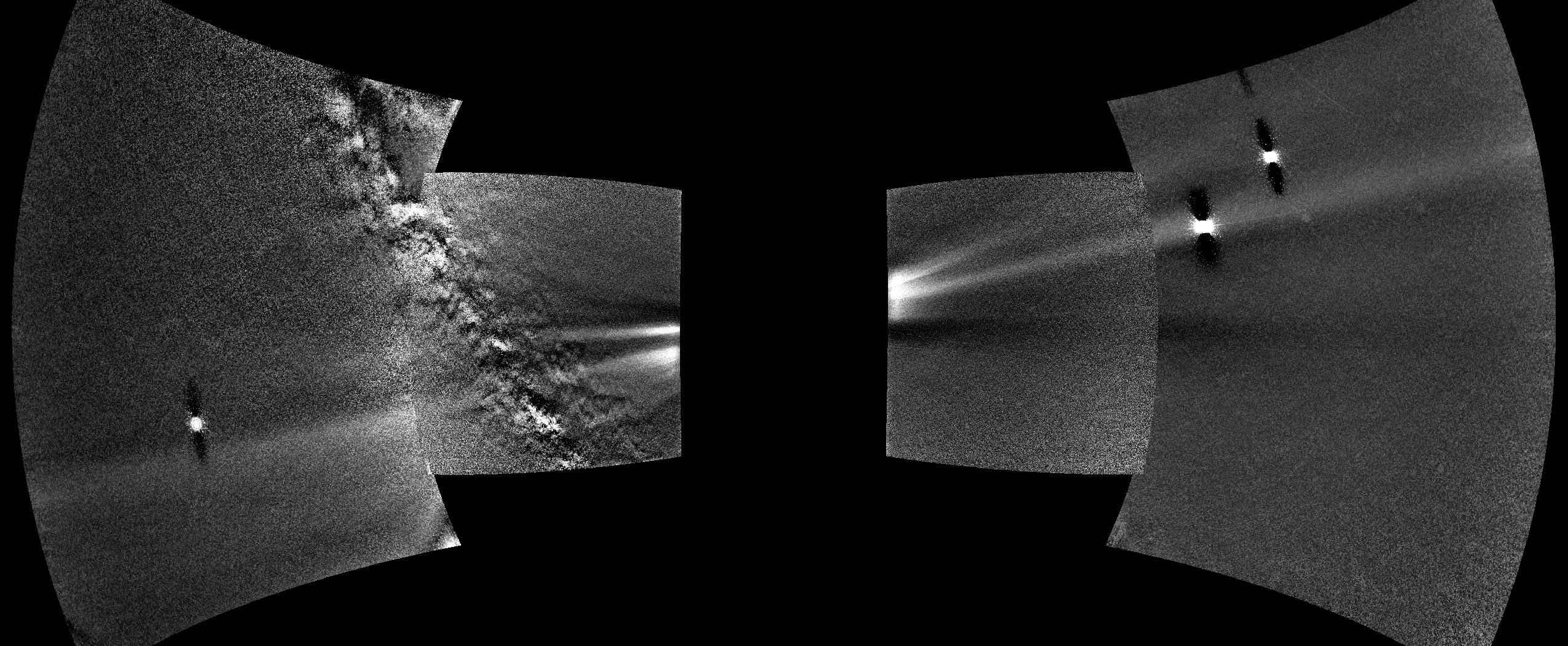
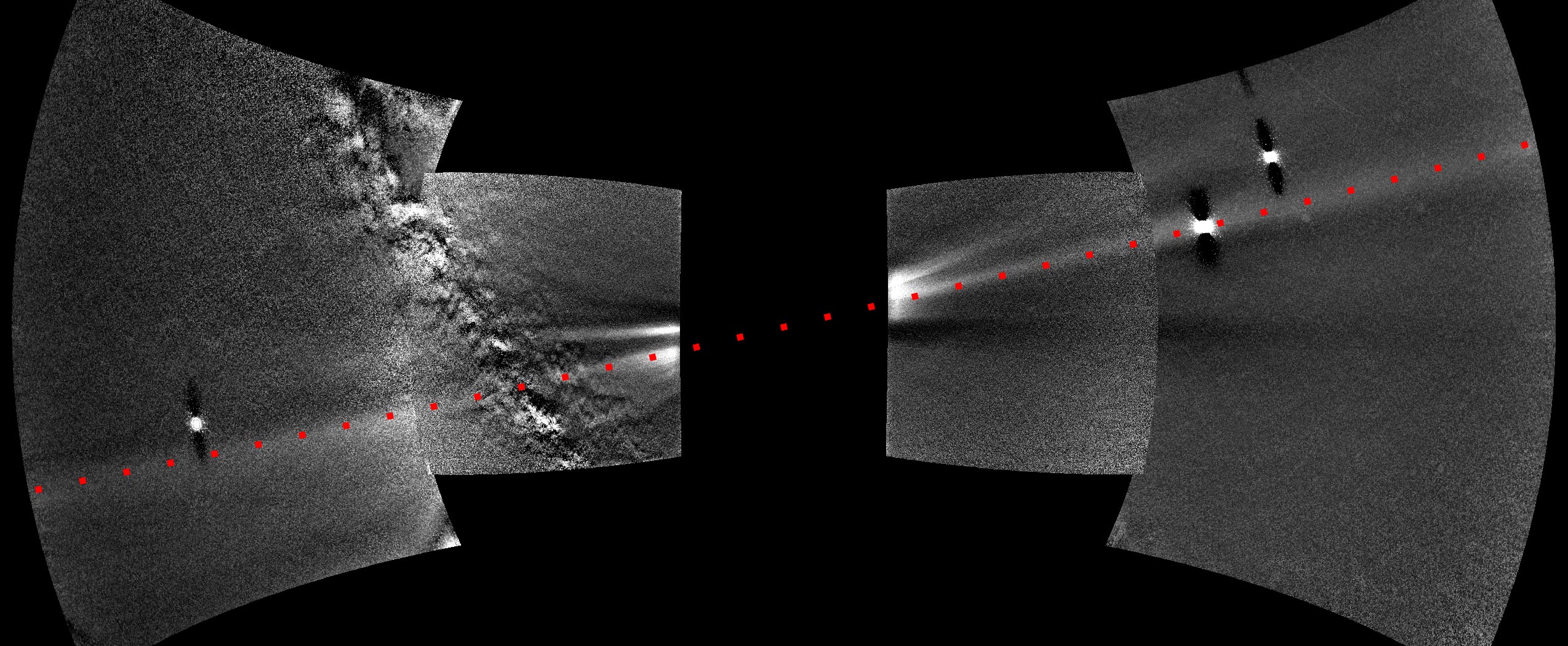
NASA’s Parker Solar Probe mission has given scientists the first complete look at Venus’ orbital dust ring, a collection of microscopic dust particles that circulates around the Sun along Venus’ orbit. Though earlier missions have made some observations of Venus’ orbital dust ring, Parker Solar Probe’s images are the first to show the planet’s dust ring for nearly its entire 360-degree span around the Sun.
Parker Solar Probe’s WISPR instrument — short for Wide-field Imager for Solar Probe — is designed to study the solar wind, the Sun’s constantly outflowing material. Space is teeming with dust, which reflects so much light that it typically shines at least a hundred times brighter than the solar wind. (The light reflected from space dust is what creates the zodiacal light, sometimes visible from Earth as a faint column of light rising upward from the horizon.)
Revealing a Hidden Band
In order to see the solar wind with WISPR, scientists use image processing to remove the dust background and stars from the images. This process worked so well that Venus’ orbital dust ring — which appears as a bright band stretching across the images — was subtracted as well. It wasn’t until Parker Solar Probe performed rolling maneuvers to manage its momentum on its way to its next solar flyby, which changed the orientation of its cameras, that the static dust ring was noticed by scientists. Based on the relative brightness, scientists estimate that the dust along Venus’ orbit is about 10% more dense than in neighboring regions. The results were published on April 7, 2021, in The Astrophysical Journal. Read more about Parker Solar Probe’s observations from the Johns Hopkins University Applied Physics Laboratory, which designed, built, and operates the spacecraft.
The German-American Helios spacecraft and NASA’s STEREO mission — short for Solar Terrestrial Relations Observatory — have both made earlier observations of the dust ring along Venus’ orbit. Those measurements have allowed scientists to develop new models of the origins of dust along Venus’ orbit. Parker Solar Probe’s sensitive imagers and unique orbit have given scientists an unprecedented peek at Venus’ dust ring — something the science team aimed for since the mission’s early days.
This animation shows the geometry of the dust rings along the orbits of Mercury, Venus, and Earth, along with Parker Solar Probe’s trajectory. Only the dust along these planets’ orbital paths is shown — the dust near the Sun and between the planets’ orbits is omitted for clarity. Credit: NASA/Johns Hopkins APL/Ben Smith
As Parker Solar Probe flies ever-closer to the Sun over the course of its mission, the science team also expects to make the first observations of a long-hypothesized dust-free zone, a region close to the Sun where dust has been heated and vaporized by the intense sunlight. If there is a dust-free zone near the Sun — an idea supported by regions of thinning dust that Parker Solar Probe has already observed from afar — this would not only confirm theories about the interaction between our star and its nearby dust, but could also help astrophysicists who study more distant objects: Just as space dust can interfere with seeing the solar wind, it can also muddle measurements of stars and galaxies.
The Origin of Space Dust
However, for many scientists, the dust itself is what’s interesting. For example, the exact origins of the dust that fills the solar system isn’t settled science. For decades, scientists have largely thought the dust is debris from comets and asteroids — but new research using data from NASA’s Juno mission to Jupiter suggests that dust storms on Mars could be the source of much of the solar system’s dust.
Space dust may also form the building blocks of stars and planets, carry gases between star systems, and provide a nurturing environment for young planets. These were some of the questions in mind for scientists on the DUST sounding rocket mission — short for Determining Unknown yet Significant Traits — which launched in 2019 to investigate how dust grains coagulate in the microgravity of space.
Reference: “Pristine PSP/WISPR Observations of the Circumsolar Dust Ring near Venus’s Orbit” by Guillermo Stenborg, Brendan Gallagher, Russell A. Howard, Phillip Hess and Nour Eddine Raouafi, 7 April 2021, The Astrophysical Journal.
DOI: 10.3847/1538-4357/abe623
Parker Solar Probe is part of NASA’s Living with a Star program to explore aspects of the Sun-Earth system that directly affect life and society. The Living with a Star program is managed by the agency’s Goddard Space Flight Center in Greenbelt, Maryland, for NASA’s Science Mission Directorate in Washington. Johns Hopkins APL in Laurel, Maryland, manages the Parker Solar Probe mission for NASA and designed, built, and operates the spacecraft. The Naval Research Laboratory in Washington, D.C, designed, developed, and operates the WISPR instrument on Parker Solar Probe.
Never miss a breakthrough: Join the SciTechDaily newsletter.
Follow us on Google and Google News.
5 Comments
The dumbed down masses beleive anything
* believe. Fify genius
Try worrying about your dumb butt being blinded by fake space and not how a person spells a certain word. Your education has done nothing for your programmed brain.
This is some BS why don’t they just show you the pictures why do they have to just break them up, I’ll try us all why because it’s BS.
At least one person on here has a brain that sees reality.