
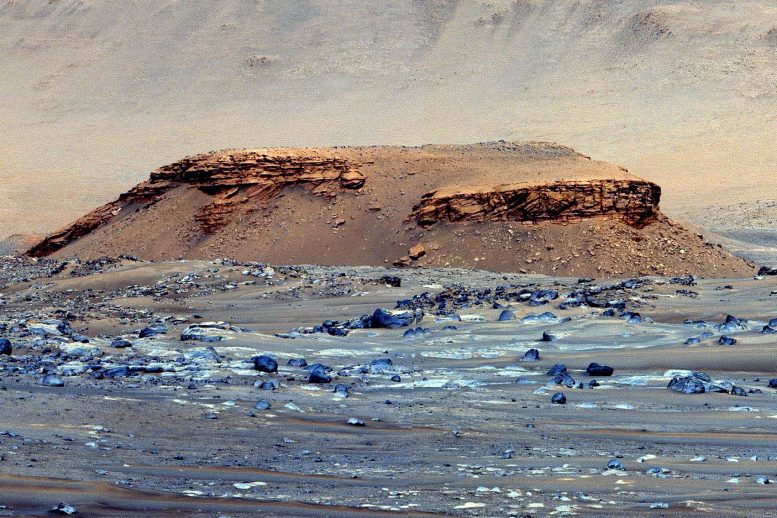
Rock samples from the Jezero crater analyzed by NASA’s Perseverance Mars rover show evidence of liquid water and signatures that could be organic compounds.
Analyses of multiple rocks found at the bottom of Jezero Crater on Mars, where the Perseverance rover landed in 2020, has revealed significant interaction between the rocks and liquid water. Evidence consistent with the presence of organic compounds has also been discoved in those rocks.
“I hope that one day these samples could be returned to Earth so that we can explore whether conditions were right for life in the early history of Mars.” Professor Mark Sephton
Organic compounds (chemical compounds with carbon–hydrogen bonds) can be created through nonbiological processes, so the mere existence of these compounds is not direct evidence of life. To determine this conclusively, a future mission returning the samples to Earth would be needed.
Led by researchers at Caltech and carried out by an international team including Imperial College London researchers, the study was published on November 23 in the journal Science.
Professor Mark Sephton, from the Imperial College London Department of Earth Science & Engineering, is a member of the science team who took part in rover operations on Mars and considered the implications of the results. He said: “I hope that one day these samples could be returned to Earth so that we can look at the evidence of water and possible organic matter, and explore whether conditions were right for life in the early history of Mars.”
Moving water
Perseverance previously found organic compounds at Jezero’s delta. Deltas are fan-shaped geologic formations created at the intersection of a river and a lake at the edge of the crater.
Mission scientists had been particularly interested in the Jezero delta because such formations can preserve microorganisms. Deltas are created when a river transporting fine-grained sediments enters a deeper, slower-moving body of water. As the river water spreads out, it abruptly slows down, depositing the sediments it is carrying and trapping and preserving any microorganisms that may exist in the water.
However, the crater floor, where the rover landed for safety reasons before traveling to the delta, was more of a mystery. In lake beds, the researchers expected to find sedimentary rocks, because the water deposits layer after layer of sediment. However, when the rover touched down there, some researchers were surprised to find igneous rocks (cooled magma) on the crater floor with minerals in them that recorded not just igneous processes but significant contact with water.
These minerals, such as carbonates and salts, require water to circulate in the igneous rocks, carving out niches and depositing dissolved minerals in different areas like voids and cracks. In some places, the data show evidence for organics within these potentially habitable niches.
Discovered by SHERLOC
The minerals and co-located possible organic compounds were discovered using SHERLOC, or the Scanning Habitable Environments with Raman & Luminescence for Organics & Chemicals instrument.
Mounted on the rover’s robotic arm, SHERLOC is equipped with a number of tools, including a Raman spectrometer that uses a specific type of fluorescence to search for organic compounds and also see how they are distributed in a material, providing insight into how they were preserved in that location.
Bethany Ehlmann, co-author of the paper, professor of planetary science, and associate director of the Keck Institute for Space Studies, said: “The microscopic compositional imaging capabilities of SHERLOC have really blown open our ability to decipher the time-ordering of Mars’s past environments.”
As the rover rolled toward the delta, it took several samples of the water-altered igneous rocks and cached them for a possible future sample-return mission. The samples would need to be returned to Earth and examined in laboratories with advanced instrumentation in order to determine definitively the presence and type of organics and whether they have anything to do with life.
Reference: “Aqueous alteration processes in Jezero crater, Mars−implications for organic geochemistry” by Eva L. Scheller, Joseph Razzell Hollis, Emily L. Cardarelli, Andrew Steele, Luther W. Beegle, Rohit Bhartia, Pamela Conrad, Kyle Uckert, Sunanda Sharma, Bethany L. Ehlmann, William J. Abbey, Sanford A. Asher, Kathleen C. Benison, Eve L. Berger, Olivier Beyssac, Benjamin L. Bleefeld, Tanja Bosak, Adrian J. Brown, Aaron S. Burton, Sergei V. Bykov, Ed Cloutis, Alberto G. Fairén, Lauren DeFlores, Kenneth A. Farley, Deidra M. Fey, Teresa Fornaro, Allison C. Fox, Marc Fries, Keyron Hickman-Lewis, William F. Hug, Joshua E. Huggett, Samara Imbeah, Ryan S. Jakubek, Linda C. Kah, Peter Kelemen, Megan R. Kennedy, Tanya Kizovski, Carina Lee, Yang Liu, Lucia Mandon, Francis M. McCubbin, Kelsey R. Moore, Brian E. Nixon, Jorge I. Núñez, Carolina Rodriguez Sanchez-Vahamonde, Ryan D. Roppel, Mitchell Schulte, Mark A. Sephton, Shiv K. Sharma, Sandra Siljeström, Svetlana Shkolyar, David L. Shuster, Justin I. Simon, Rebecca J. Smith, Kathryn M. Stack, Kim Steadman, Benjamin P. Weiss, Alyssa Werynski, Amy J. Williams, Roger C. Wiens, Kenneth H. Williford, Kathrine Winchell, Brittan Wogsland, Anastasia Yanchilina, Rachel Yingling and Maria-Paz Zorzano, 23 November 2022, Science.
DOI: 10.1126/science.abo5204
The research was funded by NASA, the European Research Council, the Swedish National Space Agency, and the UK Space Agency.
Never miss a breakthrough: Join the SciTechDaily newsletter.
Follow us on Google and Google News.
7 Comments
No carbohydrate test on the billion dollar machine?
Nope, it was targeted for mass and budget reasons to collect samples as part of a sample return mission for a better analysis. Perseverance has tools to identify interesting samples and other types of science, not exactly what’s in them.
“The rover’s goals include identifying ancient Martian environments capable of supporting life, seeking out evidence of former microbial life existing in those environments, collecting rock and soil samples to store on the Martian surface, and testing oxygen production from the Martian atmosphere to prepare for future crewed missions.” [Wikipedia] Perseverance also carried the helicopter Ingenuity for testing if it is a useful technology [and it is].
My bad. Thought I covered it last time I camped.
hey, theres life in the womb & its killed every day…
There is little life in humans wombs due to our immunes system, but it kills a lot of life (and pre-implantation unviable or else inferior fetuses, if that was your worry – IIRC 70 % of fetuses are weeded out) in the rest of the body.
“immunes system” – immune system.
Another article using words, possible, might,may,or could. It means nothing, its BS.