
Close Menu
    Facebook X (Twitter) Instagram
    SciTechDaily
    • Biology
    • Chemistry
    • Earth
    • Health
    • Physics
    • Science
    • Space
    • Technology
    Facebook X (Twitter) Pinterest YouTube RSS
    SciTechDaily
    Home»Space»NASA Artemis I – Flight Day Nine: Orion Spacecraft One Day Away from Distant Retrograde Insertion
    Space

    NASA Artemis I – Flight Day Nine: Orion Spacecraft One Day Away from Distant Retrograde Insertion

    By NASANovember 25, 2022No Comments3 Mins Read
    Facebook Twitter Pinterest Telegram LinkedIn WhatsApp Email Reddit
    Share
    Facebook Twitter LinkedIn Pinterest Telegram Email Reddit
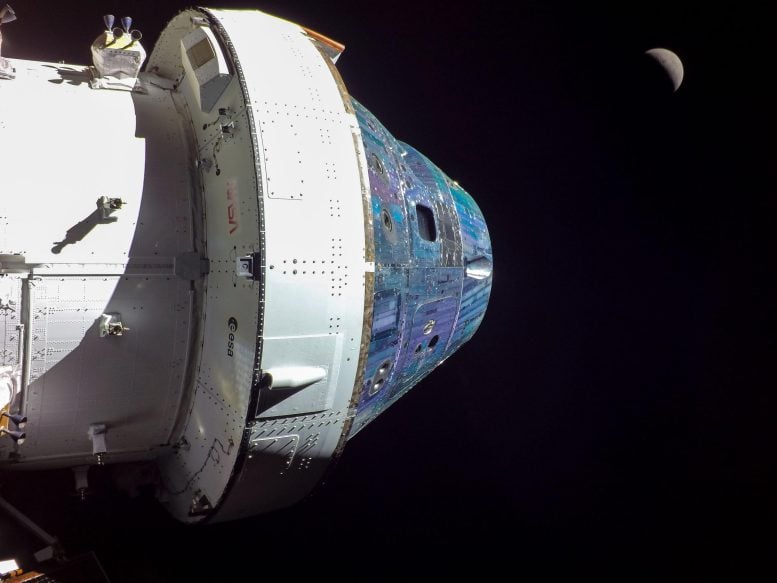
    Orion and Moon on Flight Day 8
    On Flight Day 8, NASA’s Orion spacecraft remains two days away from reaching its distant retrograde orbit. The Moon is in view as Orion snaps a selfie using a camera mounted on one of its solar array at 10:57 p.m. EST. Credit: NASA

    NASA’s Orion spacecraft is now about one day away from entering into a distant retrograde orbit around the Moon. The orbit is “distant” in the sense that it’s at a high altitude approximately 50,000 miles (80,000 km) from the surface of the Moon. Due to the distance, the orbit is so large that it will take the spacecraft six days to complete half of a revolution around the Moon before exiting the orbit for the return journey back to Earth.

    During the last day in the transit to distant retrograde orbit, flight controllers performed a third in a series of planned star tracker development flight tests relative to the Sun, with a fourth planned for tomorrow. Star trackers are a navigation tool that measure the positions of stars to help the spacecraft determine its orientation. In the first three flight days, engineers evaluated initial data to understand star tracker readings correlated to thruster firings.

    The spacecraft completed its sixth outbound trajectory correction burn at 3:52 p.m. CST, firing the European Service Module’s auxiliary engines for 17 seconds to propel the spacecraft at 8.9 feet per second. This is the final trajectory correction before entering distant retrograde orbit. When in lunar orbit, Orion will perform three orbital maintenance burns to keep the spacecraft on course.


    On the eighth day of the Artemis I mission, a camera mounted on one of Orion’s solar arrays captured the spacecraft and the Moon as it continued toward distant retrograde orbit. Credit: NASA

    Overnight, engineers will begin a 24-hour test of the reaction control system engines to evaluate engine performance for standard and non-standard thruster configurations. This test will provide data to inform procedures and ensure that the reaction control thrusters can control Orion’s orientation in an alternate configuration if there is an issue with the primary configuration.

    Just after 1:42 p.m. CST on November 24, Orion was traveling 222,993 miles (358,872 km) from Earth and 55,819 miles (89,832 km) from the Moon, cruising at 2,610 miles per hour (4,200 km per hour).

    NASA Television coverage of the distant retrograde orbit insertion burn is scheduled for 4:30 p.m. EST on Friday, November 25. The burn is scheduled to take place at 4:52 p.m.

    Never miss a breakthrough: Join the SciTechDaily newsletter.
    Follow us on Google and Google News.

    ARTEMIS Mission Moon NASA Orion Spacecraft
    Share. Facebook Twitter Pinterest LinkedIn Email Reddit

    Related Articles

    See the Far Side of the Moon: Incredibly Detailed Pictures From Artemis I Orion Close Lunar Flyby

    NASA Artemis I – Flight Day 10: Orion Spacecraft Enters Distant Retrograde Orbit

    NASA Artemis I – Flight Day Eight: Orion Spacecraft Exits Lunar Sphere Of Influence

    NASA Artemis I – Flight Day Seven: Orion To Exit Lunar Sphere of Influence

    NASA Orion Spacecraft Captures Stunning Views During Artemis I Lunar Flyby

    Behold! NASA’s Artemis I Orion Close Flyby of the Moon

    Artemis I Distant Retrograde Orbit: NASA’s Orion Spacecraft Will Travel 40,000 Miles Beyond the Moon

    NASA’s Additional Artemis I Test Objectives for Space Launch System Rocket and Orion Spacecraft

    The International Space Station Is Helping Us Get Back to the Moon – Here’s How

    Leave A Reply Cancel Reply

    • Facebook
    • Twitter
    • Pinterest
    • YouTube

    Don't Miss a Discovery

    Subscribe for the Latest in Science & Tech!

    Trending News

    Why Popular Diabetes Drugs Like Ozempic Don’t Work for Everyone: The “Genetic Glitch”

    Scientists Stunned After Finding Plant Thought Extinct for 60 Years

    Scientists Discover Tiny New Spider That Hunts Prey 6x Its Size

    Natural Component From Licorice Shows Promise for Treating Inflammatory Bowel Disease

    Scientists Warn: Popular Sweetener Linked to Dangerous Metabolic Effects

    Monster Storms on Jupiter Unleash Lightning Beyond Anything on Earth

    Scientists Create “Liquid Gears” That Spin Without Touching

    The Simple Habit That Could Help Prevent Cancer

    Follow SciTechDaily
    • Facebook
    • Twitter
    • YouTube
    • Pinterest
    • Newsletter
    • RSS
    SciTech News
    • Biology News
    • Chemistry News
    • Earth News
    • Health News
    • Physics News
    • Science News
    • Space News
    • Technology News
    Recent Posts
    • The Atomic Gap That Could Cost the Semiconductor Industry Billions
    • Earth’s Secret Advantage: Why Most Alien Worlds May Be Too Dry for Life
    • Ancient Bacteria Turned a DNA System Into a Cell Skeleton
    • Researchers Finally Solve 50-Year-Old Blood Group Mystery
    • Scientists Discover “Molecular Switch” That Fuels Alzheimer’s Brain Inflammation
    Copyright © 1998 - 2026 SciTechDaily. All Rights Reserved.
    • Science News
    • About
    • Contact
    • Editorial Board
    • Privacy Policy
    • Terms of Use

    Type above and press Enter to search. Press Esc to cancel.