
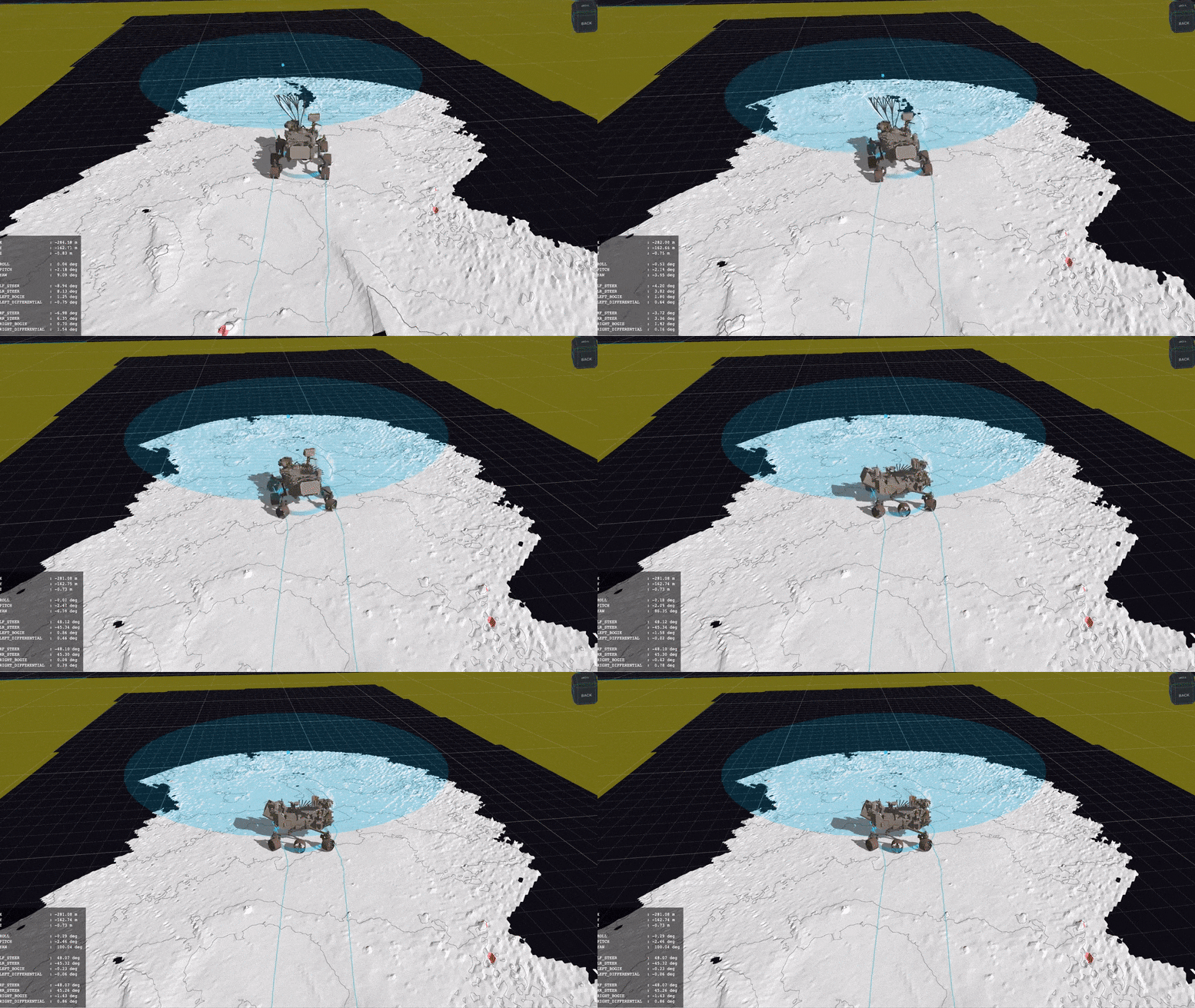
Perseverance’s autonomous navigation allows it to traverse challenging Martian terrain, accelerating its journey to the Jezero river delta.
NASA’s Perseverance Mars rover is using its self-driving capabilities as it treks across Jezero Crater seeking signs of ancient life and gathering rock and soil samples for planned return to Earth.
With the help of special 3D glasses, rover drivers on Earth plan routes with specific stops, but increasingly allow the rover to “take the wheel” and choose how it gets to those stops. Perseverance’s auto-navigation system, known as AutoNav, makes 3D maps of the terrain ahead, identifies hazards, and plans a route around any obstacles without additional direction from controllers back on Earth.
Now the rover can drive through these more complex terrains, which helps Perseverance achieve its science goals and break driving records. The rover is traversing from an area near its landing site, “Octavia E. Butler Landing,” to an area where an ancient river flowed into a body of water and deposited sediments (known as a delta).
Video transcript:
The Perseverance rover is currently driving a three-mile journey to get to the Jezero river delta.
I’m Tyler Del Sesto, I’m a rover driver for NASA’s Perseverance rover. We’re here at NASA’s Jet Propulsion Laboratory, where the rover drivers are planning the drive.
We use 3D monitors and 3D glasses to look at the terrain around the rover, and that 3D environment is created from images taken on the previous day on Mars.
Over the past year, the rover drivers have taken a very active role in Perseverance’s drives.
Currently, though, we’re just trying to drive as far as we can every day, so we’re relying more on Perseverance’s self-driving capabilities.
That means instead of the rover drivers choosing exactly where to turn and what rocks to avoid, we’re letting Perseverance choose on its own. We give it specific stops along the route, but it chooses how to get there, and we trust it to avoid the hazards along that path.
The rover’s self-driving ability is very similar to self-driving cars on Earth. But there are different challenges.
Perseverance needs to look at rocks, sand, and other types of hazards like craters and large things like cliffs, and it needs to avoid these to keep itself safe.
This is one of our tools to look at how drives perform on Mars. This is the actual map the rover created onboard using its left and right cameras.
As the rover drives this path, it’s using this map to identify which paths are safe to drive.
Perseverance’s self-driving software is a big improvement over previous rovers which also had self-driving capabilities. Perseverance is able to process and analyze images while the wheels are still in motion.
Previous rovers like Curiosity needed to stop then take images and then process those images before choosing a safe path.
Perseverance is able to do all of this while driving. We call this a thinking while driving capability.
The Perseverance rover has already broken all of the driving records from previous rovers. This means we’re able to drive farther every day than the previous rovers ever were able to.
The Perseverance rover has a top speed of 0.1 miles per hour (4.5 cm/s). Now that doesn’t sound very fast, but that does enable us to drive over 300 yards (274 meters) every day and keep the rover safe.
Perseverance’s self-driving ability is very important to this mission. It allows us to get to the Jezero river delta as fast as possible, and that gives the science team as much time there to study the rocks and collect samples for future return to Earth.
Never miss a breakthrough: Join the SciTechDaily newsletter.
Follow us on Google and Google News.