
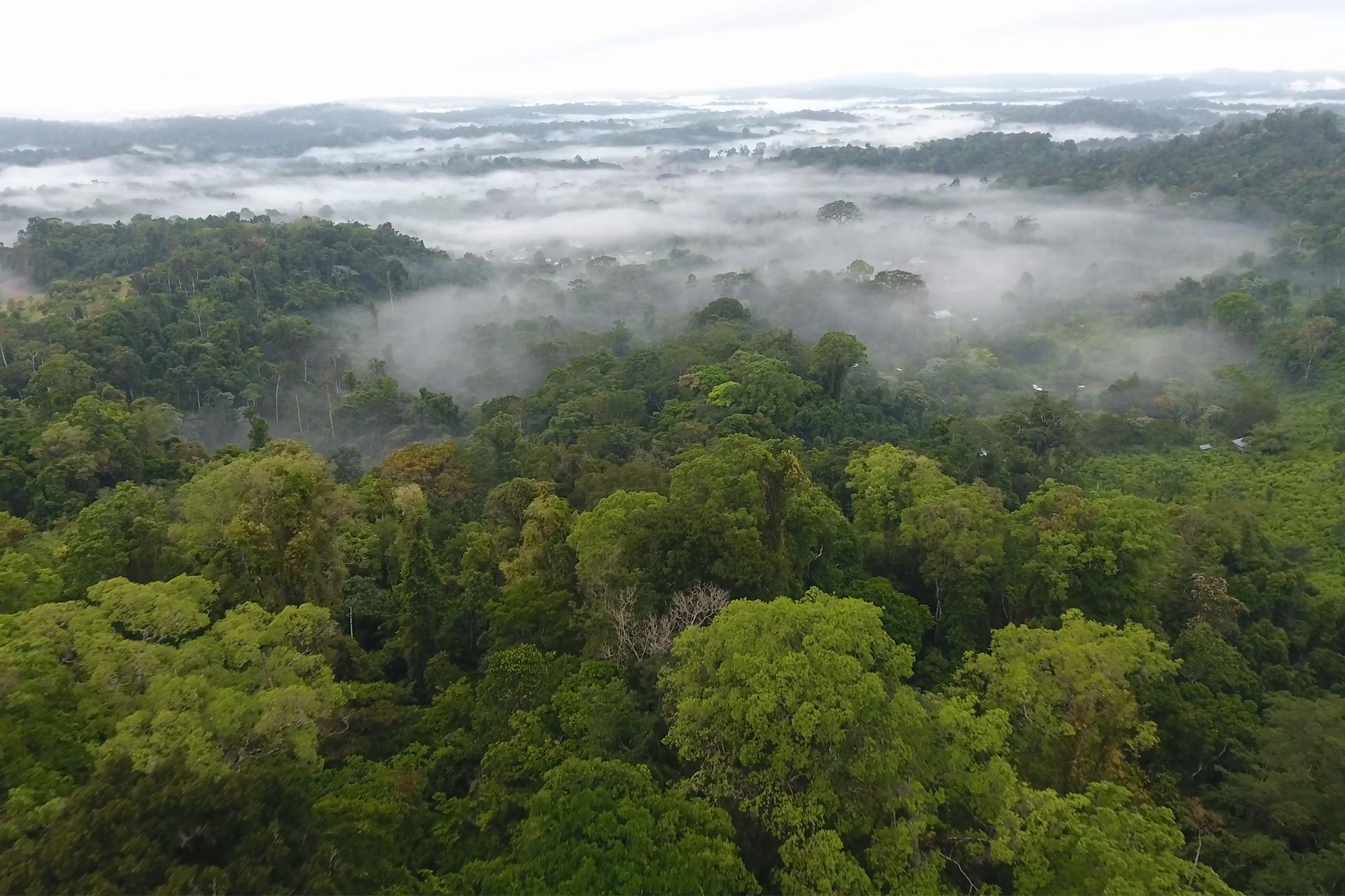
A new study finds that temporary nature-based carbon removal can lower global peak warming levels but only if complemented by ambitious fossil fuel emission reductions.
Nature-based climate solutions aim to preserve and enhance carbon storage in terrestrial or aquatic ecosystems and could be a potential contributor to Canada’s climate change mitigation strategy. “However, the risk is that carbon stored in ecosystems could be lost back to the atmosphere as a result of wildfires, insect outbreaks, deforestation, or other human activities,” says Kirsten Zickfeld, a distinguished professor of climate science in Simon Fraser University’s Department of Geography who is on the research team.
The researchers used a global climate model to simulate temperature change through two scenarios ranging from weak to ambitious greenhouse gas emissions reductions. In the relatively weak emissions reduction scenario, carbon emissions continue through 2100. In the ambitious scenario, carbon emissions reach net-zero by 2050.
In order to meet the Paris Agreement’s climate goals, the world will need to reach net-zero CO2 emissions around or before mid-century, according to the United Nations’ Intergovernmental Panel on Climate Change.
Temporary Nature-Based Carbon Storage Outcomes
In both scenarios, it is assumed that carbon storage through nature-based climate solutions is temporary as forests are vulnerable to both natural and human disturbances. Therefore, nature-based climate solutions are anticipated to withdraw carbon from the atmosphere over the next 30 years then slowly release the carbon during the second half of the century.
The team found that in a scenario with carbon emissions decreasing rapidly to net-zero, temporary nature-based carbon storage can decrease the level of peak warming. However, in a scenario with continued carbon emissions temporary nature-based carbon storage would serve only to delay the temperature increase.
“Our study shows that nature-based carbon storage, even if temporary, can have tangible climate benefits, but only if implemented alongside a rapid transition to zero fossil-fuel emissions,” says Zickfeld.
The findings are published in Nature Communications Earth & Environment.
Zickfeld is also the lead author of the recent United Nations’ Intergovernmental Panel on Climate Change (IPCC) Working Group I contribution to the Sixth Assessment Report released in summer 2021, and the IPCC’s 2018 special report on the global warming of 1.5 degrees.
Social and Environmental Benefits Beyond Carbon Storage
The researchers also note that investing in protecting and restoring nature offers social and environmental benefits for local and Indigenous communities beyond storing carbon to mitigate climate change. They add that biodiversity, water, and air quality are inherently valuable and that efforts to enhance these can also help to build community resilience to climate change.
Reference: “Temporary nature-based carbon removal can lower peak warming in a well-below 2 °C scenario” by H. Damon Matthews, Kirsten Zickfeld, Mitchell Dickau, Alexander J. MacIsaac, Sabine Mathesius, Claude-Michel Nzotungicimpaye and Amy Luers, 17 March 2022, Communications Earth & Environment.
DOI: 10.1038/s43247-022-00391-z
Never miss a breakthrough: Join the SciTechDaily newsletter.
Follow us on Google and Google News.
1 Comment
disinformation.
There is no temperature record of the last 150 years that shows any temperature variations greater than those variations science tells us that have occurred over the previous 5000 years.
Are you a vaccine salesman?