
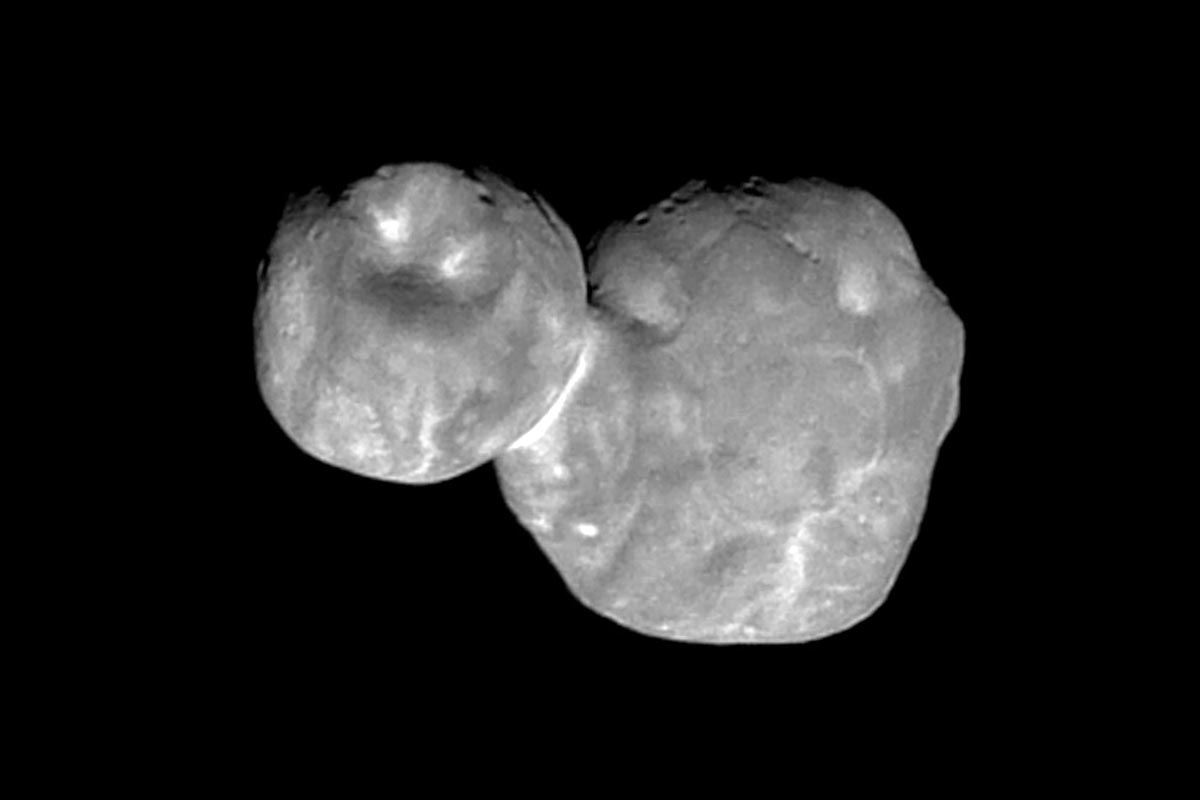
Cosmic “snowmen” in the outer solar system may form from a surprisingly simple gravitational dance.
Astronomers have puzzled for years over a strange pattern in the outer solar system. A surprising number of icy bodies far beyond Neptune resemble snowmen, made of two rounded lobes stuck together. Now researchers at Michigan State University say they have uncovered a straightforward explanation for how these unusual shapes form.
Beyond the turbulent asteroid belt between Mars and Jupiter lies the Kuiper Belt, a vast region past Neptune filled with frozen leftovers from the birth of the solar system. These ancient objects, called planetesimals, are essentially the original building blocks of planets. Roughly 10 percent of them are known as contact binaries, meaning they consist of two connected spheres that look strikingly similar to Frosty the Snowman. Until now, scientists were unsure how such delicate structures could take shape naturally.
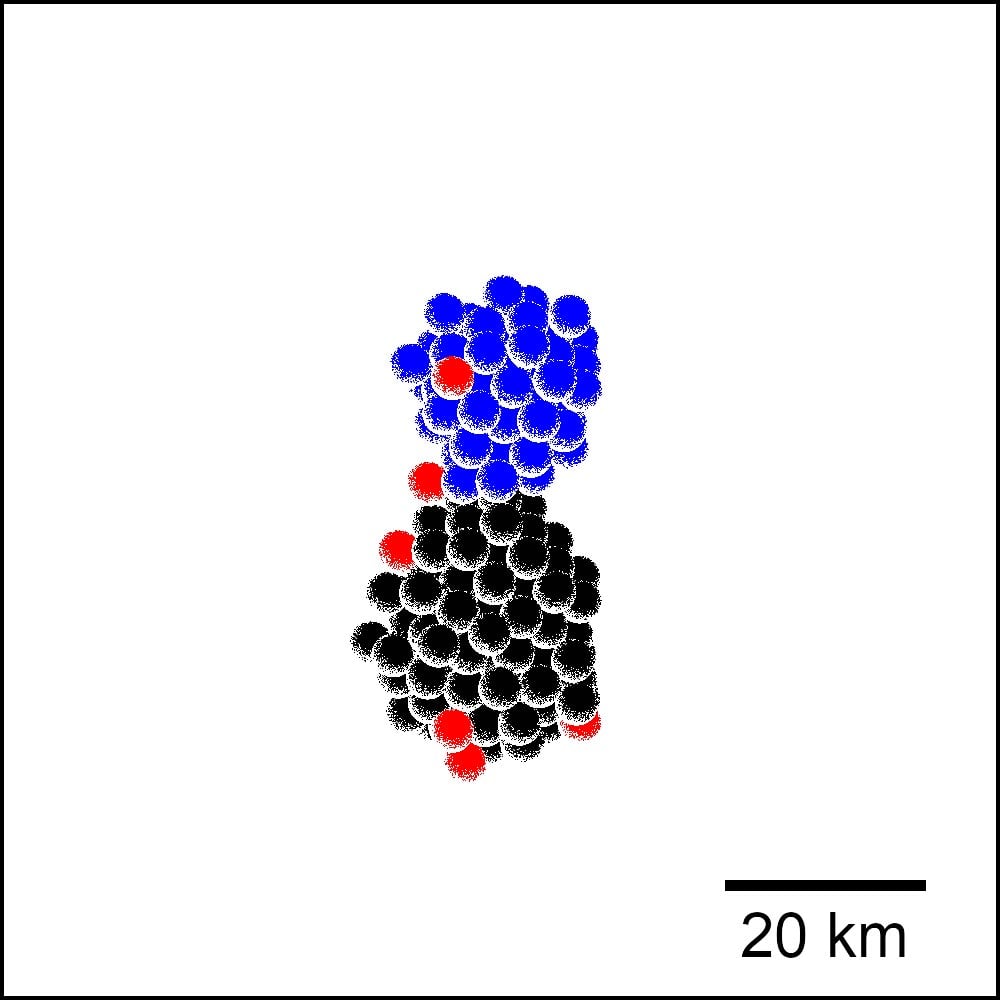
Jackson Barnes created this computer simulation showing how a contact binary’s two-lobed shape could be formed by gravitational collapse. Credit: Michigan State University Jacobson Lab
A Simulation That Recreates Snowman-Shaped Worlds
Jackson Barnes, a graduate student at MSU, developed the first computer simulation that can naturally produce these double-lobed objects through a process known as gravitational collapse. His findings appear today (February 19) in the Monthly Notices of the Royal Astronomical Society.
Earlier models simplified collisions by treating objects like soft fluid blobs that merged into smooth spheres. That approach made it impossible to recreate the distinctive two-lobed structure seen in contact binaries. Using the powerful computing resources of MSU’s Institute for Cyber-Enabled Research, or ICER, Barnes built a more realistic simulation. His model allows forming objects to maintain their structural integrity, enabling them to settle against each other rather than blending into a single round mass.
Other explanations have suggested rare cosmic events or unusual conditions, but those scenarios would not easily account for the fact that about one in 10 planetesimals share this shape.
“If we think 10 percent of planetesimal objects are contact binaries, the process that forms them can’t be rare,” said Earth and Environmental Science Professor Seth Jacobson, senior author on the paper. “Gravitational collapse fits nicely with what we’ve observed.”
This short movie shows the view of Kuiper Belt object 2014 MU69 (nicknamed Ultima Thule) as seen by NASA’s New Horizons spacecraft from December 7, 2018 to January 1, 2019. Credit: NASA
NASA’s New Horizons and the Kuiper Belt
Interest in contact binaries surged after NASA’s New Horizons spacecraft captured close-up images of one in January 2019. The detailed pictures encouraged scientists to reexamine other Kuiper Belt objects, revealing that these snowman-like bodies are more common than previously realized. In the relatively empty Kuiper Belt, objects drift with little disturbance, reducing the likelihood of destructive impacts.
The Kuiper Belt itself is a relic of the early Milky Way, when the galaxy was still a swirling disc of gas and dust. Leftover material from that era remains in this distant region, including dwarf planets like Pluto, comets, and countless planetesimals.
How Gravitational Collapse Builds Contact Binaries
Planetesimals were among the first sizable objects to emerge from the primordial disc of dust and pebbles. Similar to how snowflakes gather into a snowball, tiny particles were pulled together by gravity, forming larger and larger clumps.
In some cases, a rotating cloud of material collapses inward and splits into two separate bodies that begin orbiting each other. Astronomers frequently observe such binary pairs in the Kuiper Belt. In Barnes’ simulation, these orbiting partners gradually spiral closer together. Instead of crashing violently, they gently touch and fuse, preserving their rounded forms and creating the classic snowman appearance.
Once joined, these objects can remain intact for billions of years. According to Barnes, the key is their isolation. In the sparse outer solar system, collisions are rare. Without an impact to break them apart, the fused bodies stay connected. Many binary objects show few signs of heavy cratering.
Testing a Long-Standing Hypothesis
Scientists have long suspected gravitational collapse might be responsible for forming contact binaries, but earlier models lacked the detailed physics needed to prove it. Barnes’ simulation is the first to fully capture the necessary conditions to reproduce these structures.
“We’re able to test this hypothesis for the first time in a legitimate way,” Barnes said. “That’s what’s so exciting about this paper.”
He believes the model could also shed light on more complex systems involving three or more objects. The research team is already refining their simulations to better represent how collapsing clouds behave.
As future NASA missions venture deeper into unexplored regions of the solar system, Jacobson and Barnes expect that even more distant snowman-like worlds may be discovered.
Reference: “Direct contact binary planetesimal formation from gravitational collapse” by Jackson T Barnes, Stephen R Schwartz and Seth A Jacobson, 19 February 2026, Monthly Notices of the Royal Astronomical Society.
DOI: 10.1093/mnras/stag002
Never miss a breakthrough: Join the SciTechDaily newsletter.
Follow us on Google and Google News.