

Researchers have developed an eco-friendly method to produce antibacterial silver nanoparticles using goji berries, a popular superfood.
This innovative approach promises a greener alternative to conventional chemical methods, leveraging the natural properties of goji berries for effective antimicrobial applications.
Sustainable Nanotechnology from Goji Berries
As sustainability becomes a priority across various fields, researchers are exploring innovative ways to create antibacterial silver nanoparticles (Ag-NPs). One unexpected but promising source? The humble goji berry.
Known as a superfood packed with health benefits, including natural antibiotic properties, goji berries have now captured the attention of scientists. In a study published today (January 7) in AIP Advances by AIP Publishing, Kamran Alam of Sapienza University of Rome, alongside collaborators from NED University of Engineering and Technology and King Saud University, demonstrated an effective method for synthesizing silver nanoparticles using goji berries.
Green Synthesis of Silver Nanoparticles
“Silver nanoparticles are responsible for disrupting the cell membrane structure, which can generate reactive oxygen species used for inhibiting bacterial growth,” explained Alam.
Silver nanoparticles can be generated using a number of chemical techniques, but green solutions that use biological sources like fruit or leaf extracts are preferred because they save on energy and are nontoxic, nonhazardous, and biologically compatible with humans.
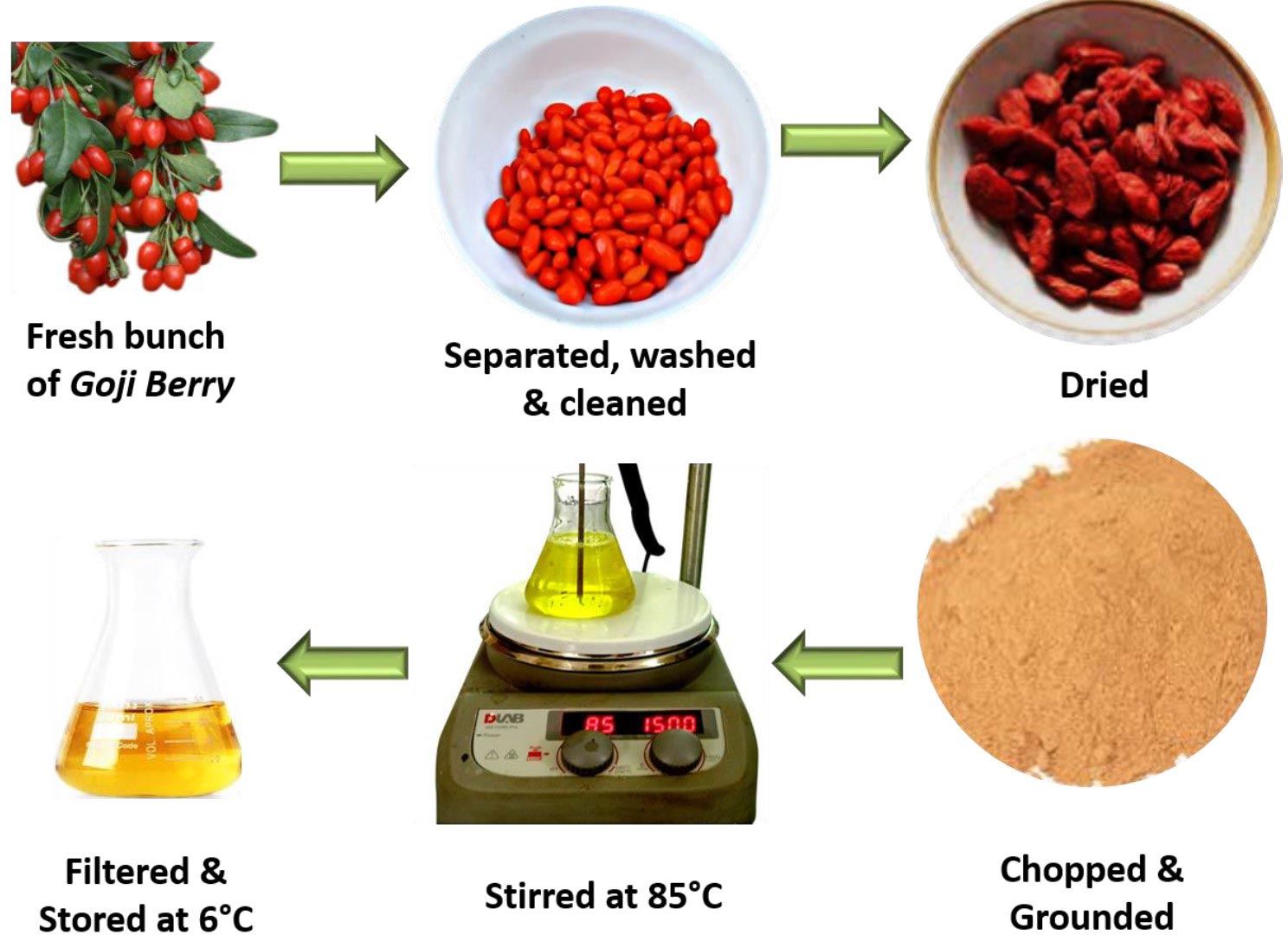
In this interdisciplinary undertaking, Alam and researchers demonstrated a technique for the synthesis of silver nanoparticles using store-bought goji berries.
“Goji berries are easily and locally available in the botanic garden and are rich in bioactive compounds that have natural reducing and stabilizing agents, eliminating the need for additional capping agents during processing,” Alam said.
Efficient Production and Antimicrobial Testing
Alam and the team created silver nanoparticles by drying, grinding, and then filtering the goji berries to create an extract. Then, they added the chemical silver nitrate (AgNO3) and reduced the solution.
Using visualization techniques such as X-ray diffraction, Ultraviolet-Visible (UV-Vis) Spectroscopy, and Fourier Transform Infrared (FT-IR) Spectroscopy, the team confirmed the presence of silver nanoparticles. The nanoparticles were also viewed under a microscope and tested for their antimicrobial activity against Staphylococcus aureus, a gram-positive bacterium that causes staph infections among other diseases.
Future Applications and Industrial Potential
In the future, Alam plans to study the cellular toxicity and biocompatibility of the nanoparticles synthesized from these berries, which could positively contribute to biomedical research.
“This is a simple and straightforward synthesis method which does not need additional chemicals or complex equipment and can be scaled up for industrial applications,” he said.
Reference: “Ecofriendly synthesis of silver nanoparticles using metallic solution-based goji berry extract for their antibacterial properties” by Abdul Rauf Jamali, Waseem Khan, Salahuddin Khan, Ahmed Ahmed Ibrahim and Kamran Alam, 7 January 2025, AIP Advances.
DOI: 10.1063/5.0237276
Never miss a breakthrough: Join the SciTechDaily newsletter.
Follow us on Google and Google News.
2 Comments
Why not simply eat the berries themselves? Why the unnecessary technological extra-step?
@boba That isn’t the point of the process.
The berries are great for health. Silver nanoparticles are even better. Also silver particles can be used to make antibacterial materials. For example some phone cases are now made with silver nanoparticles mixed into the material so that the phone case remains bacteria free even while held.
This article is discussing a new method for creating silver nanoparticles. The usual method requires toxic chemicals resulting in toxic waste that must be disposed of. This new method using goji berries allows them to create silver nanoparticles without chemical toxic waste byproducts.