

Close Menu
    Facebook X (Twitter) Instagram
    SciTechDaily
    • Biology
    • Chemistry
    • Earth
    • Health
    • Physics
    • Science
    • Space
    • Technology
    Facebook X (Twitter) Pinterest YouTube RSS
    SciTechDaily
    Home»Biology»Neuroscience Breakthrough: In-Vitro Neurons Exhibit Advanced Brain-Like Behavior
    Biology

    Neuroscience Breakthrough: In-Vitro Neurons Exhibit Advanced Brain-Like Behavior

    By Tohoku UniversityDecember 30, 20242 Comments4 Mins Read
    Facebook Twitter Pinterest Telegram LinkedIn WhatsApp Email Reddit
    Share
    Facebook Twitter LinkedIn Pinterest Telegram Email Reddit
    Neuronal Networks
    Tohoku University researchers have used microfluidic devices to grow lab neurons that mimic natural brain networks, showing learning-like plasticity. This innovation could revolutionize neuroscience research by providing better models for studying memory and learning. Credit: Hakuba Murota et al.

    Tohoku University scientists created lab-grown neural networks using microfluidic devices, mimicking natural brain activity and enabling advanced studies of learning and memory.

    The phrase “Neurons that fire together, wire together” encapsulates the principle of neural plasticity in the human brain. However, neurons grown in a laboratory dish do not typically adhere to these rules. Instead, cultured neurons often form random, unstructured networks where all cells fire simultaneously, failing to mimic the organized and meaningful connections seen in a real brain. As a result, these in-vitro models provide only limited insights into how learning occurs in living systems.

    What if, however, we could create in-vitro neurons that more closely replicate natural brain behavior?

    A research team at Tohoku University has taken a significant step in this direction. Using microfluidic devices, they engineered biological neuronal networks with connectivity patterns resembling those of animal nervous systems. These networks exhibited complex activity dynamics and demonstrated the ability to be “reconfigured” through repetitive stimulation. This groundbreaking discovery offers a promising new tool for studying learning, memory, and the underlying mechanisms of neural plasticity.

    The results were published online in Advanced Materials Technologies on November 23, 2024.

    Schematic of the Microfluidic Device and Cell Culture
    (a) Schematic of the microfluidic device and cell culture. (b) Photograph of neuronal networks. Neurons are separated by square areas, and these are connected through the microchannels. Credit: Hakuba Murota et al.

    Neural Ensembles: The Basis of Learning and Memory

    In certain areas of the brain, information is encoded and stored as “neuronal ensembles,” or groups of neurons that fire together. Ensembles change based on input signals from the environment, which is considered to be the neural basis of how we learn and remember things. However, studying these processes using animal models is difficult because of its complex structure.

    “The reason there is a need to grow neurons in the lab is because the systems are much simpler,” remarks Hideaki Yamamoto (Tohoku University), “Lab-grown neurons allow scientists to explore how learning and memory work in highly controlled conditions. There is a demand for these neurons to be as close to the real thing as possible.”
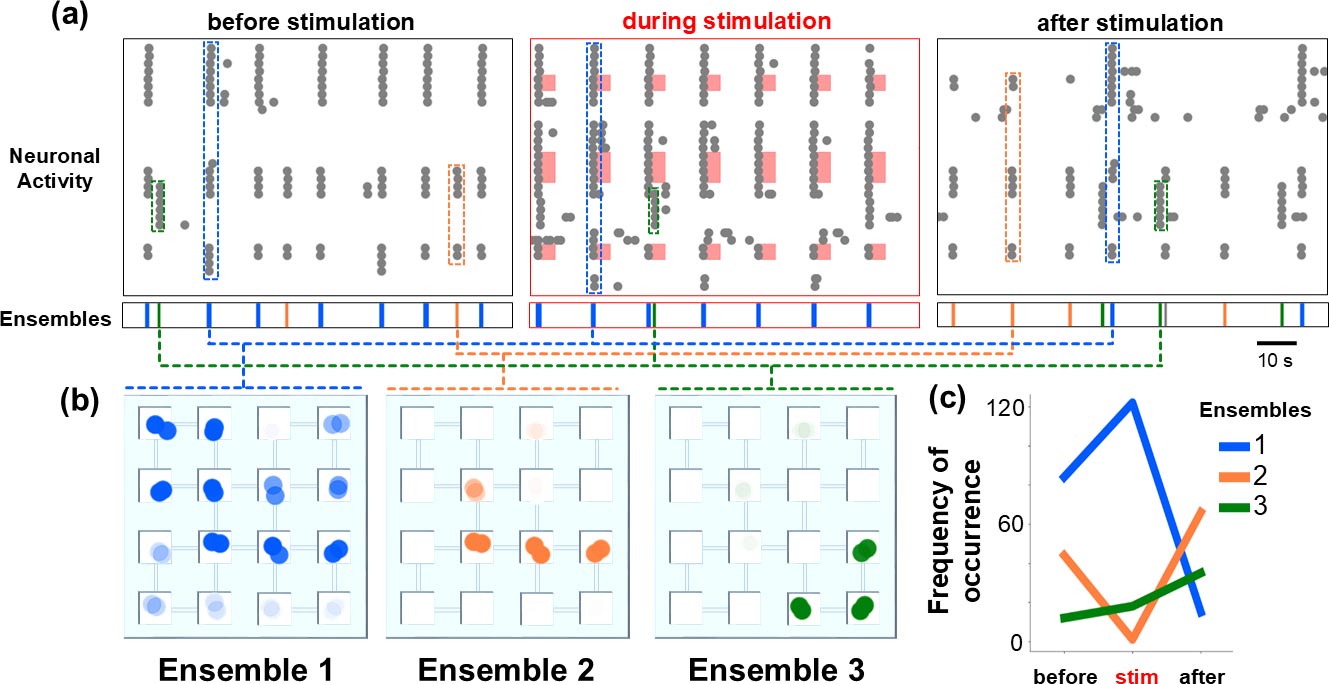
    Activities of Neurons and Neuronal Ensembles That Emerged During the Experiment
    (a) Activities of neurons and neuronal ensembles that emerged during the experiment. Each grey dot indicates the individual activity of the neuron. Colour lines at the bottom represent detected neuronal ensembles. (b) Spatial maps of neurons belonging to neuronal ensembles. (c) The changes in frequency of occurrence of neuronal ensembles during experiments. The frequency of each ensemble is changed before and after stimulation. Credit: Hakuba Murota et al.

    The research team created a special model using a microfluidic device–a small chip with tiny 3D structures. This device allowed neurons to connect and form networks similar to those in the animals’ nervous system. By changing the size and shape of the tiny tunnels (called microchannels) that connect the neurons, the team controlled how strongly the neurons interacted.

    The researchers demonstrated that networks with smaller microchannels can maintain diverse neuronal ensembles. For example, the in-vitro neurons grown in traditional devices tended to only exhibit a single ensemble, while those grown with the smaller microchannels showed up to six ensembles. Additionally, the team found that repeated stimulation modulates these ensembles, showing a process resembling neural plasticity, as if the cells were being reconfigured.

    This microfluid technology in conjunction with in-vitro neurons could be used in the future to develop more advanced models that can mimic specific brain functions, like forming and recalling memories.

    Reference: “Precision Microfluidic Control of Neuronal Ensembles in Cultured Cortical Networks” by Hakuba Murota, Hideaki Yamamoto, Nobuaki Monma, Shigeo Sato and Ayumi Hirano-Iwata, 23 November 2024, Advanced Materials Technologies.
    DOI: 10.1002/admt.202400894

    Never miss a breakthrough: Join the SciTechDaily newsletter.
    Follow us on Google and Google News.

    Brain Neuroscience Tohoku University
    Share. Facebook Twitter Pinterest LinkedIn Email Reddit

    Related Articles

    Saying Goodbye to Traumatic Memories: How Astrocytes Decide What We Remember

    Researchers Record Detailed Live Images Inside the Brain of a Living Mouse

    Alzheimer’s Spreads Throughout the Brain by Jumping From Neuron to Neuron

    Synchronized Brain Oscillations Crucial for Short-Term Memory

    Human Brains Take Longer to Wire Up Than Simian Ones

    Researchers Use fMRI to Study How Humor Activates Kids’ Brain Regions

    Neuroscientists Decode Correlation Between Sound and Brain Activity

    Mother’s Nurturing Results in Larger Hippocampus in Children

    Neuroscientists Study Cortical Areas Specialized in Processing Visual Inputs in Mice

    2 Comments

    1. J ANBALAGAN on December 31, 2024 7:40 am

      Useful
      Amazing

      Reply
    2. Khasnuri Husain on January 1, 2025 7:56 am

      I had been since diagnosed as a “schizophrenia” since I was 19 and I have a very good photographic memory that ranges from 30-40 years. However,my health has been on the decline pending a thorocottomy operation in 1992. I can simulate events that far reaches when I was minor but I find Neuro medicines do not help me in the long distance to self discovery.

      Reply
    Leave A Reply Cancel Reply

    • Facebook
    • Twitter
    • Pinterest
    • YouTube

    Don't Miss a Discovery

    Subscribe for the Latest in Science & Tech!

    Trending News

    Scientists Warn That This Common Pet Fish Can Wreck Entire Ecosystems

    Scientists Make Breakthrough in Turning Plastic Trash Into Clean Fuel Using Sunlight

    This Popular Supplement May Interfere With Cancer Treatment, Scientists Warn

    Scientists Finally Solved One of Water’s Biggest Mysteries

    Could This New Weight-Loss Pill Disrupt the Entire Market? Here’s What You Should Know About Orforglipron

    Earth’s Crust Is Tearing Open in Africa, and It Could Form a New Ocean

    Breakthrough Bowel Cancer Trial Leaves Patients Cancer-Free for Nearly 3 Years

    Natural Compound Shows Powerful Potential Against Rheumatoid Arthritis

    Follow SciTechDaily
    • Facebook
    • Twitter
    • YouTube
    • Pinterest
    • Newsletter
    • RSS
    SciTech News
    • Biology News
    • Chemistry News
    • Earth News
    • Health News
    • Physics News
    • Science News
    • Space News
    • Technology News
    Recent Posts
    • Kratom Use Explodes in the US, With Life-Changing Consequences
    • Scientists Uncover Fatal Weakness in “Zombie Cells” Linked to Cancer
    • World-First Study Reveals Human Hearts Can Regenerate After a Heart Attack
    • Why Your Dreams Feel So Real Sometimes and So Strange Other Times
    • Scientists Debunk 100-Year-Old Belief About Brain Cells, Rewriting Textbooks
    Copyright © 1998 - 2026 SciTechDaily. All Rights Reserved.
    • Science News
    • About
    • Contact
    • Editorial Board
    • Privacy Policy
    • Terms of Use

    Type above and press Enter to search. Press Esc to cancel.