
Combining neuroscience with algorithms and network science, Yale researchers have developed a method of analyzing the neuronal connections of individual brains that allow them to successfully predict the subjects’ IQs, their sex, and even tasks they were performing at the time of the brain scan.
In a collaboration between the labs of Amin Karbasi, assistant professor of electrical engineering & computer science, and Todd Constable, professor of radiology and biomedical imaging and of neurosurgery, the researchers analyzed the functional MRI scans of more than 100 subjects from the Human Connectome Project, a five-year effort to create a network map of the human brain.
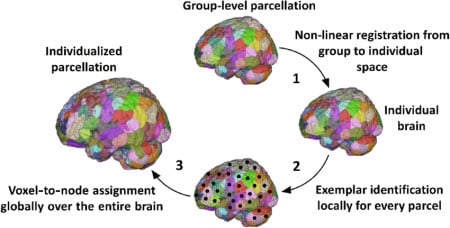
The research, recently presented at the International Conference on Medical Image Computing and Computer-Assisted Intervention, focuses on what’s known as voxels. Analogous to a pixel, a voxel is the lowest resolution achievable in the scans, and each can represent up to millions of neurons. Researchers cluster voxels into different areas called nodes or parcels, a process known as parcellating. Traditional methods of parcellating the brain have been used to map the brain connections to create a universal atlas of the brain. But these methods ignore the many inter-individual variations and the unique nature of the neural connections. These variations are particularly important for patient and developmental studies where a single functional atlas may not apply to all individuals or conditions.
“Traditional approaches to human brain parcellation collapse data from all the subjects in the group and then they cluster the average,” said Mehraveh Salehi, a Ph.D. candidate in the labs of both Constable and Karbasi. “But we’ve shown that if you do this at the individual level, each individual has a different parcellation.”
To individualize the existing parcellations, the team used a method of summarizing large amounts of data known as exemplar-based clustering. “The idea is to find those elements of the data that are most representative,” Salehi said. To identify these exemplars, the team applied submodular function optimization algorithms.
“If we account for those variations, we can build up better models from the functional connectivity analysis, and those models are better at predicting behaviors, such as IQ,” she said.
Karbasi, who is a faculty member at the Yale Institute for Network Science (YINS), said the amount of information that can be gleaned from the network of voxels is remarkable.
“What was very fascinating was that the shape of the network tells a lot of stories,” Karbasi said. “For example, we can say whether this person in the scanner is a male or a female. It also tells us that these people are performing different types of tasks. It’s like reading the brain.”
He added that they’re just “scratching the surface” of the technology’s potential.
“Just imagine what we might do in 20 years if we can really read the brain, and understand what people are thinking,” Karbasi said. For example, he said, it could potentially lead to a better understanding of how the brain makes the transition from one emotional state to another and new treatments for depression.
Salehi, who is also with YINS, initiated the pairing of the two labs for the project.
“It was really through networking that we did this project,” Karbasi said. “And it was a very successful example of how things work when you put the right people together.”
Reference: “A Submodular Approach to Create Individualized Parcellations of the Human Brain” by Mehraveh Salehi, Amin Karbasi, Dustin Scheinost and R. Todd Constable, 4 September 2017, MICCAI 2017.
DOI: 10.1007/978-3-319-66182-7_55
Never miss a breakthrough: Join the SciTechDaily newsletter.
Follow us on Google and Google News.