
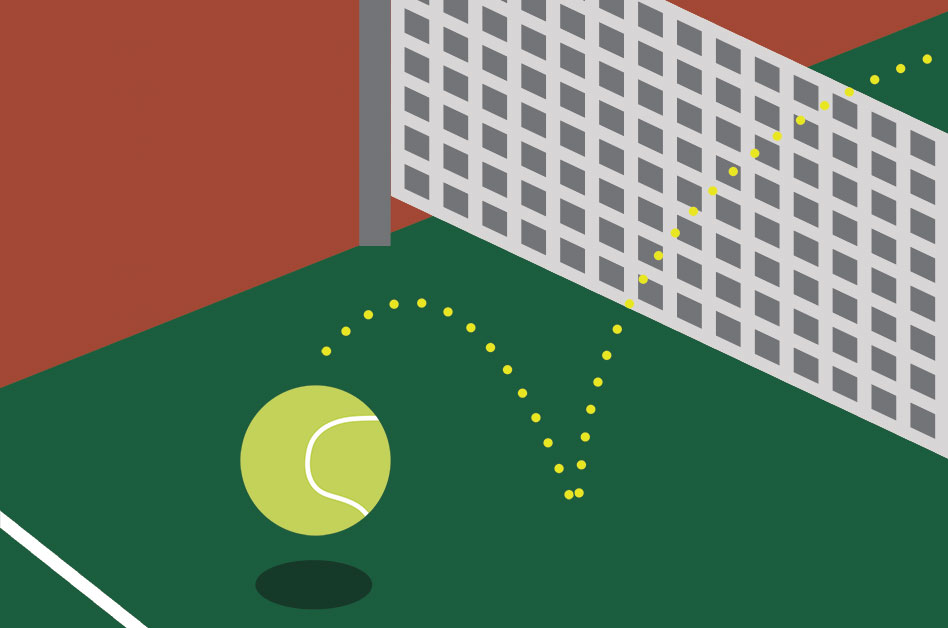
Catching a bouncing ball or hitting a ball with a racket requires estimating when the ball will arrive. Neuroscientists have long thought that the brain does this by calculating the speed of the moving object. However, a new study from MIT shows that the brain’s approach is more complex.
The new findings suggest that in addition to tracking speed, the brain incorporates information about the rhythmic patterns of an object’s movement: for example, how long it takes a ball to complete one bounce. In their new study, the researchers found that people make much more accurate estimates when they have access to information about both the speed of a moving object and the timing of its rhythmic patterns.
“People get really good at this when they have both types of information available,” says Mehrdad Jazayeri, the Robert A. Swanson Career Development Professor of Life Sciences and a member of MIT’s McGovern Institute for Brain Research. “It’s like having input from multiple senses. The statistical knowledge that we have about the world we’re interacting with is richer when we use multiple senses.”
Jazayeri is the senior author of the study, which appears in the Proceedings of the National Academy of Sciences the week of March 5. The paper’s lead author is MIT graduate student Chia-Jung Chang.
Objects in motion
Much of the information we process about objects moving around us comes from visual tracking of the objects. Our brains can use information about an object’s speed and the distance it has to cover to calculate when it will reach a certain point. Jazayeri, who studies how the brain keeps time, was intrigued by the fact that much of the movement we see also has a rhythmic element, such as the bouncing of a ball.
“It occurred to us to ask, how can it be that the brain doesn’t use this information? It would seem very strange if all this richness of additional temporal structure is not part of the way we evaluate where things are around us and how things are going to happen,” Jazayeri says.
There are many other sensory processing tasks for which the brain uses multiple sources of input. For example, to interpret language, we use both the sound we hear and the movement of the speaker’s lips, if we can see them. When we touch an object, we estimate its size based on both what we see and what we feel with our fingers.
In the case of perceiving object motion, teasing out the role of rhythmic timing, as opposed to speed, can be difficult. “I can ask someone to do a task, but then how do I know if they’re using speed or they’re using time, if both of them are always available?” Jazayeri says.
To overcome that, the researchers devised a task in which they could control how much timing information was available. They measured the performance in human volunteers as they performed the task.
During the task, the study participants watched a ball as it moved in a straight line. After traveling some distance, the ball went behind an obstacle, so the participants could no longer see it. They were asked to press a button at the time when they expected the ball to reappear.
Performance varied greatly depending on how much of the ball’s path was visible before it went behind the obstacle. If the participants saw the ball travel a very short distance before disappearing, they did not do well. As the distance before disappearance became longer, they were better able to calculate the ball’s speed, so their performance improved but eventually plateaued.
After that plateau, there was a significant jump in performance when the distance before disappearance grew until it was exactly the same as the width of the obstacle. In that case, when the path seen before disappearance was equal to the path the ball traveled behind the obstacle, the participants improved dramatically, because they knew that the time spent behind the obstacle would be the same as the time it took to reach the obstacle.
When the distance traveled to reach the obstacle became longer than the width of the obstacle, performance dropped again.
“It’s so important to have this extra information available, and when we have it, we use it,” Jazayeri says. “Temporal structure is so important that when you lose it, even at the expense of getting better visual information, people’s performance gets worse.”
Integrating information
The researchers also tested several computer models of how the brain performs this task, and found that the only model that could accurately replicate their experimental results was one in which the brain measures speed and timing in two different areas and then combines them.
Previous studies suggest that the brain performs timing estimates in premotor areas of the cortex, which plays a role in planning movement; speed, which usually requires visual input, is calculated in the visual cortex. These inputs are likely combined in parts of the brain responsible for spatial attention and tracking objects in space, which occurs in the parietal cortex, Jazayeri says.
In future studies, Jazayeri hopes to measure brain activity in animals trained to perform the same task that human subjects did in this study. This could shed further light on where this processing takes place and could also reveal what happens in the brain when it makes incorrect estimates.
The research was funded by the McGovern Institute for Brain Research.
Reference: “Integration of speed and time for estimating time to contact” by Chia-Jung Chang and Mehrdad Jazayeri, 5 March 2018, PNAS.
DOI: 10.1073/pnas.1713316115
Never miss a breakthrough: Join the SciTechDaily newsletter.
Follow us on Google and Google News.