
Astrophysicists have, for the first time, measured the temperature of elementary particles in the radioactive afterglow of a neutron star collision, which led to the formation of a black hole.
This breakthrough enables scientists to examine microscopic physical properties within these powerful cosmic events. The findings also reveal how single observations capture an object’s presence across time, like a snapshot that spans a cosmic moment. Researchers from the Niels Bohr Institute at the University of Copenhagen made this discovery, recently published in the journal Astronomy & Astrophysics.
New Observations Reveal Creation of Heavy Elements
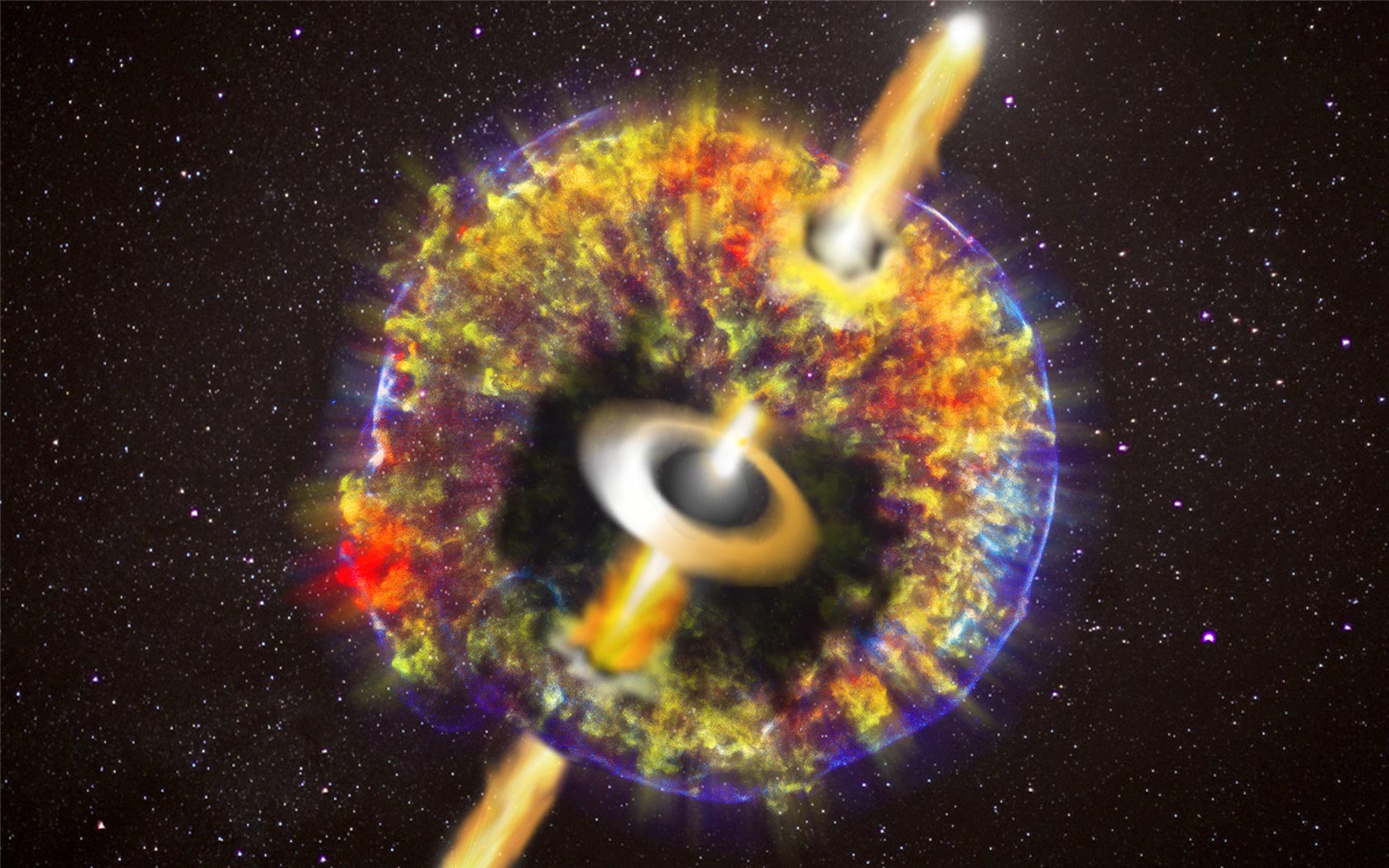
The collision of two neutron stars produced the smallest black hole ever observed. This intense cosmic event created a fireball expanding at nearly the speed of light, shining with the brightness of hundreds of millions of suns in the days following the collision.
This intensely bright object, called a kilonova, emits vast amounts of radiation due to the decay of heavy radioactive elements formed during the explosion.
By combining the measurements of the kilonova light, made with telescopes across the Globe, an international team of researchers, led by The Cosmic DAWN Center at the Niels Bohr Institute, have closed in on the enigmatic nature of the explosion and come closer to the answer of an old, astrophysical question: Where do the elements, heavier than iron, come from?

The Role of Global Observatories in Tracking Astrophysical Events
“This astrophysical explosion develops dramatically hour by hour, so no single telescope can follow its entire story. The viewing angle of the individual telescopes to the event are blocked by the rotation of the Earth.
But by combining the existing measurements from Australia, South Africa, and The Hubble Space Telescope we can follow its development in great detail.
We show that the whole shows more than the sum of the individual sets of data” says Albert Sneppen, PhD student at the Niels Bohr Institute and leader of the new study.
Extreme Temperatures in the Wake of Neutron Star Collisions
Just after the collision, the fragmented star-matter has a temperature of many billion degrees. A thousand times hotter than even the center of the Sun and comparable to the temperature of the Universe just one second after the Big Bang.
Temperatures this extreme result in electrons not being attached to atomic nuclei, but instead floating around in a so-called ionized plasma.
The electrons “dance” around. But in the ensuing moments, minutes, hours, and days, the star-matter cools, just like the entire Universe after the Big Bang.
Evidence of Heavy Elements in the Afterglow of the Collision
370,000 years after the Big Bang the Universe had cooled sufficiently for the electrons to attach to atomic nuclei and make the first atoms. Light could now travel freely in the Universe because it was no longer blocked by the free electrons.
This means that the earliest light we can see in the history of the Universe is this so-called “cosmic background radiation” – a patchwork of light, constituting the remote background of the night sky. A similar process of the unification of electrons with atomic nuclei can now be observed in the star matter of the explosion.
One of the concrete results is the observation of heavy elements like Strontium and Yttrium. They are easy to detect, but it is likely that many other heavy elements which we were unsure of the origin of, were also created in the explosion.
Insight Into Element Formation and Early Universe Conditions
“We can now see the moment where atomic nuclei and electrons are uniting in the afterglow. For the first time, we see the creation of atoms, we can measure the temperature of the matter and see the microphysics in this remote explosion. It is like admiring three cosmic background radiation surrounding us from all sides, but here, we get to see everything from the outside. We see before, during, and after the moment of birth of the atoms,” says Rasmus Damgaard, PhD student at Cosmic DAWN Center and co-author of the study.
Kasper Heintz, co-author and assistant professor at the Niels Bohr Institute continues: “The matter expands so fast and gains in size so rapidly, to the extent where it takes hours for the light to travel across the explosion. This is why, just by observing the remote end of the fireball, we can see further back in the history of the explosion.
Closer to us the electrons have hooked on to atomic nuclei, but on the other side, on the far side of the newborn black hole, the “present” is still just the future.
Reference: “Rapid kilonova evolution: Recombination and reverberation effects” by Albert Sneppen, Darach Watson, James H. Gillanders and Kasper E. Heintz, 7 August 2024, Astronomy & Astrophysics.
DOI: 10.1051/0004-6361/202348758
Never miss a breakthrough: Join the SciTechDaily newsletter.
Follow us on Google and Google News.