
In recent years, astronomy has seen itself in a bit of crisis: Although we know that the Universe expands, and although we know approximately how fast, the two primary ways to measure this expansion do not agree. Now astrophysicists from the Niels Bohr Institute suggest a novel method that may help resolve this tension.
The Universe Expands
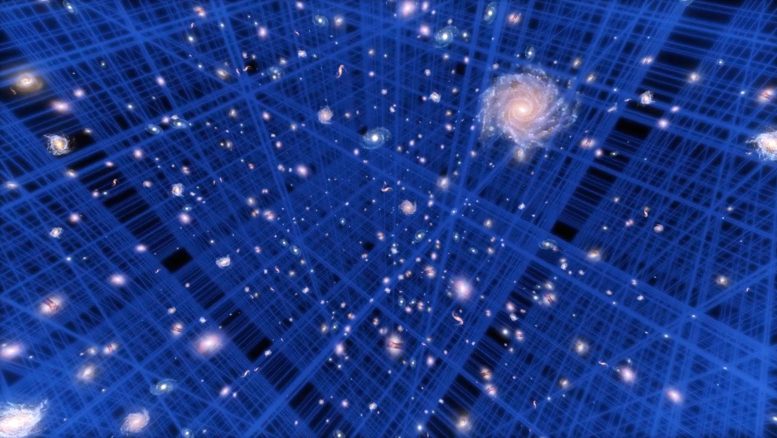
We’ve known this ever since Edwin Hubble and other astronomers, some 100 years ago, measured the velocities of a number of surrounding galaxies. The galaxies in the Universe are “carried” away from each other by this expansion, and therefore recedes from each other.
The greater the distance between two galaxies, the faster they move apart, and the precise rate of this movement is one of the most fundamental quantities in modern cosmology. The number that describes the expansion goes by the name “the Hubble constant”, appearing in multitude of different equations and models of the Universe and its constituents.
Hubble Trouble
To understand the Universe we must therefore know the Hubble constant as precisely as possible. Several methods exist to measure it; methods that are mutually independent but luckily give almost the same result.
That is, almost…
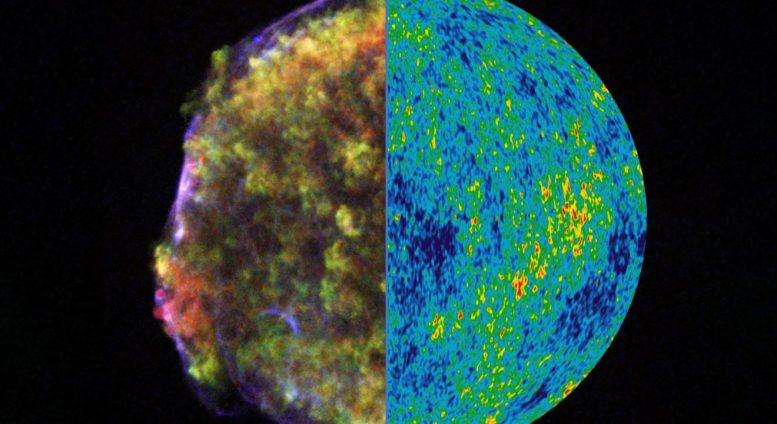
The intuitively easiest method to understand is, in principle, the same that Edwin Hubble and his colleagues used a century ago: Locate a bunch of galaxies, and measure their distances and speeds. In practice, this is done by looking for galaxies with exploding stars, so-called supernovae. This method is complemented by another method that analyzes irregularities in the so-called cosmic background radiation; an ancient form of light dating back to shortly after the Big Bang.
The two methods — the supernova method and the background radiation method — always gave slightly different results. But any measurement comes with uncertainties, and a few years back the uncertainties were substantial enough that we could blame those for the disparity.
Nevertheless, as measurement techniques have improved, uncertainties have diminished, and we’ve now reached a point where we can state with a high degree of confidence that both cannot be correct.
The root of this “Hubble trouble” — whether it is unknown effects systematically biasing one of the results, or if it hints at new physics yet to be discovered — is currently one of astronomy’s hottest topics.
The Hubble Constant Discrepancy
The expansion of the Universe is measured in “speed per distance,” and is just over 20 km/s per million lightyears. That means that a galaxy located 100 million lightyears away recedes from us at 2,000 km/s, while another galaxy 200 million lightyears away recedes at 4,000 km/s.
However, using supernovae to measure distances and velocities of galaxies yields 22.7 ± 0.4 km/s, while analyzing the background radiation of the Universe yields 20.7 ± 0.2 km/s.
It might sound persnickety to care about such a little disagreement, however, it can be very significant. For example, the number appears in the calculation of the age of the Universe, and the two methods yield an age of 12.8 and 13.8 billion years, respectively.
Kilonovae: A New Approach to Measurement
One of the greatest challenges lies in accurately determining the distances to galaxies. But in a new study, Albert Sneppen who is a PhD student in astrophysics at the Cosmic Dawn Center at the Niels Bohr Institute in Copenhagen, proposes a novel method for measuring distances, thereby helping to settle the ongoing dispute.
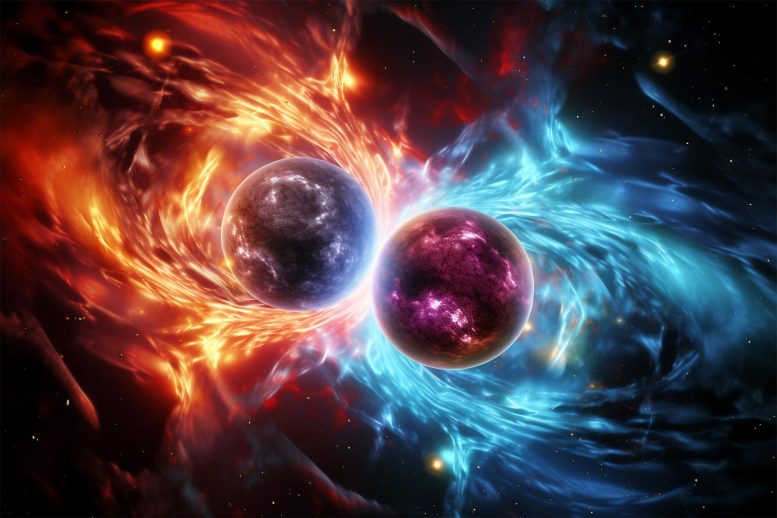
“When two ultra-compact neutron stars — which in themselves are the remnants of supernovae — orbit each other and ultimately merge, they go off in a new explosion; a so-called kilonova,” Albert Sneppen explains. “We recently demonstrated how this explosion is remarkedly symmetric, and it turns out that this symmetry not only is beautiful, but also incredibly useful.”
In a third study that has just been published, the prolific PhD student shows that kilonovae, despite their complexity, can be described by a single temperature. And it turns out that the symmetry and the simplicity of the kilonovae enable the astronomers to deduce exactly how much light they emit.
Comparing this luminosity with how much light reaches Earth, the researchers can calculate how far away the kilonova is. They have thereby obtained a novel, independent method to calculate the distance to galaxies containing kilonovae.
Darach Watson is an associate professor at the Cosmic Dawn Center and a co-author of the study. He explains: “Supernovae, which until now have been used to measure the distances of galaxies, don’t always emit the same amount of light. Moreover, they first require us to calibrate the distance using another type of stars, the so-called Cepheids, which in turn also must be calibrated. With kilonovae we can circumvent these complications that introduce uncertainties in the measurements.”
Preliminary Findings and Future Steps
To demonstrate its potential, the astrophysicists applied the method to a kilonova discovered in 2017. The result is a Hubble constant closer to the background radiation method, but whether the kilonova method can resolve the Hubble trouble, the researchers do not yet dare to state:
“We only have this one case study so far, and need many more examples before we can establish a robust result,” Albert Sneppen cautions. “But our method at least bypasses some known sources of uncertainty, and is a very “clean” system to study. It requires no calibration, no correction factor.”
Reference: “Measuring the Hubble constant with kilonovae using the expanding photosphere method” by Albert Sneppen, Darach Watson, Dovi Poznanski, Oliver Just, Andreas Bauswein and Radosław Wojtak, 2 October 2023, Astronomy & Astrophysics.
DOI: 10.1051/0004-6361/202346306
Never miss a breakthrough: Join the SciTechDaily newsletter.
Follow us on Google and Google News.
1 Comment
We are still not taking into account the topography of the universe and the fact that light redshifts as it climbs out of a gravity well.