
Close Menu
    Facebook X (Twitter) Instagram
    SciTechDaily
    • Biology
    • Chemistry
    • Earth
    • Health
    • Physics
    • Science
    • Space
    • Technology
    Facebook X (Twitter) Pinterest YouTube RSS
    SciTechDaily
    Home»Earth»Scientists Discover Hidden Threat to the Great Barrier Reef
    Earth

    Scientists Discover Hidden Threat to the Great Barrier Reef

    By Southern Cross UniversityOctober 8, 20231 Comment3 Mins Read
    Facebook Twitter Pinterest Telegram LinkedIn WhatsApp Email Reddit
    Share
    Facebook Twitter LinkedIn Pinterest Telegram Email Reddit
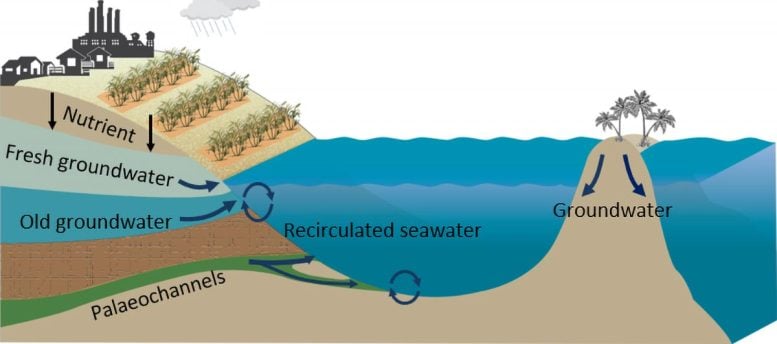
    Groundwater Sources Entering Great Barrier Reef
    Diagram showing groundwater sources on Great Barrier Reef. Credit: Douglas Tait

    Study finds nearly twice the amount of nitrogen is entering the Reef from groundwater compared to river waters.

    Scientists using natural tracers off Queensland’s coast have discovered the source of previously unquantified nitrogen and phosphorous having a profound environmental impact on the Great Barrier Reef.

    The findings, published today in Environmental Science and Technology, indicate current efforts to preserve and restore the health of the Reef may require a new perspective.

    Southern Cross University’s Dr. Douglas Tait leads the ground-breaking study, ‘Submarine groundwater discharge exceeds river inputs as a source of nutrients to the Great Barrier Reef’.

    Submarine groundwater discharge is any water released to the ocean below the waterline from various sources, including underground aquifers and the seafloor.
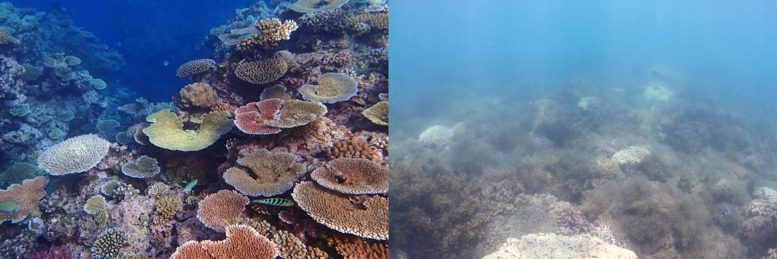
    Pristine Coral and Eutropohied Coral Composite Image
    Composite showing pristine coral alongside eutropohied coral on Great Barrier Reef. Credit: Ashly McMahon

    Research Findings and Implications

    The research team, which also includes CSIRO, AIMS, and Gothenburg University (Sweden), collected data from offshore transects, rivers, and coastal bores in an area from south of Rockhampton to north of Cairns. The use of radium isotopes allowed the scientists to track how much nutrient is transported from the land and shelf sediments via invisible groundwater flows.

    Southern Cross Professor Damien Maher said the team’s work showed that groundwater discharge was 10-15 times greater than river inputs, something previously unaccounted for.

    “Groundwater discharge accounted for approximately one-third of new nitrogen and two-thirds of phosphorous inputs, indicating that nearly twice the amount of nitrogen enters the Reef from groundwater compared to river waters,” Professor Maher said.

    Professor Maher added that the lion’s share of efforts to mitigate the impact of nutrients on the Reef were focused on outflow from river systems.
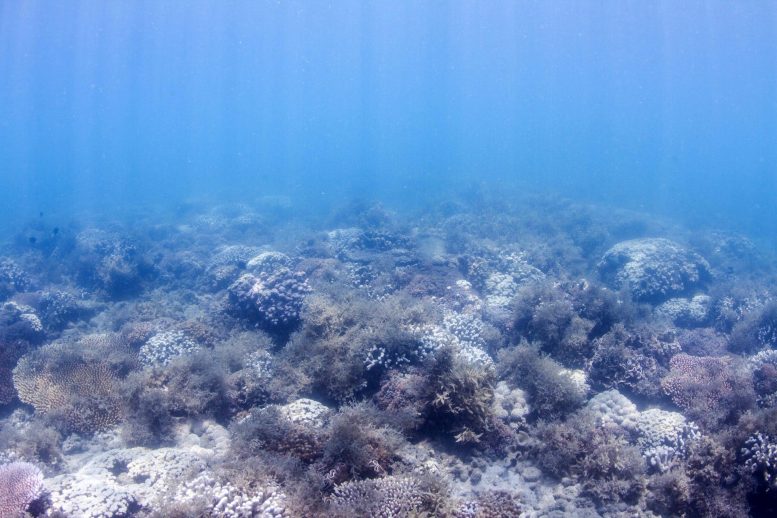
    Eutropohied Coral on Great Barrier Reef
    Eutropohied coral on Great Barrier Reef. Credit: Ashly McMahon

    Potential Environmental Impact and Recommendations

    Lead author Dr. Douglas Tait said: “Nutrients are essential to support the incredible biodiversity of the Great Barrier Reef.”

    “However, an excess of nutrients can lead to detrimental issues such as harmful algal blooms, crown-of-thorns starfish outbreaks, and fish diseases, which have been on the rise in the Reef over the past few decades.

    “Our study underscores the need for a strategic shift in management approaches aimed at safeguarding the Great Barrier Reef from the effects of excess nutrients.”

    Dr. Tait said unlike river outflow, nutrients in groundwater could be stored for decades underground before being discharged into coastal waters, meaning research and strategies to protect the Reef needed to be long-term.

    “This study sheds new light on the complex nutrient dynamics within the Great Barrier Reef,” Dr. Tait said.

    “Our understanding and ability to manage the sources of nutrients is pivotal in preserving the Reef for generations to come.”

    Reference: “Submarine Groundwater Discharge Exceeds River Inputs as a Source of Nutrients to the Great Barrier Reef” by Douglas R. Tait, Isaac R. Santos, Sèbastien Lamontagne, James Z. Sippo, Ashley McMahon, Luke C. Jeffrey and Damien T. Maher, 8 October 2023, Environmental Science & Technology.
    DOI: 10.1021/acs.est.3c03725

    The project was supported with funding from the Australian Research Council, the Herman Slade Foundation, and the Great Barrier Reef Foundation.

    Never miss a breakthrough: Join the SciTechDaily newsletter.
    Follow us on Google and Google News.

    Coral Reefs Environment Great Barrier Reef Popular
    Share. Facebook Twitter Pinterest LinkedIn Email Reddit

    Related Articles

    Highest Coral Cover in Central, Northern Great Barrier Reef Since Monitoring Began 36 Years Ago

    Injecting an Alkalinizing Agent Into the Ocean To Offset 10 Years’ Worth of Acidification of the Great Barrier Reef

    Arctic Sea Ice Set for a Record Breaking Melt

    Many Nature Reserves Struggling to Sustain Their Original Biodiversity

    Satellites Confirm Extensive Ice Sheet Melt in Greenland

    Global Warming Impacts Lake Water

    Mini-Lab Helps Predict Future Ocean Conditions

    Study Reports Air Pollution Causes Thousands of Premature Deaths Each Year

    Black Band Disease Puts Great Barrier Reef at Risk

    1 Comment

    1. Ken Towe on October 9, 2023 6:34 am

      How does that fit with the claim that global warming sea surface temperatures are the threat to the coral reefs?

      Reply
    Leave A Reply Cancel Reply

    • Facebook
    • Twitter
    • Pinterest
    • YouTube

    Don't Miss a Discovery

    Subscribe for the Latest in Science & Tech!

    Trending News

    Your Blood Pressure Reading Could Be Wrong Because of One Simple Mistake

    Astronomers Stunned by Ancient Galaxy With No Spin

    Physicists May Be on the Verge of Discovering “New Physics” at CERN

    Scientists Solve 320-Million-Year Mystery of Reptile Skin Armor

    Scientists Say This Daily Walking Habit May Be the Secret to Keeping Weight Off After Dieting

    New Therapy Rewires the Brain To Restore Joy in Depression Patients

    Giant Squid Detected off Western Australia in Stunning Deep-Sea Discovery

    Popular Sugar-Free Sweetener Linked to Liver Disease, Study Warns

    Follow SciTechDaily
    • Facebook
    • Twitter
    • YouTube
    • Pinterest
    • Newsletter
    • RSS
    SciTech News
    • Biology News
    • Chemistry News
    • Earth News
    • Health News
    • Physics News
    • Science News
    • Space News
    • Technology News
    Recent Posts
    • This Weird Sea Creature May Have Rewritten Life’s Genetic Rulebook
    • The Hidden Types of Dementia Most People Have Never Heard Of
    • Scientists Discover Why Alcohol Prevents the Liver From Healing, Even After You Quit
    • Scientists Solve a 60-Year-Old Fat Cell Mystery — and It Changes What We Know About Obesity
    • A Crucial Atlantic Current Is Weakening and Weather Could Change Worldwide
    Copyright © 1998 - 2026 SciTechDaily. All Rights Reserved.
    • Science News
    • About
    • Contact
    • Editorial Board
    • Privacy Policy
    • Terms of Use

    Type above and press Enter to search. Press Esc to cancel.