
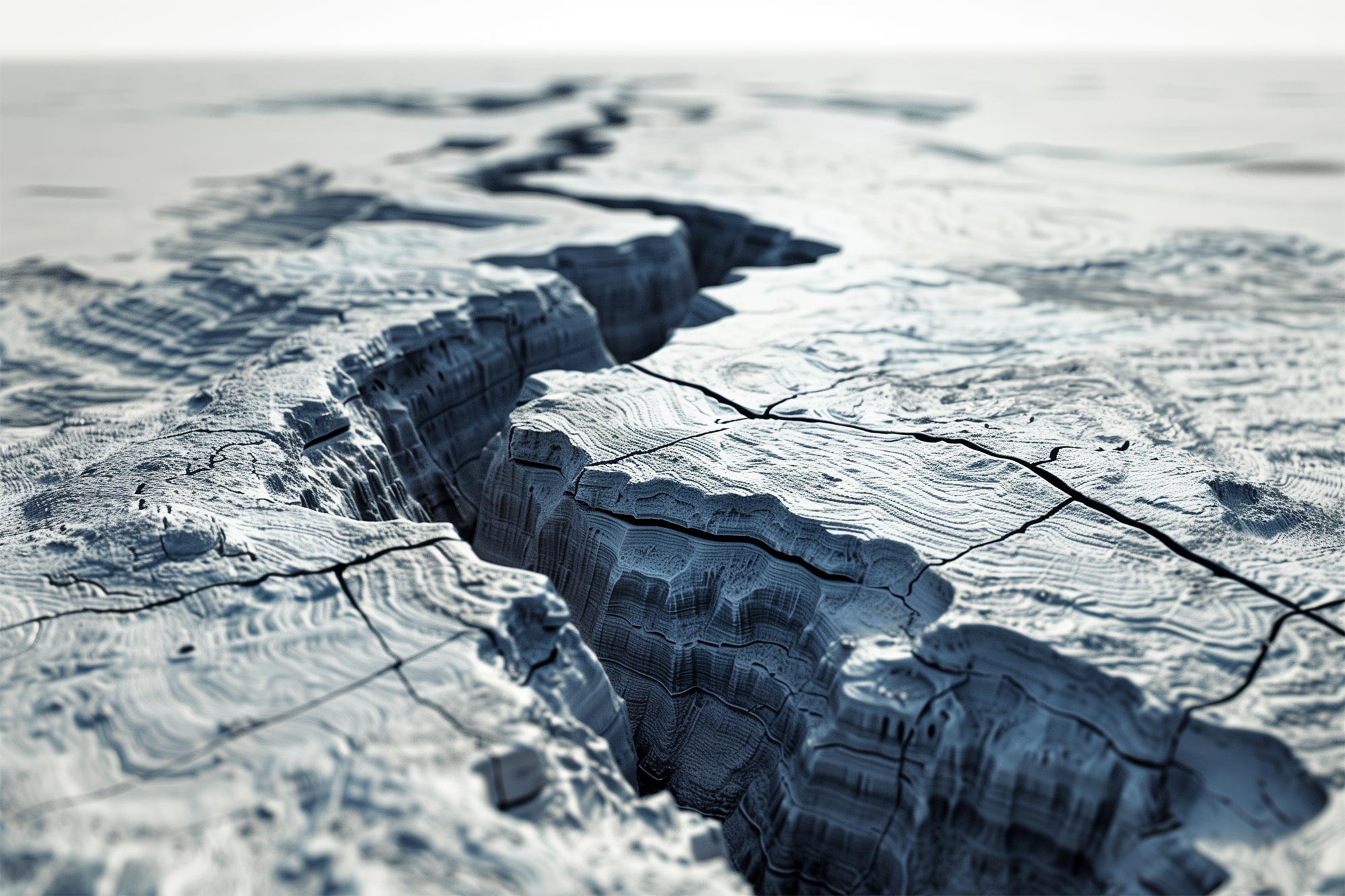
New research highlights the potential for predicting major earthquakes months in advance by using machine learning to detect early signs of seismic activity. However, the effectiveness and ethical implications of such predictive technology remain subjects of debate.
Research by a scientist at the University of Alaska Fairbanks suggests that the public could receive several days to months of advance notice before a major earthquake, based on the identification of preceding low-level tectonic activity across large areas. This analysis focused on two significant earthquakes in Alaska and California.
The work was led by research assistant professor Társilo Girona of the UAF Geophysical Institute.
Girona, a geophysicist and data scientist, studies precursory activity of volcanic eruptions and earthquakes. Geologist Kyriaki Drymoni of the Ludwig-Maximilians-Universität in Munich, Germany, is a co-author.
The detection method, based on machine learning, was published on August 28 in Nature Communications.
“Our paper demonstrates that advanced statistical techniques, particularly machine learning, have the potential to identify precursors to large-magnitude earthquakes by analyzing datasets derived from earthquake catalogs,” Girona said.
The authors wrote a computer algorithm to search the data to look for abnormal seismic activity. Algorithms are a set of computer instructions that teach a program to interpret data, learn from it, and make informed predictions or decisions.
Case Studies: Anchorage and Ridgecrest Earthquakes
They focused on two major earthquakes: the 2018 magnitude 7.1 Anchorage earthquake and the 2019 Ridgecrest, California, earthquake sequence of magnitudes 6.4 to 7.1.
They found that approximately three months of abnormal low-magnitude regional seismicity had occurred across about 15% to 25% of Southcentral Alaska and Southern California prior to each of the two studied earthquakes.
Their research finds that unrest preceding major earthquakes is mostly captured by seismic activity with a magnitude below 1.5.
The Anchorage earthquake occurred Nov. 30, 2018, at 8:29 a.m., with an epicenter located approximately 10.5 miles north of the city. It caused extensive damage to some roads and highways, and several buildings sustained damage.
Findings and Implications
Using their data-trained program, Girona and Drymoni found with the Anchorage earthquake that the probability that a major earthquake would happen in 30 days or fewer increased abruptly up to approximately 80% around three months before the Nov. 30 earthquake. The probability increased to approximately 85% just a few days before it occurred. They had similar probability findings for the Ridgecrest earthquake sequence for a period beginning about 40 days prior to the onset of the quake sequence.
Girona and Drymoni propose a geologic cause for the low-magnitude precursor activity: A significant increase in pore fluid pressure within a fault.
Pore fluid pressure refers to the pressure of fluid within a rock. High pore fluid pressures can potentially lead to fault slip if the pressure is sufficient to overcome the frictional resistance between the blocks of rock on either side of the fault.
“Increased pore fluid pressure in faults that lead to major earthquakes changes the faults’ mechanical properties, which in turn leads to uneven variations in the regional stress field,” Drymoni said. “We propose that these uneven variations … control the abnormal, precursory low-magnitude seismicity.”
Machine learning is having a major positive impact on earthquake research, Girona said.
“Modern seismic networks produce enormous datasets that, when properly analyzed, can offer valuable insights into the precursors of seismic events,” he said. “This is where advancements in machine learning and high-performance computing can play a transformative role, enabling researchers to identify meaningful patterns that could signal an impending earthquake.”
Challenges in Earthquake Forecasting
The authors state that their algorithm will be tested in near-real-time situations to identify and address potential challenges for earthquake forecasting. The method should not be employed in new regions without training the algorithm with that area’s historical seismicity, they add.
Producing reliable earthquake forecasts has a “deeply important and often controversial dimension,” Girona said.
“Accurate forecasting has the potential to save lives and reduce economic losses by providing early warnings that allow for timely evacuations and preparation,” he said. “However, the uncertainty inherent in earthquake forecasting also raises significant ethical and practical questions.”
“False alarms can lead to unnecessary panic, economic disruption, and a loss of public trust, while missed predictions can have catastrophic consequences,” he said.
Reference: “Abnormal low-magnitude seismicity preceding large-magnitude earthquakes” by Társilo Girona, and Kyriaki Drymoni, 28 August 2024, Nature Communications.
DOI: 10.1038/s41467-024-51596-z
Never miss a breakthrough: Join the SciTechDaily newsletter.
Follow us on Google and Google News.
5 Comments
About Volcano Eruptions. Volcano is the way or ways our planet bread in and bread out. Like Human beings and Animals bread in and out. Most of the planet is hot and need ways to cool down and this also served as ventilation to Earth. Volcano is the Earth Mouths and Noses where the planet breeth from, So when is blocked some how that leads to violent eruptions. Now that we have some Technology or Technologies that can show us where Volcano can erupt what we have to do is to make Hole, single hole on top of where the scientists knows or suspected that the Volcano is or on the perimeters. This also applicable to the old Volcanos. Volcano always need ways bread in and out. We just need to create ways for the Volcano can do that so She can cool down the planet. Without this Volcanoes doing what they are doing the planet can’t be like this. Is like making ways for water to flow freely. Both old Volcanos and the New sites that scientists suspected that may erupt next need to create or make (holes) ways for them to bread or breeth. If we do this no Volcano problems again, no Volcano will be erupt violently again. Volcano causes Earth Quake and landslides that kills many people every year so if we can fixed this that we be good. For once. Thanks.
You mean “breathe”, right?
As I was saying about Volcano, if you are going to make Hole or drill Hole, the hole should be 2 to 3 minthers, or 2 to 3 feets wide, and 50 to 100 methers deep. If the hole is too small it can collapse and if too wide Rain may be going in through the hole. This will allow or give the Volcano ways to release it’s pressure. The hole should be drill beside the Volcano. This only applicable to land volcanos, Thanks. M. Luke
The model results are certainly still far from useful, unfortunately. If the odds of an earthquake go up by 80-85%, they have not even doubled. In any typical earthquake-prone zone, the odds of having a negative impact from an earthquake within 30 days are extremely low. Knowing the odds are double doesn’t really help you, particularly if you have to adjust your plans for the next 30 days! I hope that within the next decade there model predictions that do many times better than this one. AI modeling at this point is very intuitive. All of the research we have, and probably ever will have, does not tell one what kind of learning algorithm to use, never mind what kind of data to use. I hope that may help to explain why we have not yet found much better models. The research using AI modeling is still in its infancy. I hope it grows up into something much more useful.
Okay, now I’m waiting for them to come up with the model we’re all really waiting for – the football games model.