
Close Menu
    Facebook X (Twitter) Instagram
    SciTechDaily
    • Biology
    • Chemistry
    • Earth
    • Health
    • Physics
    • Science
    • Space
    • Technology
    Facebook X (Twitter) Pinterest YouTube RSS
    SciTechDaily
    Home»Space»New ALMA Images Reveal Otherwise Invisible Details of Our Sun
    Space

    New ALMA Images Reveal Otherwise Invisible Details of Our Sun

    By European Southern ObservatoryJanuary 17, 2017No Comments5 Mins Read
    Facebook Twitter Pinterest Telegram LinkedIn WhatsApp Email Reddit
    Share
    Facebook Twitter LinkedIn Pinterest Telegram Email Reddit
    ALMA Starts Observing the Sun
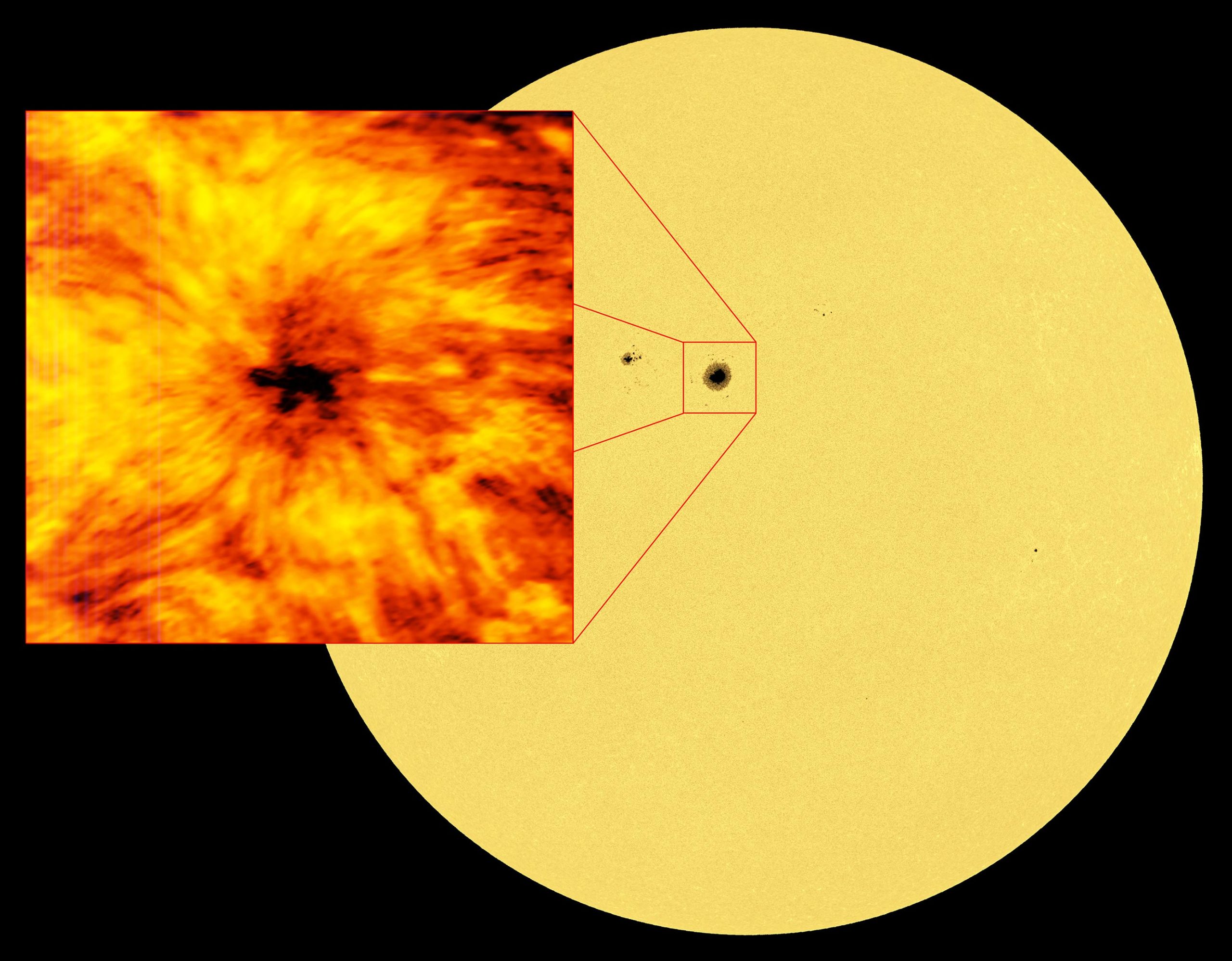
    This image of the entire Sun was taken in the red visible light emitted by iron atoms in the Sun’s atmosphere. Light at this wavelength originates from the visible solar surface, the photosphere. A cooler, darker sunspot is clearly visible in the disc, and as a visual comparison is shown alongside the image from ALMA at a wavelength of 1.25 millimeters. The full-disc solar image was taken with the Helioseismic and Magnetic Imager (HMI) on board the Solar Dynamics Observatory (SDO). Credit: ALMA (ESO/NAOJ/NRAO), NASA

    New images taken with the Atacama Large Millimeter/submillimeter Array have revealed otherwise invisible details of our Sun, including a new view of the dark, contorted center of a sunspot that is nearly twice the diameter of the Earth.

    The images are the first ever made of the Sun with a facility where ESO is a partner. The results are an important expansion of the range of observations that can be used to probe the physics of our nearest star. The ALMA antennas had been carefully designed so they could image the Sun without being damaged by the intense heat of the focused light.


    The ALMA telescope has been used to study the Sun for the first time. It is also the first time that an ESO facility has been used to study our nearest star.

    Astronomers have harnessed ALMA’s capabilities to image the millimeter-wavelength light emitted by the Sun’s chromosphere — the region that lies just above the photosphere, which forms the visible surface of the Sun. The solar campaign team, an international group of astronomers with members from Europe, North America and East Asia, produced the images as a demonstration of ALMA’s ability to study solar activity at longer wavelengths of light than are typically available to solar observatories on Earth.
    ALMA Observes a Giant Sunspot
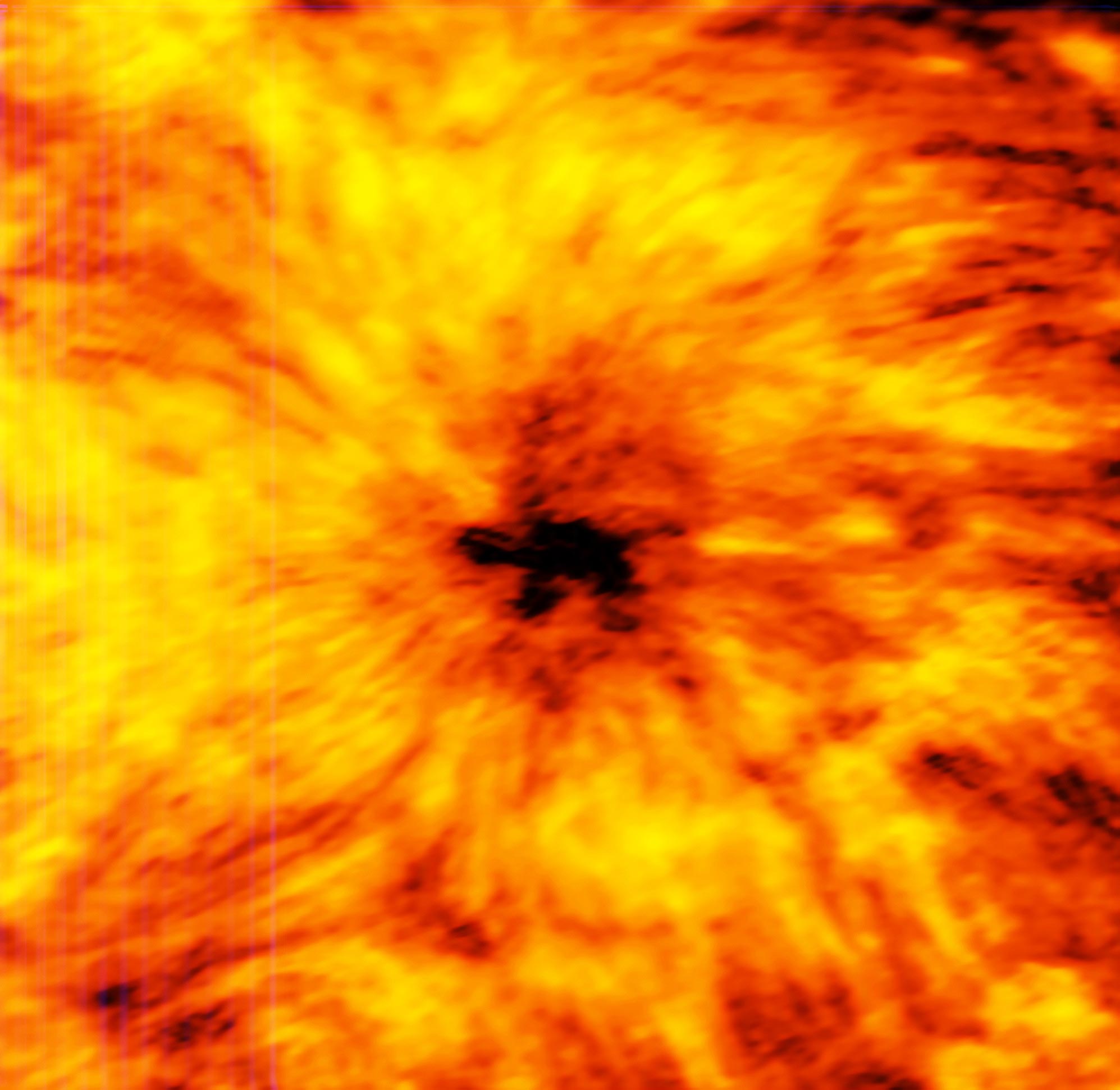
    This ALMA image of an enormous sunspot was taken at a wavelength of 1.25 millimeters. Sunspots are transient features that occur in regions where the Sun’s magnetic field is extremely concentrated and powerful. They have lower temperatures than their surrounding regions, which is why they appear relatively dark. These observations are the first ever made of the Sun with a facility where ESO is a partner. They are an important expansion of the range of observations that can be used to probe the mysterious physics of our nearest star. Credit: ALMA (ESO/NAOJ/NRAO)

    Astronomers have studied the Sun and probed its dynamic surface and energetic atmosphere in many ways through the centuries. But, to achieve a fuller understanding, astronomers need to study it across the entire electromagnetic spectrum, including the millimeter and submillimeter portion that ALMA can observe.


    This video shows a major sunspot on the surface of the Sun. The initial view is in visible light, from NASA’s Solar Dynamics Observatory and the final view is from ALMA, at millimeter wavelengths.

    Since the Sun is many billions of times brighter than the faint objects ALMA typically observes, the ALMA antennas were specially designed to allow them to image the Sun in exquisite detail using the technique of radio interferometry — and avoid damage from the intense heat of the focussed sunlight. The result of this work is a series of images that demonstrate ALMA’s unique vision and ability to study our Sun. The data from the solar observing campaign are being released this week to the worldwide astronomical community for further study and analysis.
    ALMA Observes Sunspots
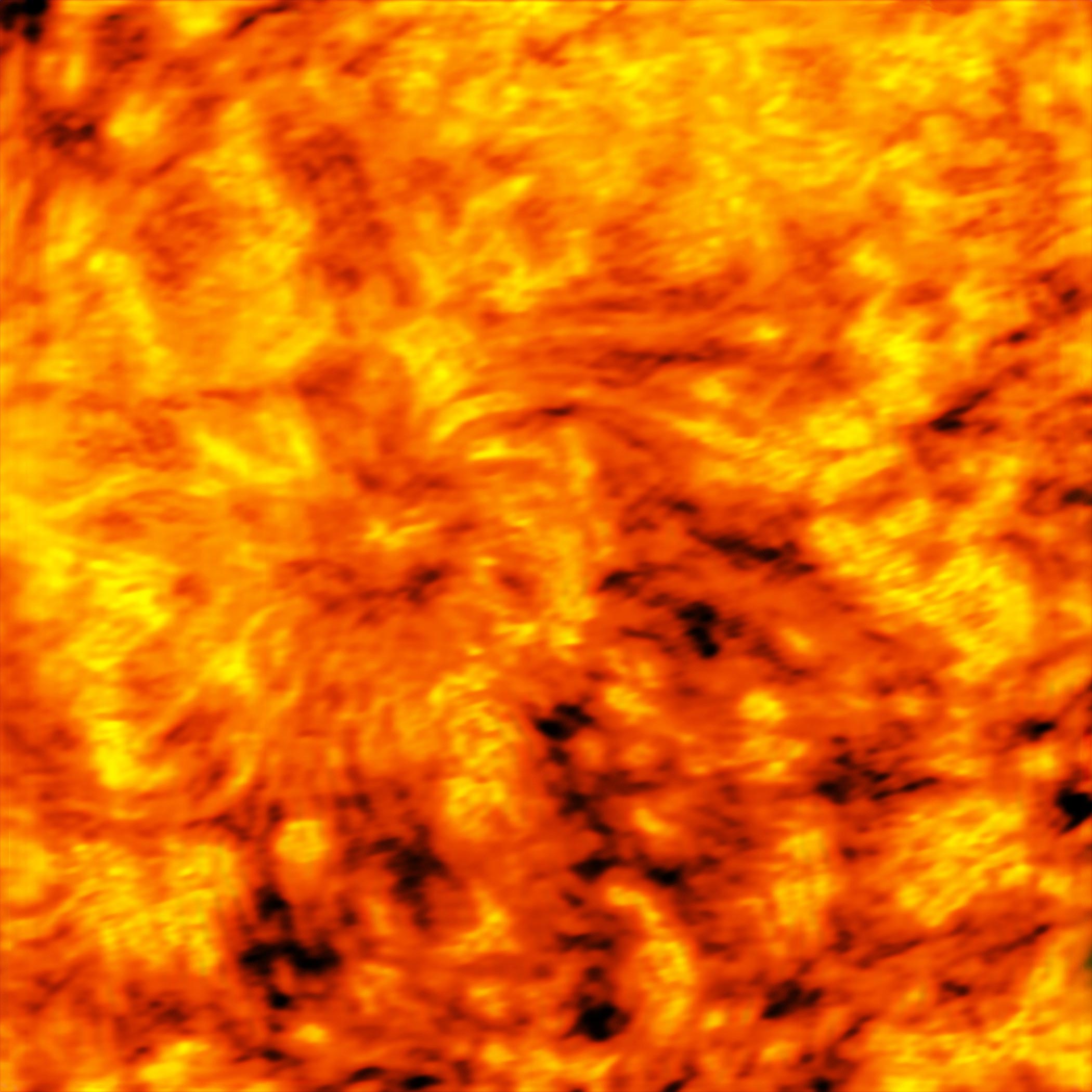
    This ALMA image of an enormous sunspot was taken at a wavelength of 3 millimeters. Sunspots are transient features that occur in regions where the Sun’s magnetic field is extremely concentrated and powerful. They have lower temperatures than their surrounding regions, which is why they appear relatively dark. These observations are the first ever made of the Sun with a facility where ESO is a partner. They are an important expansion of the range of observations that can be used to probe the mysterious physics of our nearest star. Credit: ALMA (ESO/NAOJ/NRAO)

    The team observed an enormous sunspot at wavelengths of 1.25 millimeters and 3 millimeters using two of ALMA’s receiver bands. The images reveal differences in temperature between parts of the Sun’s chromosphere. Understanding the heating and dynamics of the chromosphere are key areas of research that will be addressed in the future using ALMA.
    ALMA Observes the Full Solar Disc
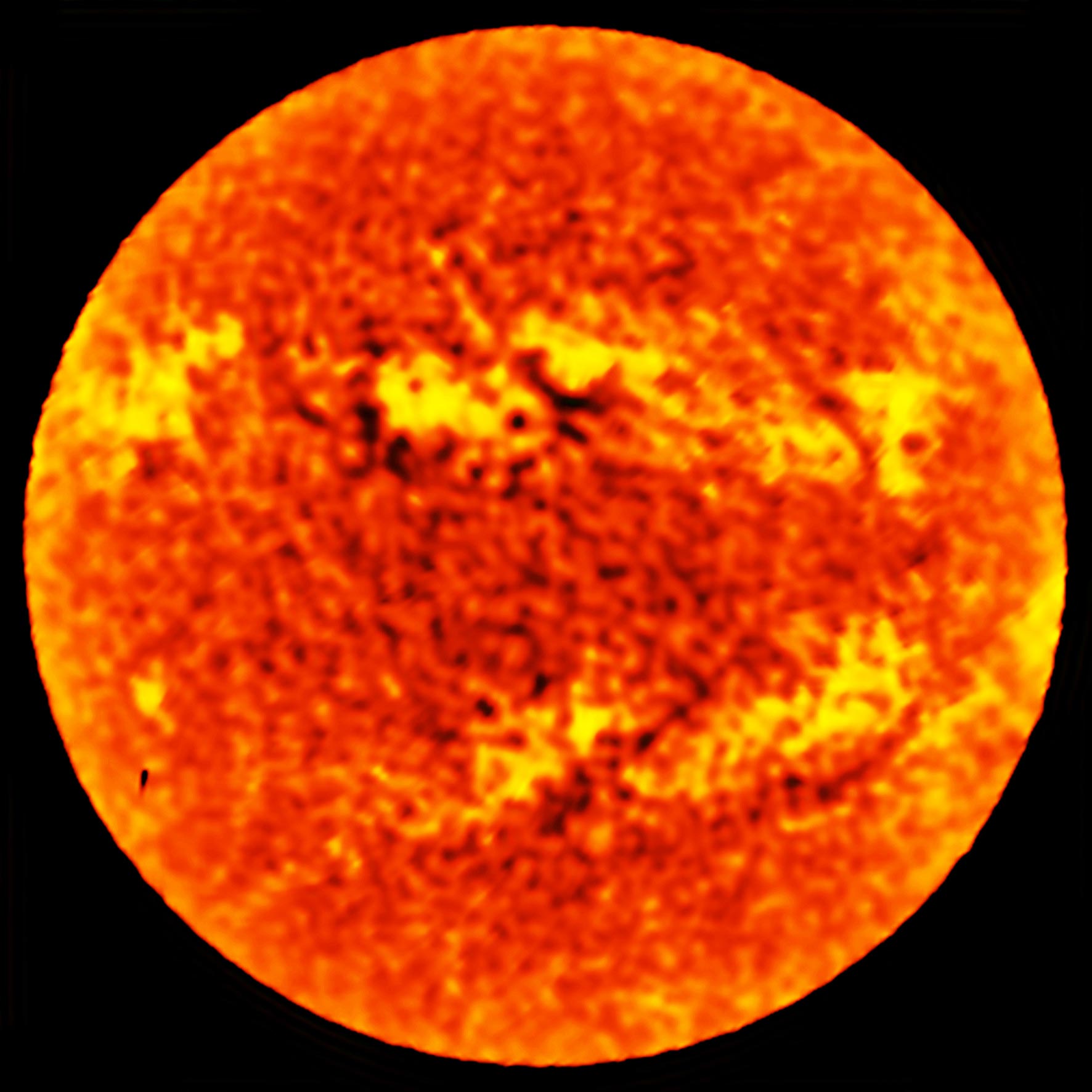
    A map of the whole disc of the Sun was also made with a single ALMA antenna, using a technique called fast-scanning, at a wavelength of 1.25 millimetres. The accuracy and speed of observing with a single ALMA antenna make it possible to produce a map of the entire solar disc in just a few minutes. These maps show the distribution of temperatures in the chromosphere over the whole disc at low spatial resolution and therefore complement the detailed interferometric images of individual regions of interest. Credit: ALMA (ESO/NAOJ/NRAO)

    Sunspots are transient features that occur in regions where the Sun’s magnetic field is extremely concentrated and powerful. They are lower in temperature than the surrounding regions, which is why they appear relatively dark.


    This comparison video starts with a view of the solar disc at ultraviolet wavelengths from the NASA Solar Dynamics Observatory. The final view of the disc comes from recent observations by ALMA at millimeter wavelengths.

    The difference in appearance between the two images is due to the different wavelengths of emitted light being observed. Observations at shorter wavelengths are able to probe deeper into the Sun, meaning the 1.25 millimeter images show a layer of the chromosphere that is deeper, and therefore closer to the photosphere, than those made at a wavelength of 3 millimeters.

    ALMA is the first facility where ESO is a partner that allows astronomers to study the nearest star, our own Sun. All other existing and past ESO facilities need to be protected from the intense solar radiation to avoid damage. The new ALMA capabilities will expand the ESO community to include solar astronomers.

    Never miss a breakthrough: Join the SciTechDaily newsletter.
    Follow us on Google and Google News.

    ALMA Astronomy Atacama Large Millimeter/submillimeter Array Sun
    Share. Facebook Twitter Pinterest LinkedIn Email Reddit

    Related Articles

    ALMA Views Galaxy-Scale Fountain in Full Glory

    ALMA Reveals Rotating Dense Molecular Torus Around an Active Supermassive Black Hole

    ALMA Reveals Diverse Nuclear Star-Forming Activities in NGC 253

    3D Model Lets Astronomers Explore Supernova 1987a Like Never Before

    ALMA Observatory Receives Final Antenna

    ALMA Will Allow Scientists to See the Universe Like Never Before

    Using ALMA and VLA to Unveil Astronomical Mysteries

    NASA’s NuSTAR is One Step Closer to Launching

    Strong Geomagnetic Storms a Possibility After Active Sunspot 1401 Erupted

    Leave A Reply Cancel Reply

    • Facebook
    • Twitter
    • Pinterest
    • YouTube

    Don't Miss a Discovery

    Subscribe for the Latest in Science & Tech!

    Trending News

    Scientists Uncover Potential Brain Risks of Popular Fish Oil Supplements

    Scientists Discover a Surprising Way To Make Bread Healthier and More Nutritious

    After 60 Years, Scientists Uncover Unexpected Brain Effects of Popular Diabetes Drug Metformin

    New Research Uncovers Hidden Side Effects of Popular Weight-Loss Drugs

    Scientists Rethink Extreme Warming After Surprising Ocean Discovery

    Landmark Study Links Never Marrying to Significantly Higher Cancer Risk

    Researchers Discover Unknown Beetle Species Just Steps From Their Lab

    Largest-Ever Study Finds Medicinal Cannabis Ineffective for Anxiety, Depression, PTSD

    Follow SciTechDaily
    • Facebook
    • Twitter
    • YouTube
    • Pinterest
    • Newsletter
    • RSS
    SciTech News
    • Biology News
    • Chemistry News
    • Earth News
    • Health News
    • Physics News
    • Science News
    • Space News
    • Technology News
    Recent Posts
    • Early Warning Signals of Esophageal Cancer May Be Hiding in Plain Sight
    • Researchers Have Discovered a THC-Free Cannabis Compound That May Replace Opioids
    • Common Blood Pressure Drug Shows Surprising Power Against Deadly Antibiotic-Resistant Superbug
    • Students Build Dark Matter Detector and Set New Experimental Limits
    • Scientists Discover Caffeine Can Repair Key Memory Circuits After Sleep Loss
    Copyright © 1998 - 2026 SciTechDaily. All Rights Reserved.
    • Science News
    • About
    • Contact
    • Editorial Board
    • Privacy Policy
    • Terms of Use

    Type above and press Enter to search. Press Esc to cancel.