
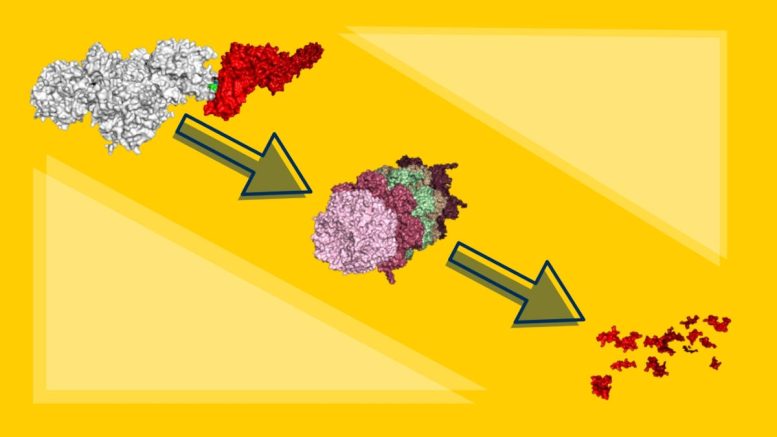
A protein degrader shows potential in targeting STAT5, a protein involved in leukemia and other forms of cancer.
For decades, researchers have been interested in targeting the protein STAT5 in the fight against cancer. However, despite extensive efforts, STAT5 was eventually considered “undruggable.” But now, researchers at the University of Michigan Rogel Cancer Center have found success with a novel approach.
The researchers discovered they could eliminate STAT5 from cell cultures and mice by utilizing a cellular garbage disposal function, laying the foundation for its potential as a cancer treatment.
STAT5 plays a key role in how some blood cancers develop and progress. But efforts to identify a small molecule inhibitor to block STAT5 have been stymied. Previous research efforts have found it challenging to design a drug to bind to STAT5 with a high-affinity, a measure of how well they fit together. Even when a compound was found to bind with the protein, it may not make its way into cells and tissue. It’s also difficult to find a compound that inhibits STAT5 only without affecting any of the other STAT proteins.
A Novel Protein Degradation Approach
Shaomeng Wang, Ph.D., Warner-Lambert/Parke-Davis Professor in Medicine and professor of medicine, pharmacology, and medicinal chemistry at the University of Michigan, had another idea.
His lab has been working on a new drug development approach targeting protein degradation. This is a naturally occurring function within cells to get rid of unwanted proteins. Think of it as the garbage disposal: When a protein is no longer needed to keep a body healthy, this mechanism removes the unwanted or damaged protein from the cell.
Using this approach, Wang’s lab identified a protein degrader, AK-2292, that targets and removes STAT5. The compound was highly specific to STAT5 with no effect on other STAT proteins. It was effectively taken up by both cell lines and mouse models and was found to stop cell growth in cell lines of human chronic myeloid leukemia (CML) and to induce tumor regression in mouse models of CML. The results were published in Nature Chemical Biology.
The protein degrader works by eliminating STAT5 proteins from tumor cells and tissues, unlike a small molecule inhibitor that would traditionally be designed to bind with the protein and interfere with its function.
Overcoming Barriers to Target STAT5
“We’ve overcome some of the major issues that were barriers for scientists to target STAT5,” Wang said. “People have worked in this field for the last 20 years, and there are no small molecules targeting STAT5 going into clinical development. This study shows us STAT5 can be targeted through a protein degradation approach. It’s a new, exciting direction for developing a potential drug molecule targeting STAT5 for the treatment of cancers in which this protein plays a major role.
“This compound gives us a very solid foundation to do further optimization to identify a compound that we eventually can advance into clinical development,” Wang added.
Wang’s lab has been investigating protein degraders for several years and has a number of degraders in advanced preclinical development studies, which they hope will lead to clinical trials for the treatment of cancer in people.
Reference: “A selective small-molecule STAT5 PROTAC degrader capable of achieving tumor regression in vivo” by Atsunori Kaneshige, Longchuan Bai, Mi Wang, Donna McEachern, Jennifer L. Meagher, Renqi Xu, Yu Wang, Wei Jiang, Hoda Metwally, Paul D. Kirchhoff, Lijie Zhao, Hui Jiang, Meilin Wang, Bo Wen, Duxin Sun, Jeanne A. Stuckey and Shaomeng Wang, 2 February 2023, Nature Chemical Biology.
DOI: 10.1038/s41589-022-01248-4
The study was funded by Proteovant Therapeutics, Oncopia Therapeutics (acquired by Proteovant), the National Cancer Institute, the U.S. Department of Energy, and a Michigan Economic Development Corporation and Michigan Technology Tri-Corridor grant.
This work was supported by these Rogel Cancer Center Shared Resources: Pharmacokinetics, Proteomics, and Structure and Drug Screening.
Disclosure: The University of Michigan has filed patent applications on inhibitors and degraders described in this study, which have been licensed to Proteovant Therapeutics. S.W., A.K., L.B. M.W., D.M., and J.S. are co-inventors on one or more of these patent applications and receive royalties from the University of Michigan. The University of Michigan has received a research contract from Proteovant Therapeutics and Oncopia Therapeutics for which S.W. serves as the principal investigator. S.W. is a paid consultant to Proteovant/Roivant and owns equity in Roivant.
Never miss a breakthrough: Join the SciTechDaily newsletter.
Follow us on Google and Google News.